The Flying Fortress on Mount Tom Near Holyoke, Massachusetts July 9, 1946 “Cross-roads of the World” Gander was chosen for the construction of an airport in 1935 because of its location close to the northeast tip of the North American continent. Construction of the airport began in 1936 and it was opened in 1938, with its first landing on January 11 of that year, by Captain Douglas Fraser flying a Fox Moth of Imperial Airways. Within a few years it had four runways and was the largest airport in the world. Its official name until 1941 was Newfoundland Airport. During the Second World War, as many as 10,000 Canadian, British and American military personnel resided in Gander. The area became a strategic post for the Royal Air Force Air Ferry Command, renaming the airport to RCAF Station Gander in 1941 , with over 20,000 American and Canadian-built fighters and bombers stopping at Gander en route to Europe. After the Second World War, the RCAF handed operation of the airfield back to the dominion government in March 1946, and the town of Gander grew as the airport was used as a refuelling stop for civilian transatlantic flights, earning its name "Cross-roads of the world" as nearly all overseas flights had to stop there before crossing the Atlantic. Swords to Plowshares... On the afternoon of July 9th, 1946, a Boeing B-17G “Flying Fortress” bomber, tail number 43-39136, that had been converted for passenger transit, departed from Gander – bound for Mitchell Field on New York's Mitchell Field, making a stopover at Westover Field near Springfield, Massachusetts. The pilot of the plane was Flight Officer Herman J. Valdrini Jr, a native of Prescott, Arizona. He was a week short of being discharged from the Army. Also members aboard the bomber that were of the US Army Air Corps.were Captain Henry A. Lebrecht, 1Lt Wayne L. Austin, Flight Officer Samuel A. Turrentine,., Sergeant Daniel R. Roe, PFC Howard E. Carson, PFC Eulogio Sanchez, PFC Rex A. Tansey. Carried as passengers aboard Lieutenant Frank G. Meriam, Lieutenant Wilfred U. Johnson, Lieutenant (junior grade) George E. Orford, YNC Hugh J. Worth, RM2c Lee Winnard, BM2c Russell S. Scott, RM3c Alfred L. Warm, RM3c Arnold J. Simons, RM3c Ernest R. Gillis, ETM3c George R. Benfield, ETM3c George E. Fleming, S1c Arthur C. Miller, S1c Stanley P. Warshaw, S1c Gregory S. Davenport, and S2c David F. Archilles, all of the U.S. Coast Guard. Also aboard were two civilians - Lieutenant Pasquale P. Coviello, an assistant surgeon with the United States Public Health Service (USPHS) that was assigned to the Coast Guard, as well as Mr. Arthur Bailey of the American Red Cross. Slated originally to land at 8:27 in the evening, the bomber circled the town of Holyoke for nearly two hours – steadily losing altitude while circling. Cleared to land at Westover Field, the bomber descended to down to 800 feet, on approach to the field, and in the direction of Mount Tom – a steep, rugged mountain peak on the west bank of the Connecticut River. According to Massachusetts highway patrolman Frank O'Connell, a beacon was lit up on the hill, but the flight crew of the bomber must not have seen it, or they did, but too late. A Frightful Sound... At about 10:20 at night, the plane impacted at the southern face of Mount Tom. It first brushed the treetops, tearing off an engine and gasoline containers which ignited, and then struck a bare, rocky space further up the elevation - exploding on impact, and starting several fires. The first men to respond to crash stated the heat was so intense that they were only able to get within 100 yards of the crash. The broken bodies of the occupants were scattered among the plane's wreckage along a 400-foot swath torn by the bomber through dense woods 200 yards from the hill top. Also littering the path were a gold wrist watch, that somehow withstood the shattering crash, glittered among the ashes - its hands stopped at 10:20, the time of the crash. Vinyl musical records, charred & torn parachutes, unopened, lay in piles strewn among the wreckage, amongst naval pea jackets, burned shoes, wallets, blankets, and several letters. It was quickly clear that the 25 people aboard the plane were all killed on impact – deeming the accident at New England's worst air disaster at that time. Luckily, a heavy rain downpour and misty weather prevented a serious forest fire from starting. Parkside Witnesses... The impact was witnessed by many of the thousands of people attending events at the Mountain Park Amusement Area on the mountain's eastern side. Holyoke police stated that it was quite fortunate that the bomber had not struck the park, as an estimated 4,000 were in attendance there. Robert Hodash, a correspondent for the Associated Press, was at Mountain Park, and was one of the first to reach the scene - following the bed of an abandoned cable railway up to the crash site. He described it as "a gruesome spectacle" with some of the bodies "horribly mangled," trees knocked down across a wide strip, others singed by fire, and wreckage scattered over hundreds of yards.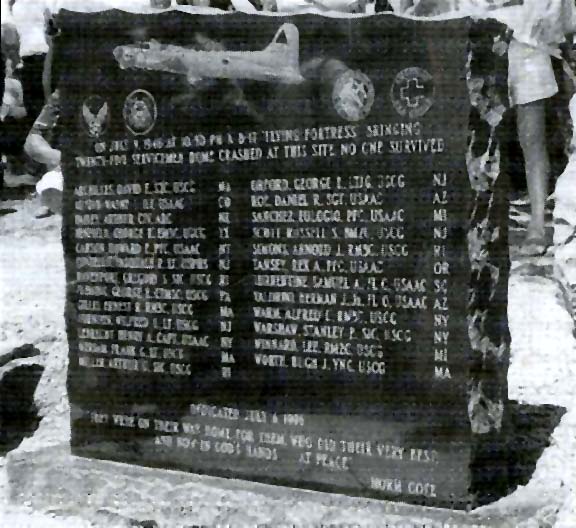 The following morning, hours after the crash, the forests still were smoking, with occasional bursts of flame keeping the Army guards busy with portable extinguishers. The molten engine nacelles and mangled parts of the fuselage still gave off an intense heat from still-unburned fuel. Charred wreckage was spread in small pieces over the quarter mile square area. The crash site went unmarked until 1994 when someone piled rocks there as a memorial. Holyoke resident Norman Cote noticed the rock memorial and persuaded local officials to establish a permanent monument on the old tramway. Fifty years after the tragedy, a monument was constructed at the crash site – dedicated on July 6, 1996, the Saturday before the 50th anniversary of the mishap. Lieutenant Wilfred Johnson, a graduate of the Coast Guard Academy class of 1944, was enshrined in the Academy's Chase Hall's “Hall of Heroes”on its “Wall of Remembrance”. |