Full Accounting Near Thanh Trach, Bo Trach, Quang Binh province, Vietnam 7 April 2001
"Bring Them Home..."
In January of 1992, the government of the United States established Joint Task Force-Full Accounting (JTF-FA), whose task was to systematically seek out information related to the more than 2,000 Americans missing in Vietnam, Laos, Cambodia, and China. Based in Camp H.M. Smith in Hawaii, the unit has searched for MIA remains from the Second Indochina War, and the unit's Detachment 2 (Det 2) in Hanoi, which was established in late 1991, and was the only American government agency in Vietnam at that time. In more recent years, the unit's operations have expanded to include World War II, Korean War, and Cold War MIA recovery cases, in which the United States spends up to $6 million each year conducting regular searches, which often involve helicopter flights carrying both American and Vietnamese military personnel and civilians into remote areas. Since 1973, the remains of 591 American service members formerly listed as unaccounted for have been identified and returned to their families. There are 1,992 Americans still unaccounted for from the conflict in Southeast Asia, including 1,498 in Vietnam. In 2001, JTF-FA's activities focused on the Quang Binh province – 400 kilometers south of Hanoi, and the southernmost province of North Vietnam during the war, just north of the former demilitarized zone (DMZ). Because of the region's proximity to the DMZ, it was heavily bombed during the war, and contains many military aircraft crash sites – many which had not been investigated at that time. In transit... In early April of 2001, an advance team for a 95-member group of military service members visited the post-war Vietnam, coordinating the logistics to begin work at six MIA recovery sites the following month – the unit's 65th expedition, called a Joint Field Activity. For this, a Russian-made M-17 helicopter was chartered from the Vietnamese military to aid in expediting equipment and personnel – as JTF-FA had been doing since 1992, according to Alan Liotta, acting director of the POW-MIA office. Late on the afternoon of Saturday, April 7th, 2001, one of the chartered helicopters was ferrying personnel from Vinh to Hue. A Vietnamese official said the helicopter had been on a flight to the central city of Hue, leaving Vinh at 4:15 in the afternoon, and had been scheduled to stop at Dong Hoi, the Quang Binh provincial capital, before heading south to Hue. But earlier that day, a member of the JTF-FA team called their headquarters in Hawaii to report that they were canceling a stop in Dong Hoi because of bad weather. 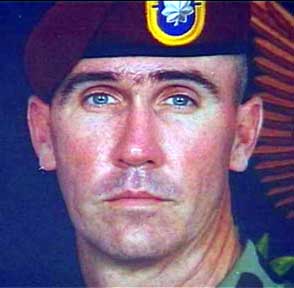 Aboard the helicopter, piloted by Vietnamese, were seven Americans – all active duty military servicemen – and nine Vietnamese military men. The Americans: Army Lieutenant Colonel Rennie M. Cory Jr., the outgoing commanding officer of Det 2. His previous assignments had included being the commander of 2nd Battalion, 504th Parachute Infantry Regiment, 82nd Airborne Division, at Fort Bragg, North Carolina; executive officer and plans officer of Joint Task Force 6 at Fort Bliss, Texas; division chief and operations officer, G3 Emergency Deployment Readiness Exercise, Fort Bragg; battalion executive officer, United Nations Joint Security Area, Panmunjon, South Korea; operations officer, School of Americas, Fort Benning, Ga.; company commander and assistant S3, 4th Battalion, 325th Airborne Infantry Regiment, 82nd Airborne Division, Fort Bragg; detachment commander, 2nd Battalion, 7th Special Forces Group, Fort Bragg; company executive officer, scout and rifle platoon leader, 2nd Battalion, 325th Airborne Infantry Regiment, 82nd Airborne Division, Fort Bragg. Aboard the helicopter, piloted by Vietnamese, were seven Americans – all active duty military servicemen – and nine Vietnamese military men. The Americans: Army Lieutenant Colonel Rennie M. Cory Jr., the outgoing commanding officer of Det 2. His previous assignments had included being the commander of 2nd Battalion, 504th Parachute Infantry Regiment, 82nd Airborne Division, at Fort Bragg, North Carolina; executive officer and plans officer of Joint Task Force 6 at Fort Bliss, Texas; division chief and operations officer, G3 Emergency Deployment Readiness Exercise, Fort Bragg; battalion executive officer, United Nations Joint Security Area, Panmunjon, South Korea; operations officer, School of Americas, Fort Benning, Ga.; company commander and assistant S3, 4th Battalion, 325th Airborne Infantry Regiment, 82nd Airborne Division, Fort Bragg; detachment commander, 2nd Battalion, 7th Special Forces Group, Fort Bragg; company executive officer, scout and rifle platoon leader, 2nd Battalion, 325th Airborne Infantry Regiment, 82nd Airborne Division, Fort Bragg.
The other Americans aboard were Army Lieutenant Colonel George D. Martin III, the incoming commanding officer of Det 2, from Hopkins, South Carolina, and who previously commanded the 1st Battalion, 32nd Infantry at Fort Drum, New York; Air Force Major Charles E. Lewis, the unit’s deputy commander, from of Las Cruces, New Mexico, and, prior to his JTF-FA service, was responsible for the design and construction of the F-15 Eagle mounted on a pedestal at the entrance to the 333rd Fighter Interceptor Wing at Eglin AFB in Florida, and was a a military-history buff trained as an engineer; Army Sergeant 1st Class Tommy J. Murphy, a Mortuary Affairs specialist with the part of Central Identification Laboratory Hawai'i (CILHI) and the team's Sergeant who was from Georgia, but lived in Honolulu; Air Force Master Sergeant Steven L. Moser, an Vietnamese Intelligence Analyst & Linguist who was from San Diego, but also lived in Honolulu; Navy Chief Petty Officer Pedro J. Gonzales, a Hospital Corpsman from Buckeye, Arizona, who was a crack diver and served as the team's medic; and Air Force Technical Sergeant Robert M. Flynn, a Vietnamese Linguist from Huntsville, Alabama, who served as Cory's translator. The Vietnamese aboard the helicopter were: Deputy Director Nguyen Than Ha of the Vietnamese Liaison Office; Senior Colonel Tran Van Bien, Deputy Director of the Vietnamese Office for Seeking Missing Persons (VNOSMP) and former General in the People's Army of Vietnam; Vietnamese Air Force Lieutenant Colonels Nguyen Van Ha & Nguyen Thanh Son, Majors Nguyen Huu Nham & Vu Pham The Kien; and Lieutenants Giap Thanh Ngan, Pham Duy Dung, and Dang Ngoc. During a flight to a recovery site, the MI-17 was flying south when the crew made a request to descend for a landing at Dong Hoi airfield. The helicopter flew into thick and quickly moving fog, and while attempting to ascend above it. In this region, the weather is so volatile that the local villagers have two names for the 750-foot-tall mountain -offically called Am Mountian - that rises near the coastal sand dunes: when it's sunny and calm, they call it "Mother Cow Mountain". But when the wind blows heavy clouds in from the west, it becomes Source of Darkness. Searching for a way out of the mist, the helicopter dipped below 700 feet. Moments later it slammed into the mountain at full throttle, 60 feet below the summit, according to Vietnamese officials. Local Talent... ''The helicopter tilted side to side, then fluttered up and down in an abnormal pattern,'' said Nguyen Viet Cuong, a local resident, speaking by telephone. ''The helicopter crashed into the mountain and exploded. We all saw flames flare up.'' "I heard the helicopter flying very low. The engine made a big noise, and then we heard a big explosion. It was very foggy so we couldn't see very much," said Nguyen Van Minh, 45. 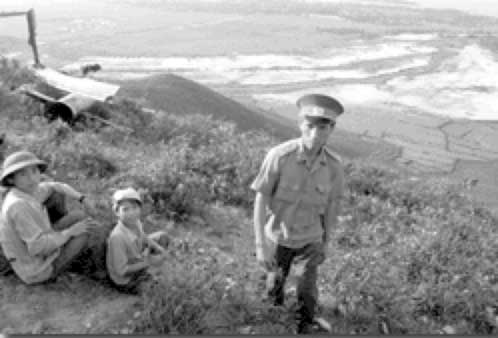 | A Vietnamese security police officer guards the site of the wreckage |
"It was like during the Vietnam War again when we ran to see if we could help anyone from the crash. There was only one man who was still alive. He told us he was with the MIA team," he said. That man, a Vietnamese, died shortly afterward at the Am Mountain crash site. A tattered rotor blade jutting from the hillside served as a grim marker over a valley of emerald-green rice paddies, while Vietnamese authorities in Quang Binh province mobilized army troops, public security troops – who confiscated the camera of an Associated Press photographer in the process - and medical workers to overcome the aftermath of the incident. Recovery teams carried the bodies in stretchers 30 minutes down a hillside for transportation by car to Hanoi for examination and autopsy. An MIA recovery team was diverted from Laos to Vietnam to aid with the effort, a JTF-FA spokesman said. They will secure the crash site and search for personal effects to aid in the identification of remains. The American government quickly issued a statement of condolence from its highest level after the accident. President Bush offered condolences to the families of those killed, saying: ''Today's loss is a terrible one for America. Although not lost in a hostile act, like those for whom they search, they too have lived lives of great consequence, answering a calling of service to their fellow citizens.'' STATEMENT OF SECRETARY RUMSFELD ON ACCIDENT IN VIETNAM "Americans are saddened by today's tragic loss of life of both U.S. and Vietnamese service personnel in the Socialist Republic of Vietnam. Those of us in the Department of Defense, and the families of our missing, are keenly aware of the dedication of both the American and Vietnamese team members who were, on this very day, searching for servicemen who have been missing in action since the end of the war. "Since 1985, American teams, with the full support of their Vietnamese counterparts, have conducted investigations and excavations in that country. As a result of this sustained cooperation, we have recovered and identified the remains of more than 600 Americans and continue to search for those still missing in Southeast Asia. Led by the Joint Task Force-Full Accounting and the U.S. Army's Central Identification Laboratory, Hawaii, this recovery work is truly a noble calling. "These joint teams have maintained a truly remarkable safety record, particularly given the dangerous and difficult terrain in which they work. Today's tragedy represents the first loss of life either side has suffered in the 65 joint field activities that have been completed in Vietnam. To the families of those whose loved ones have yet to be accounted-for, be assured that our mission will continue, even in the face of this tragedy. Our hearts go to the families and friends of those who today made the ultimatesacrifice in carrying out this humanitarian mission. They gave their lives so that others might come home. May God bless and be with them." |
At the same time, Vietnam also issued a statement, saying, ''On behalf of the government of the Socialist Republic of Vietnam, Foreign Minister Nguyen Dy Nien has sent his deep condolences to the families of the Vietnamese victims and at the same time to the government, the people and the families of the United States.'' But an unexpected problem plagued investigators at the crash site – looting. The Monday following the crash, the state-run Tien Phong ("Vanguard") newspaper said that a local resident stole nearly 500 kilograms (1,100 lb) of wreckage from the helicopter right after the crash. However, an official of the commune People's Committee called this an exaggeration. "Some children took little pieces away but we have been able to get all those things back," he said. A U.S. official said such incidents were a concern to those trying to discover the cause of the crash, but cited reports that the amount of wreckage taken was much less than 500 kilograms. "Any disturbance of a crash site is undesirable from the standpoint of a clear investigation," he said. By Tuesday, the Tuoi Tre newspaper quoted a top Vietnamese official - deputy air force commander Major General Mai Van Cuong - as saying that heavy fog led the chopper to veer into the mountain. "With very limited visibility, the MI-17 deviated to the left. When they realized that, it was too late, and when the aircraft tried to climb, its rear side hit the mountain." Lasting Effects... Nevertheless - the crash resulted in the cancellation of the 65th Joint Field Activity – marking only the second time such a search mission was canceled. The other was in November 1999, when there was severe flooding in central Vietnam. The cancellation allowed for both governments to focus on the investigation and rebuild their search capabilities. One of the targets of the 65th JFA included the crash site of Air Force Captain Lawrence Evert's F-105D, which went down in 1967. On April 13th, 2001, the remains of all 7 Americans were repatriated to the United States, starting at Noi Bai International Airport, the main airport in Hanoi, Vietnam, on Friday. Following the ceremony, the flag-draped transfer cases were placed aboard an Air Force C-17 by a military honor guard for the trip back to the United States. Brigadier General Harry B. Axson, the commanding general of the entire Joint Task Force, and the U.S. contingent escorted the remains back to the United States, arriving at Hickam Air Force Base in Hawaii. At a ceremony memorializing the occasion, Admiral Dennis C. Blair, the Commander of the U.S. Pacific Command (PACOM), stated, “We can only say to the families who have suffered this loss that we grieve for your sons, husbands, and brothers – our teammates. We honor their service; we renew our dedication to the cause they served. We will never forget them.” 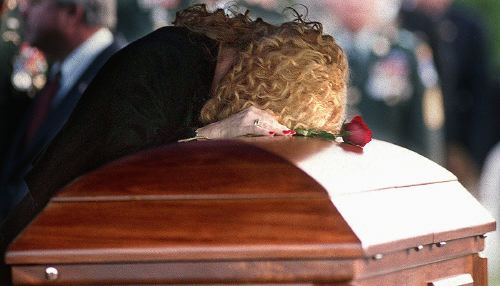 Colonel Cory was buried at site 574 at Fort Bragg Post Cemetery in North Carolina; Colonel Martin was buried at Greenlawn Memorial Park in Columbia, South Carolina; Major Lewis was buried at section 6-T, row 4, site 5 of Arlington National Cemetery; Sergeant Murphy was buried at Southlawn Memorial Park in Petersburg, Virginia; Master Sergeant Moser was buried at section A-E, site C-61A of Fort Rosecrans National Cemetery in San Diego, California; Chief Gonzales was buried in section 48, site 102 of the National Memorial Cemetery of Arizona in Phoenix, Arizona; and Sergeant Flynn was buried at Montevallo Cemetery in Alabama. Colonel Cory was buried at site 574 at Fort Bragg Post Cemetery in North Carolina; Colonel Martin was buried at Greenlawn Memorial Park in Columbia, South Carolina; Major Lewis was buried at section 6-T, row 4, site 5 of Arlington National Cemetery; Sergeant Murphy was buried at Southlawn Memorial Park in Petersburg, Virginia; Master Sergeant Moser was buried at section A-E, site C-61A of Fort Rosecrans National Cemetery in San Diego, California; Chief Gonzales was buried in section 48, site 102 of the National Memorial Cemetery of Arizona in Phoenix, Arizona; and Sergeant Flynn was buried at Montevallo Cemetery in Alabama.
On the morning of Wednesday, April 25th, 2001, at Fort Myer, Virginia, a memorial service was held for those killed in the mishap. Attended by family members of the seven Americans and co-workers from JTF-FA, Vietnamese Deputy Chief of Mission Pham Van Que,and members of the Vietnamese Embassy. Speaking at the event, Deputy Defense Secretary Paul Wolfowitz said the example of the seven Americans and nine Vietnamese killed in the crash will serve to renew the commitment to further their work of accounting for missing Americans in Southeast Asia. "Let us remember the words of Abraham Lincoln ... when he said 'It is for us the living to be dedicated to the unfinished work which they so nobly advanced,'" Wolfowitz said. "Our resolve is strengthened by their example." After a 121 day hiatus, during which the JTF-FA, CILHI, and PACOM undertook a stringent review of operating procedures and implemented additional risk mitigation measures, the accounting mission in Vietnam continued at its previous pace, with the 66th scheduled search mission occurring in July 2001. On October 10th, 2001, the collateral investigation of the MI-17 helicopter crash was completed. Each of the next of kin was given an opportunity to be personally briefed on the investigation results and, although exact details of the accident may never be known, a report by an American investigator, Army Lt. Col. David Shaffer, found that the flight crew was very experienced, and the pilot in command had more than 3,300 flight hours and was considered the Vietnamese military's best at maneuvering the Mi-17. Furthermore, the report indicated that deteriorating weather conditions, poor visibility and the pilot’s failure to properly react to the changing weather conditions - a scattered cloud level into an unforecasted, rapidly forming thick layer of fog - were all predominant factors in the accident. Based on these results, PACOM lifted the moratorium on passenger use of the MI-17, with safety modifications – namely, the removal of the internal fuel tanks - in Vietnam and Laos. In 2002, the Department of Defense decided that accounting efforts for all past conflicts would be best served by combining JTF-FA and CILHI into a single, cohesive organization. Thus, on October 1st, 2003, the Joint Prisoners of War, Missing in Action Accounting Command, better known as JPAC, was established and headquartered on Hickam Air Force Base, Hawaii. 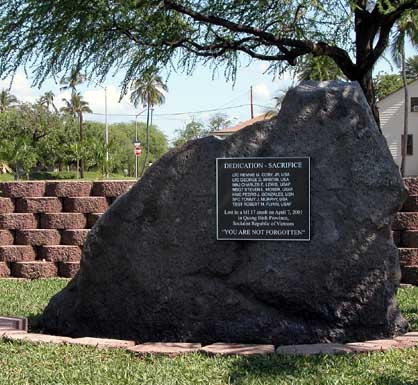 At its headquarters in Hawaii, and on the third anniversary of the mishap, JPAC’s Commanding General, Brigadier General W. Montague Winfield unveiled and dedicated a memorial on an area called “Heroes Green.” The memorial is a lone rock about three feet high with an engraved plaque that bears the names of seven Americans, as well as the entire park. The general began the dedication by giving a short speech and reading the names on the plaque. In Hanoi, near Det 2's headquarters, is another memorial to the 16 killed in this mishap. On July 7th, 2006, the 16 killed were honored by the 109th Congress of the United States in a concurrent resolution (HCON 444 IH). |