A Lady of Hollywood in Germany… The Crash of the "Airwolf" Helicopter Near Halbeswig, Germany June 6th, 1992 A Machine as a Muse... The design of the Bell 222 helicopter was revolutionary to the world of rotary wing aircraft. With a light alloy structure, and a fuselage built around a large cabin, it could seat two pilots and five or six passengers. The large main rotor with two wide blades were made of steel with a honeycomb core, and the blades were held to the rotor hub by standard Bell elastomeric bearings. 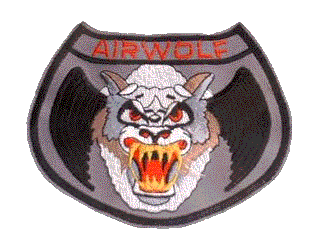 The tail rotor is also metal with two blades. A pair of 650 horsepower Lycoming LTS-101 engines powered the copter, and were mounted side-by-side above the fuselage and have integral particle separators. The fuel is contained in three tanks, one in the fuselage and two in the sponsons into which the main landing gear members retract. Such a modern aircraft called for celebration. And television producer Donald P. Bellisario found inspiration in its design. In the mid-80s, a television series was developed with an unusual concept – having a helicopter be the star. In the vein of Knight Rider and Blue Thunder, Bellisario chose the Bell 222. The tail rotor is also metal with two blades. A pair of 650 horsepower Lycoming LTS-101 engines powered the copter, and were mounted side-by-side above the fuselage and have integral particle separators. The fuel is contained in three tanks, one in the fuselage and two in the sponsons into which the main landing gear members retract. Such a modern aircraft called for celebration. And television producer Donald P. Bellisario found inspiration in its design. In the mid-80s, a television series was developed with an unusual concept – having a helicopter be the star. In the vein of Knight Rider and Blue Thunder, Bellisario chose the Bell 222. The Bell 222 used in the series, registered as N3176S, was one of the last “222A” helicopters that Bell manufactured before the release of the 222B model. Nevertheless, the owner of 76S – JetCopters Incorporated of Van Nuys, California – modified the chopper as if it were equipped with concealable machine guns, missiles, and an array of other weaponry and improvements. The series ran for 55 episodes (the first being a two-hour TV movie) on the CBS network in the United States in 1984–1986 and an additional 24 episodes, with a new cast and production company, on the USA Network, in 1987, a total of 79 episodes, and enjoyed moderate success. At the conclusion of the series' run, the copter was repainted, its body kit modifications removed and sold, and the copter sold to the German helicopter charter company, Hubschrauber-Sonder-Dienst (as known as HSD Luftrettung and Blue Helicopter Alliance) in June of 1987, and assigned the registration number D-HHSD. Angel of Mercy... On the afternoon of Saturday, June 6th, 1992, D-HHSD was flying a little girl suffering from heavy burns on a mercy mission from Berlin to the Cologne University Burns Unit in Köln. After safely delivering the girl, the helicopter and its crew of three was returning to Berlin when they encountered unexpected weather. With the visibility reduced to nearly 100 feet due to fog amidst a brewing thunderstorm, the copter's 42 year old pilot must have struggled to navigate the wooded German mountainsides.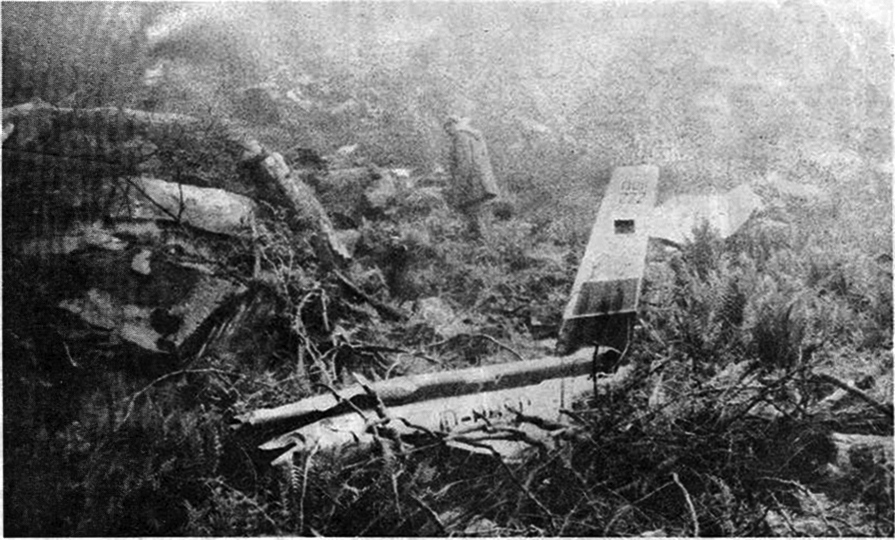 Unfortunately, at 2:30 in the afternoon, at a speed of nearly 100 miles an hour, the helicopter impacted near a rock quarry near Halbeswig. Its rotor blades clipped the tops of several tree, and then struck the mountainside. A nearby farmer heard, during his work, a big bang, and alerted emergency services. But, given the weather conditions, it took about an hour before the rescuers could find the wreck site. When they arrived, they found the helicopter was broken in half in the middle, the engine destroyed, and the 3 occupants, including a 38 year old doctor and his 31 year old assistant, all had been killed in the impact. The forested area around the crash site was locked down for nearly 7 hours. The fire department had to close several roads near the site because not enough police. The police Dortmund and the Federal Air Transport Authority Braunschweig started their investigation on late afternoon, which continued into the following day. Afterwards, the crash site was released the helicopter's owners, who salvaged the wreck. However, due to the impassable terrain, some parts of the helicopter could only be snug out by air. Causes... Three days after the crash, the Federal Air Transport Authority concluded that human error was the cause of the crash. |