Hitting Water at One Thousand Feet… Near Orinda, California September 30, 1960 Star-Studded Career... Born in Cleveland, Ohio, and educated at West Point, Carl Ferdinand Fritzsche started as an Infantry officer, served as "The Master of the Sword" - the head of the Department of Physical Education and the director of the program of physical instruction at West Point during the 1943-1944 school year, and later was an intelligence officer for the 12th Army group in Europe during 1945, later promoted to the unit's deputy Chief of Staff of Intelligence. During the Korean War, he was assistant commander of the 25th Infantry Division in Korea. In October of 1955, General Fritzsche made national news when he issued a order to discourage the men in his command from using Army jeeps "to transport indigenous female personnel for recreational purposes." After serving as Chief of Staff for the 5th Army in Chicago, he took command of Fort Ord near Monterey, California, in 1958. By 1960, his decorations included the Legion of Merit with oak leaf clusters, the Bronze Star and the French Legion of Honor, and he, among with his wife, who he married in 1931, were scheduled to report to Europe in November of 1960 so he could take command the northern area of the U.S. Army in Germany with its headquarters in Frankfurt. During the last week of September of 1960, General Fritzsche, 57, planned to drive to Berkeley for the football game - but decided by Friday morning to fly - as he also had to visit the Sixth Army headquarters at the Presidio of San Francisco to participate in a briefing scheduled for Sunday for then-Assistant Army Secretary Courtney Johnson. But he also had the additional duty of attending the Army-California football game in the Berkeley's Memorial Stadium on that following Saturday morning. Entourage in Tow... Along with General Fritzsche for the flight was his deputy commander, Brigadier General Thomas H. Hayes, 49, a native of Minnesota and a 1934 graduate of West Point, commanded an infantry regiment in World War II in Europe and was attached to the headquarters of the Far East Command in Japan during the Korean War, during which time he received the Silver Star, Bronze Star with two oak leaf clusters, the Purple Heart and the French Croix de Guerre. General Hayes also had business at the Presidio, and was due to meet and escort a group of prominent civilians to a joint civilian orientation conference at Fort Benning, Georiga. Also with General Hayes was his aide, 1st Lt. Robert L. Fisher, 27, of Savannah, Georiga. Piloting the de Havilland U-1A “Otter”, serial number 58-1693 and assigned to the Army's 17th Aviation Company, was Chief Warrant Officer Robert K. Brown, 38. With him was his co-pilot, Chief Warrant Officer Kenneth R. Kiester, 38, of Hemingford, Nebraska, and the plane's crew chief, Specialist Fifth Class Donald E. Peterman, 25, of North Hollywood. Cumulo-Granite... At 3:20 in the afternoon, the Otter was flying near the town of Orinda, some eight miles from Oakland, apparently lost in the heavy fog which covered the Bay Area that day, as it was bound for the Presidio's Crissy Field landing strip. 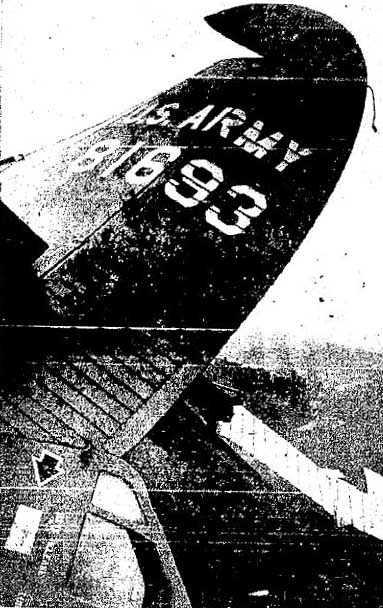 Flying low over the hills, the plane clipped a water tank of the East Bay Municipal Utility District atop a 1,300 foot peak, skidded 100 feet on the hillside and burst into flames at the top of Alta Vista Road, just off El Toyonal Road. Flying low over the hills, the plane clipped a water tank of the East Bay Municipal Utility District atop a 1,300 foot peak, skidded 100 feet on the hillside and burst into flames at the top of Alta Vista Road, just off El Toyonal Road.
It missed by only 200 yards the home of John Barren on Los Narrabos Road. Mrs. Barren was feeding her two children, Caroline, two years old, and John Patrick, eight months old, when "I heard a roar, it sounded directly over the house." "I heard a choke—like an engine dying. Then came the sound of a crash. I looked out but couldn't see anything at first because of the fog. Then I began to see blue-orange flames as if the plane had struck the high tension lines coming down the hill.” A nearby neighbor phoned the Orinda Fire Department, the first unit to arrive at the crash under direction of Fire Chief Alan Winsor, whose men extinguished a stubborn brush fire, which destroyed about 20 acres, that started from the crashed plane. A bit of the wing tip of the plane was embedded in the top of the five million gallon water tank which acts as a storage lank for the Dos Osos reservoir, and the cockpit door, which bore a major general's two stars, survived the impact. Other than that, the VIP transport was demolished, and all aboard were killed. 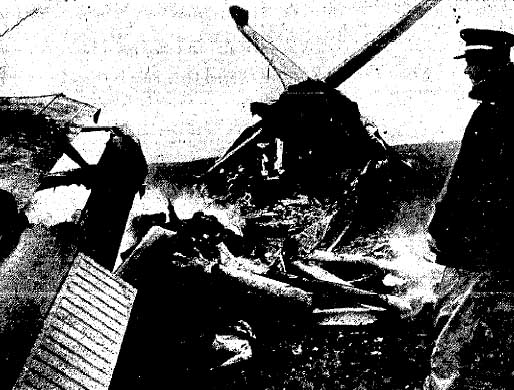 The Army sent an investigating team to the site to determine the cause of the accident, and a team from Letterman General Hospilal in the Presidio removed the bodies for burial. The Army sent an investigating team to the site to determine the cause of the accident, and a team from Letterman General Hospilal in the Presidio removed the bodies for burial.
Afterwards... The chaplain of Fort Ord, Peter S. Rush, in his eulogy to those who died in the cash, stated, “This morning with heartfelt grief, we pay our respects to a father and five of his military sons.” General Fritzsche was buried at Arlington National Cemetery in Section 2, Site 3444 L H. Lieutenant Fisher was also buried there, in Section 48, Site 1815. Chief Warrant Officer Kiester was buried at Fort Logan National Cemetery in Section L, Site 908. Specialist Peterson was buried at Golden Gate National Cemetery in Section X, Site 3937. Brigadier General Charles S. Dorsa, commanding general of Combat Development Experiment Center at Fort Ord, took command of Fort Ord's 30,000 men. On December 9th, 1960, Fritzsche posthumously received a third award of the Legion of Merit medal. In the early 1960s, when a larger Army airfield was constructed adjacent to Fort Ord, it was named in memory of Major General Carl F. Fritzsche. After Fort Ord was closed in 1991, the air field became Marina Municipal Airport (OAR), and opened to general aviation traffic. In October of 2004, the first new housing area completed by Monterey Bay Military housing was opened in the community of Seaside near Monterrey. It was named “Hayes Park," in honor of the fallen General. |