When the B-1 bomber program was re-instituted in 1981, the plan called for the use of the original four B-1A prototypes as test-beds for systems for the B-1B. B-1A number 2 (74-0159) was modified by having B-1B flight control system features installed and was intended for air load testing and engine/inlet development. It began flying on March 23, 1983.
On August 29th, 1984, the second B-1A prototype departed Edwards on a test flight, under the mission callsign of "Wiry 29". On board was the B-1 program chief test pilot, Tommie Douglas "Doug" Benefield. He had logged over 11,000 hours in many different aircraft, including the F-4, F-102, C-124, C-130 Hercules, C-133, C-141, T-39 and SA-16.
Born in Rison, Arkansas, and raised in Jefferson, Texas, the 55-year-old Benefield graduated from Jefferson High School, and from Texas A&M University in 1949. He joined the Air Force in 1950, completed the service's test pilot program in 1955, and worked with flight test operations at Edwards - testing the unusual stall characteristics of the C-133 - until 1966. Having flown 176 combat missions aboard F-4C Phantoms for the Air Force in Vietnam, he made all the early B-1 test flights. He also spent four years as a test pilot for the Federal Aviation Administration after retiring from the Air Force as a colonel in 1973. He also tested the Concorde for France.
Also aboard the experimental bomber were Major Richard V. Reynolds, 35, an Air Force pilot from Hoquiam, Washington, and Captain Otto J. Waniczek Jr., 30, a flight engineer from Seattle, Washington. The third of three low-speed control test flights, it was supposedly to be an easy test flight.
Reynolds graduated from the U.S. Air Force Academy in 1971, and joined the B-1 Combined Test Force at Edwards in the summer of 1980 as a test pilot.
Waniczek had worked on several projects, including Project “HAVE IDEA,” an evaluation of several captured aircraft of Soviet manufacture at Nevada’s Tonopah Test Range.
But, while flying north of Harper dry lake, after two master control warning lights and a center-of-gravity warning light illuminated. An automatic system that normally transfers fuel was disengaged, having been set to manual control for the purposes of the test flight. But the warning lights indicating fuel had not been shifted did not light. As the plane's movable wings were manually swung forward for a low-altitude test, the bomber's center of gravity thus stayed toward the tail, causing the bomber to rear up at a 70° angle, forcing the plane's nose upwards, and stalling the plane. The B-1 started to tumble into a spin earthward from an altitude of 4,200 feet.
A F-111 chase plane radioed to co-pilot Doug Benefield, "How are you doing, Doug?"
Benefield replied, "We may have to punch it. We have to punch."
At 1,515 feet above the ground, command pilot Richard Reynolds said "we got to get out" and pulled the ejection handle, launching the B-1A's escape capsule. Nine seconds later, the unmanned "Lancer" - with 90,000 pounds of fuel - impacted the desert floor.
The escape capsule deployed successfully, but the 3 parachute risers did not properly. The capsule hit the ground on its right side at a steep angle - so steep that the inflatable cushions could not shield the impact. Chief test pilot Douglas Benefield was killed on impact, his seat ripped away from the floor of the capsule due to the 40g impact forces - a victim of severe "whip-lash" - and the two other crew members were seriously injured - Waniczek, who was not wearing his helmet nor strapped into his seat, suffered a partial collapse of both lungs, and Reynolds was temporarily paralyzed from back injuries.
Responding to the Brush Fire...
The bomber crash ignited a large brush fire. From Boron Federal Prison, six miles southwest of the crash site, a fire fighting crew - Inmate Company #52 and composed of inmates - was dispatched to douse the resulting fires caused by burning fuel and debris.
"An inmate witnessed the crash, but not the aircraft type. Boron was unique in that as an ex-Air Force radar installation, it had two fire trucks," said Stephen Arrington, then-inmate chief engineer of inmate fire company. "Because people died from lack of assistance when this camp was still remote, the Warden authorized the camp fire crew to respond to accidents within a 25 mile radius of the camp."
"Our camp was only 30 miles from Edwards and I thought we were responding to a downed B-52," he continued. "As I am ex-Navy EOD so I feared we were in for a very dangerous situation.We responded to the B-1A crash with four vehicles, three of which broke down in the rugged desert terrain."
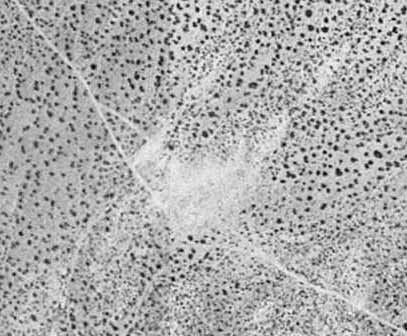
Aerial photo of the B-1A crash site, taken by USAF pilot Keith Svendsen from an F-4 in 1984
Recounting their arrival, Arrington noted: "When we arrived on the scene there was a large brush fire threatening the ejection pod. Being a pilot, I recognized it as the B-1A and knew it was the only aircraft where the whole crew ejected together in a pod. The hatch was closed so I knew they needed help inside. The brush fire had almost reached the pod, I swung the fire truck in between the fire and the pod to protect it. We knocked back the flames. Two of our inmate firefighters and our escort officer rushed to helped the crew. At the same time two Air Force helicopters landed and the aircrew ran to assist and take over the rescue."
"My job was to protect the pod, and secondly, establish a fire line to keep the fire from spreading and of course to send men to rescue the crew. I did not have enough water to also put out the B-1 burning, which could have caused exotic metals to exploded. It needed foam and about half an hour later a crash truck arrived on the scene and doused the fire on the wreckage."
Arrington concluded that, "while the pilot died, two of the crew lived - and a horrible tragedy was averted that day because of a Warden who had the insight and the courage to allow his inmates to help others. Had the fire truck not been on the scene, the aircrew personnel from the choppers would have had to stand helplessly by as the fire engulfed the pod. It was that close."
We are currently searching for photos of the crash site taken during the investigation. If you have any - please contact us.
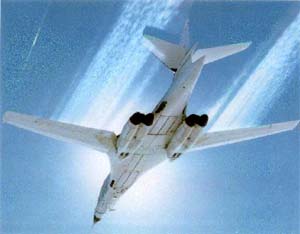
The B-1A, 74-0159, in flight during early testing.
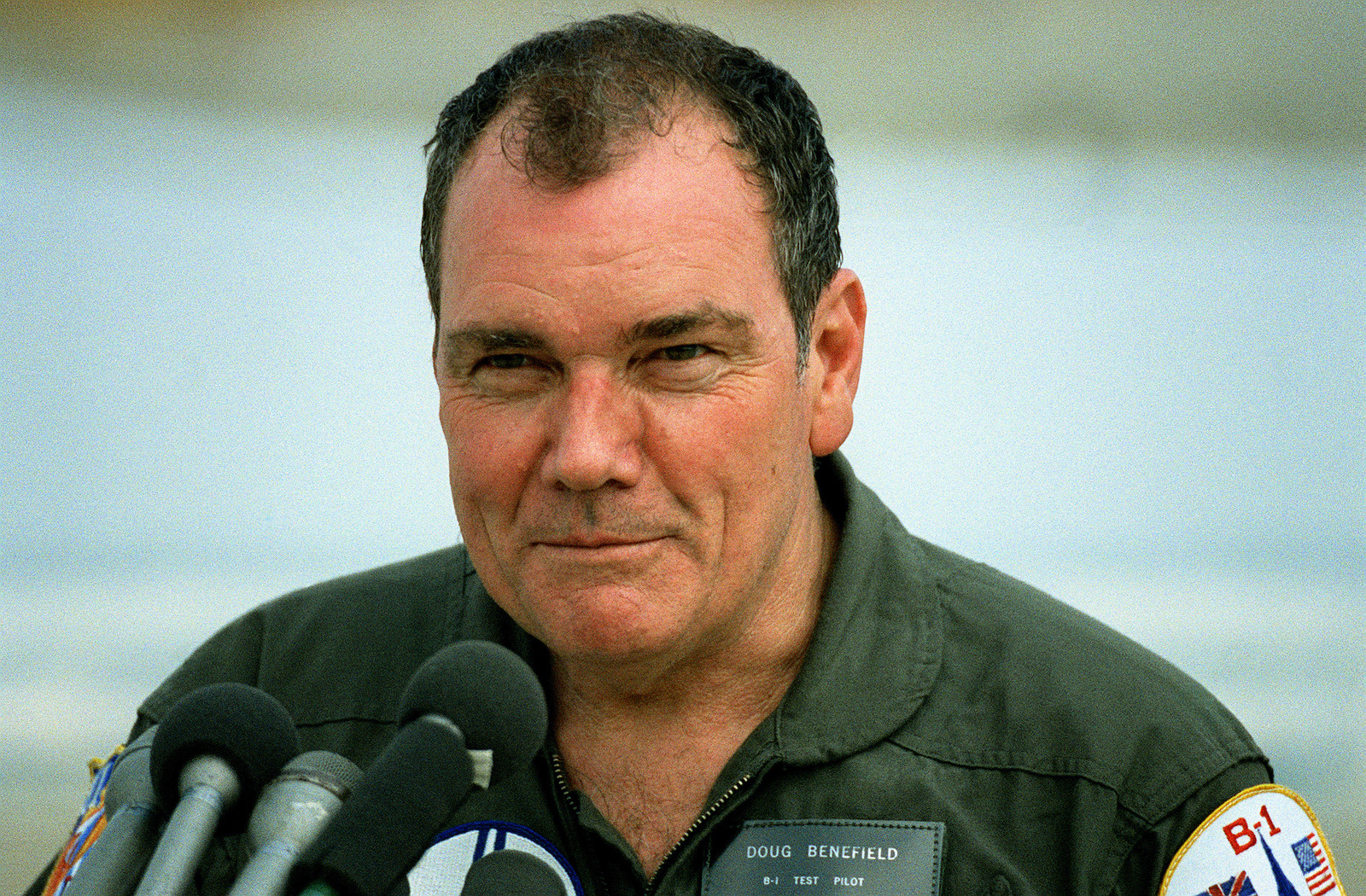
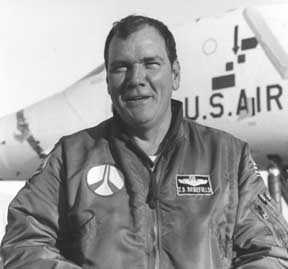
Rockwell's chief test pilot Doug Benefield was killed in the crash.
On September 4th, 1984, several days after the accident - the first production B-1B bomber rolled out of his factory hanger at Palmdale. "This day has not come without sacrifice.” Rockwell International Corporation Chairman Robert Anderson told about 1,500 people during rollout ceremony. "One man, whom many of us knew, respected and loved, has paid the supreme sacrifice." referring to Benefield. Ironically, the Air Force announced it was grounding the last B-1A prototype because Benefield's crash at the same time as the roll-out.
Reynolds and Waniczek told investigators they do not recall seeing warning lights, indicating the fuel had not been shifted. However, the investigation uncovered that two master control warning lights and a center-of-gravity warning light did function.Key to the discussion of the crew’s responsibility was that the automatic system that normally transfers fuel was disengaged because the test flight called for manual control, and Benefield was supposed to turn a control knob to actuate the process.
The Air Force attributed the crash to be caused by human error. As the plane's movable wings were swung forward for a low-altitude test, Benefield apparently forgot to switch on a mechanism that shifts fuel among various tanks. This caused the nose to shift upwards, and the plane to stall and spin.
According to Brigadier General John Schoeppner, who headed the investigation, "It was human error. They did not shift the center of gravity."
Furthermore, the board also blamed equipment failure – namely, the failure of an explosive bolt - for the co-pilot's death after the crew ejected in a parachute-equipped escape capsule.
Epilogue...
The B-1 program marched on after the loss - the test launching of nuclear-tipped cruise missiles from the craft, however, were postponed over a year.
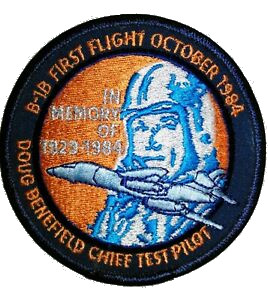
Benefield was buried at Oakwood Cemetery in Jefferson, Texas. The October 1984 first flight of the B-1B was dedicated to his memory, and - in July 1989 – the Benefield Anechoic Facility, used for testing how aircraft react to and jam radar signals, was named in his honor.
In February of 1985, Benefield’s widow filed a lawsuit, and – in October 1989 - was awarded a judgment of $1.4 million, in Los Angeles Superior Court, against Ordnance Engineering Associates, the manufacturer of the escape capsule parachute’s firing mechanism. The company, renamed “OEA,” and had pioneered the development of air-bag triggers was acquired in 2000 by Autoliv, Inc., the Swedish manufacturer of automotive airbags.
Benefield’s son, Tommie Jr., then a Navy Lieutenant stationed in Jacksonville, Florida, flying attack jets, continued in his career as a pilot, undeterred by the loss of his father.
Richard Reynolds left the B-1 program in 1986. He went on to command the Flight Test Center at Edwards in 1998, and retired in 2005 at the rank of Lieutenant General as the vice commander of the Air Force Material Command.
Otto Waniczek took a job with Northrup, continuing as a flight test engineer on the B-2 bomber, and later was vice president of Rainier Precision, a company that specializes in custom plastic injection molding.
Stephen Arrington, who had been jailed in 1982 for a cross-country cocaine smuggling trip, allegedly connected to automaker John DeLorean, was released in 1985. He joined the Cousteau Society as a chief diver and expedition leader and later a full-time lay youth minister, motivational speaker, and author - writing about his experiences as a inmate firefighter in the book, "In Delorean's Shadow." In 2017, he received a full pardon from President Obama.
From the air, it just looks like a clear spot in the desert. However, it doesn't take much imagination to see the resemblance of the spot to the shape of the B-1A.
Roads to the area are the result of the heavy equipment that was brought in for the recovery efforts.
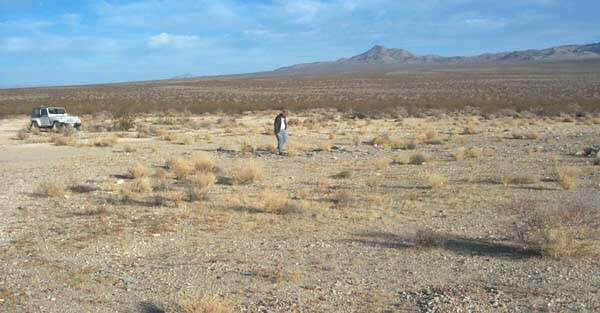
At the site looking to the east. Small desert plants are slowly to filling in the area that was bulldozed during the recovery efforts.
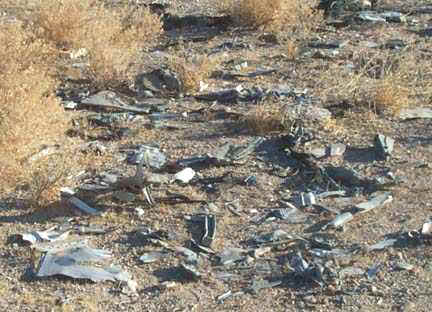
It is not hard to find wreckage (mostly aluminum and steel) from the B-1A. In fact, filling up a truck with wreckage would be an easy task. What is missing from the wreckage are bits of Titanium. Because of its high cost, it was only used where absolutely necessary. Only about 20-percent of the aircraft was made of Titanium and most of that was in the engines.



 Also aboard the experimental bomber were Major Richard V. Reynolds, 35, an Air Force pilot from Hoquiam, Washington, and Captain Otto J. Waniczek Jr., 30, a flight engineer from Seattle, Washington. The third of three low-speed control test flights, it was supposedly to be an easy test flight.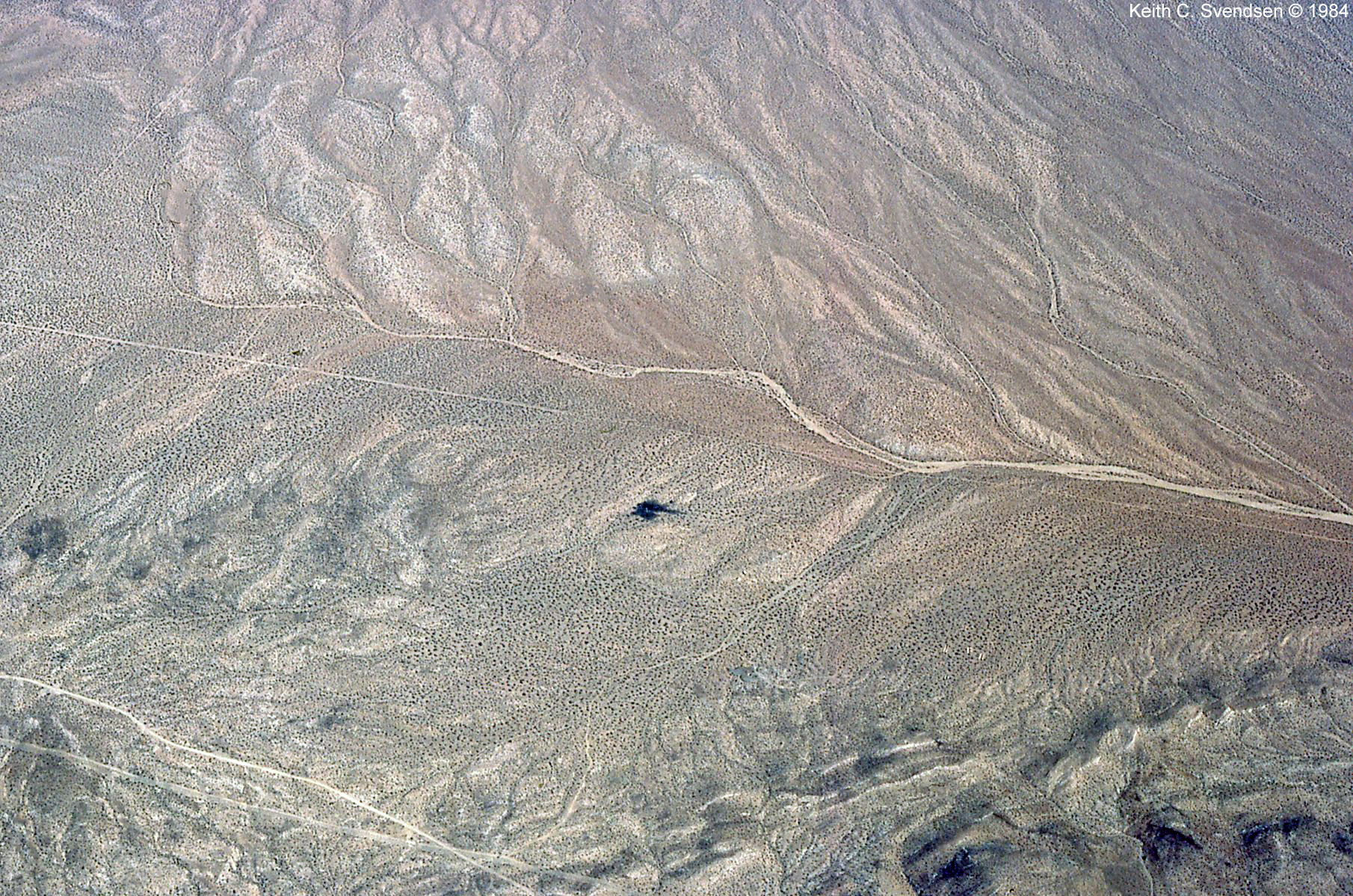
 Epilogue...