The Disappearance of the Great Bill Barilko North of Cochrane, Ontario August 26, 1951
"The Kid" of the Toronto Maple Leafs...
In February 1947, the five-foot-nine, 180 pound Bill Barilko was asked to join the Maple Leafs from the Pacific Coast Hockey League's Hollywood Wolves. Barilko teamed with Bill Ezinicki, to give the Maple Leafs one of the toughest-checking defenses in National Hockey League history in the late 1940s. His sweater number was 21 when he first joined the Maple Leafs during the 1946-47 and 1947-48 seasons, and he was promoted to number 19 for the 1948-49 and 1949-50 seasons. The number 5 (which was retired by the Leafs) was only worn by Barilko for one season, 1950-51. During that span of five seasons, Barilko and the Toronto Maple Leafs were Stanley Cup champions on four occasions 1947, 1948, 1949, 1951.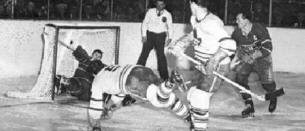 Barilko scored the overtime goal against the Montreal Canadiens' Gerry McNeil in Game 5 of the Stanley Cup final on April 21, 1951, to clinch the Cup for the Maple Leafs. His career total was a mere 26 goals in 252 games - five of those goals in a span of 47 playoff games. "Bashin' Bill" Four months and five days later, "Bashing Bill" Barilko boarded a yellow Fairchild 24 single-engine floatplane piloted by his friend Henry Hudson, a dentist and pilot in Barilko's hometown of Timmins. Barilko was returning home from a fishing trip on James Bay. The plane vanished between Rupert House (today known as Waskaganish) and Timmins. No trace of Hudson, Barilko or the Fairchild was discovered for eleven years, despite massive search efforts lasting two months, covering 10,000 square miles, and at a costs of $385,000 – the largest search in Canadian history. The Maple Leafs were so distraught and unwilling to accept the tragedy that Barilko's equipment remained in his usual locker room stall at the opening of the 1951 fall training camp, and in October of 1951, posted a $10,000 for information leading to the discovery and recovery of Barilko's plane. Unfounded rumors began circulating that Barilko, who was of Ukrainian ancestry, had potentially defected to the Soviet Union to teach his skills to young Soviet players. Serendipity...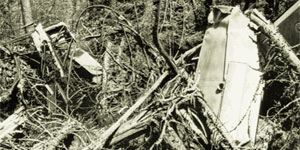 Finally, on Friday, June 1st, 1962, bush pilot Gary Fields of Dominion Helicopter Services Ltd. of Toronto, was on a routine patrol flight when he was accidentally blown off his flight course by high winds. While there, he came upon the weather-beaten debris from a Fairchild 24, about 45 miles north of Cochrane, Ontario, in dense and swampy bushland. Thinking it was a known wreck site, it was disregarded at first. But a recheck of local records found that the site was undocumented, and merited further investigation. The featureless terrain made pinpointing the exact site difficult, but several days later, on June 7th, helicopter pilot Ron Boyd, and his engineer Phil Weston, relocated the site. Using rolls of toilet paper, the pair marked the crash site, landed, and hiked over a mile through the thicket to arrive at the crash site. There, they found the plane to be half-buried in the soft arctic soil, and discovered that the plane's registration number is still visible on the wreckage - a pontoon and piece of empennage - and the skeletons of both Barilko and Hudson, were still strapped to their seats. They were followed by a team of searchers, equipped with knives and chain saws, who beat a passage through the dense bush so that the helicopter could fly in a coroner and Department of Transport officials. Ultimately, the skeletal remains were hiked out by members of the Cochrane Police and forestry officials. Days later, on June 15th, Barilko was finally laid to rest in Timmins Memorial Cemetery in Ontario, Canada, with over 100 friends and family in attendance. Later that year, the Leafs won their first Stanley Cup since his disappearance eleven years earlier. But Gary Fields was denied the reward money offered by the Maple Leafs, as the offer expired in December of 1951. The Search and Rescue report, issued by the government, cited pilot inexperience and bad weather conditions as the cause of the crash. The Tragically Hip, a popular Canadian band, recorded a song called "Fifty Mission Cap." In the song, the narrator tells the story of Bill Barilko, indicating in the chorus that he stole the lines from a hockey card he keeps in his fifty mission cap. In May of 2005, John Shaw, a dentist practicing in Timmins, and forestry technician Roland Szyska ventured to the crash site, and erected an aluminum memorial sign that reads: "At this location August 26, 1951, hockey player Bill Barilko and dentist Henry Hudson lost their lives. Rest in Peace." Beneath the wording, a yellow Fairchild 24 model G is depicted. Click here for more crash stories on Check-Six.com |