The Battle of the Bay Bridge Over San Francisco Bay, California February 11th, 1968 A “Shooting Star”… Originally developed from the Lockheed P-80, the first operational jet fighter of the United States military, the Lockheed T-33 “Shooting Star” first flew in 1948, and was piloted by none other than Tony LeVier, famed air racer, and chief test pilot for the Lockheed corporation. Unlike its fighter ancestor, this airframe was intended for use as a training aircraft. Designated as the TP-80C/TF-80C in development, it later became the T-33A. As the airframe design became increasing popular, so much so that the U.S. Navy picked the T-33 design for its training fleet as well, the T-33 was called by its naval counterparts initially as theTO-2, then the TV-2. However, when the United States Tri-Service aircraft designation system came into use in September of 1962, the naval “Shooting Stars” became known as the T-33B. Increasing Global Tensions… On January 23rd, 1968, a U.S. intelligence ship, the USS Pueblo, with 83 crew members aboard, was captured by North Korea somewhere just inside or outside North Korean waters. And, a week later, on January 30th, North Vietnam launched the "Tet Offensive" against all major cities in South Vietnam, including an attack on the U.S. Embassy in Saigon. While U.S. troops drove them out and General Westmoreland called it a "go-for-broke effort" that failed, the Tet Offensive shattered any belief in an approaching U.S. military victory in Vietnam among most politicians and the public. Late on the morning of Sunday, February 11th, 1968, a pair of Naval reserve aviators, aboard their T-33B, prepared for their departure from the Alameda Naval Air Station to their home field of Los Alamitos Naval Air Station, near Long Beach, California. Attached to Reserve Attack Squadron 773, the two reservists, pilot Lt. Bruce C. Turnbull, 34, and Lt. Anthony V. Miller, 33, were completing a weekend-long training exercise drill. 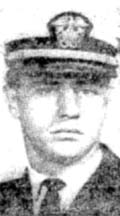 | 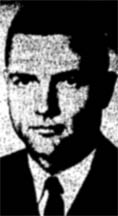 | | Lt. Bruce C. Turnbull | Lt. Anthony V. Miller |
The Upper Crust… Turnbull was from a well-to-do family. His father, Raymond W. Turnbull, had been regional vice president of General Electric, a former president of Hotpoint, Inc, and a former executive with Edison Electric. Bruce Turnbull had been born in Bridgeport, Connecticut, but moved to San Mateo, California, with his family in 1948, and had attended several local schools there, such as Menlo College, and Stanford University, where he was known as "Doc”. He was commissioned a Naval officer in 1956, and married a year later in 1957. He was employed at a Los Angeles advertising agency and was the father of three children. However, he had recently divorced from his wife, and had established residence in Los Angeles. Anthony Miller was a native of Los Angeles, and graduate of the University of Southern California. After college, he became employed by North American Aviation, and was married. Returning to the Southland… The jet launched into dense fog from Runway 31 at Alameda, and flew straight and level for two miles – when the hand of fate intervened… 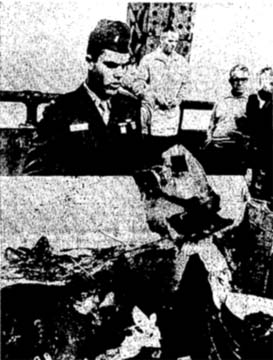 | A young Marine aids in the bridge cleanup, placing a chuck of debris into a truck |
Truck driver Ronald Terry, 25, of El Sobrante, was carrying 8,050 gallons of jet fuel on his truck on the San Francisco-Oakland Bay Bridge. The thick fog covered the bay, and he was driving westward towards San Francisco on the upper deck of the bridge’s eastern cantilever span when, out of nowhere, a “flash of aluminum” caught Terry’s eye, followed by “a streak of light…” He then heard an explosion and saw a fireball about 15 feet above the roadway, and him, on the bridge! "Stuff was raining down all over the place. All I thought of is where can I go from here," Terry said. "I got out as quick as I could. I looked down over the rail but I couldn't see anything in the fog." The “Shooting Star” that Turnbull was piloting had crashed in the bridge – shattering and scattering flaming pieces of metal in front of cars, one large chunk landing on the hood of Terry’s truck-tanker. Scorched debris from the plane, including a blistered red, white-and-blue Navy star insignia from one of the wings, laid scattered on the bridge deck. The Highway Patrol said scores of drivers maneuvered around the wing section before traffic was halted and turned back. And Yet…
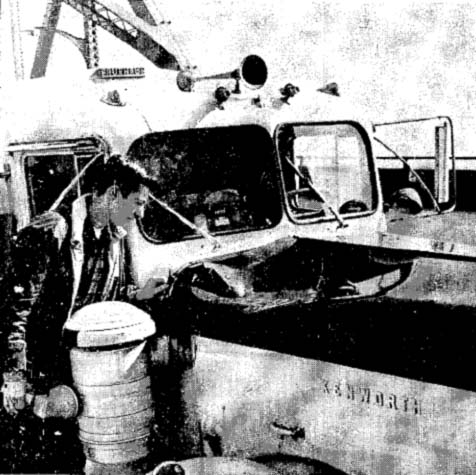 | Ronald Terry inspects the only damage to his truck, which was carrying over 8,000 gallons of jet fuel. |
From below the bridge, Edward Mackey, the captain of the tug “Napa River”, witnessed the accident. He said the plane plunged directly into the water. He picked up bits of debris and stood by until the Coast Guard arrived. The bridge was, at the time, the third busiest in the nation, carrying an average of 150,000 automobiles and trucks a day. Surprisingly, no motorists were injured, but several said their cars were sprayed with oil, and the truck was apparently the only vehicle hit by the large pieces of airplane. However, the five-lane, upper deck of the bridge was closed to traffic for over two hours. Many cars, trucks and buses from the Oakland side were required to turn about and head jack to the toll plaza, and traffic was backed up for six miles on the Nimitz Freeway. Navy divers and Coast Guard vessels searched wreckage, and the crew's bodies, for several days following. On the morning of Wednesday, February 14th, the nose wheel of the plane was found, and its location was marked by a buoy. Later that the evening , the two bodies were found inside the cockpit of their T-33 when the fuselage was lifted from 50 feet of water about 600 yards north of the Bay Bridge. Also recovered was part of the starboard wing assembly. All of the wreckage was being returned to the Alameda Naval Air Station. A Bigger Problem... 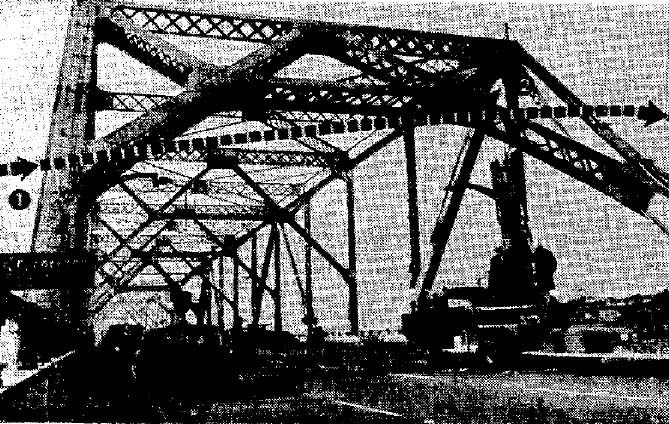 | | The path of the T-33, as it cut across the bridge |
One of the bridge's cantilever arches was blackened by the fireball, and a vertical girder was badly bent by the impact force of the crash. According to the chief engineer of the span, E. R. Foley, the plane hit one of five main truss stands for the structure. He said the bent and blackened portion of cantilever, weighing several tons, would be replaced, but that the crash would not affect the soundness of the bridge because none of the main beams was damaged. Deputy engineer John Kozak said a temporary one would be put in its place until a permanent girder could be installed. When It Rains, It Pours… Meanwhile, as thousands of motorists were waiting for two hours for the bridge to re-open after the plane struck. And for one, it was too much: The son of a socially prominent New Yorker plunged to his death after being caught for two hours in the traffic jam caused by the crash. The California Highway Patrol quoted a motorist as saying he saw John Caufield Morgan, 20, a senior majoring in political science at Stanford University, leap out of his car, run to the bridge railing and jump. He was the son of U.K. Morgan, member of one of New York's oldest families, being a member of the Union League, the Union, Knickerbocker, and Century clubs, and a member of the Sons of the American Revolution, Colonial Wars and Mayflower Descendants. The leap occurred while Morgan had been returning to Stanford from visiting a brother, Seth, a student at the University of California in Berkeley, and with having just been accepted to the George Washington University law school. The Coast Guard said a strong underwater current had prevented an effective search for the body. Epilogue Lieutenant Bruce Turnbull was buried at Golden Gate National Cemetery, in San Bruno, California, in Section W, Site 2465.The naval air station is Alameda NAS Alameda was identified for closure under the Base Realignment and Closure Program in 1993, and ceased operation in April of 1997. Attempts to redevelop the area have met with limited success. The San Francisco-Oakland Bay Bridge remains open to vehicle traffic. The 1989 Loma Prieta earthquake collapsed a portion of the bridge not too far from where Turnbull's plane crashed 21 years earlier. A replacement span has been built, which opened in 2013, and the original span is currently being dismantled. |