The Helicopter that Fell to Earth Gene Cernan's Bell 47 Crash January 23, 1971 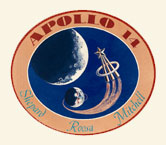 | | The prime crew patch design for Apollo 14 | 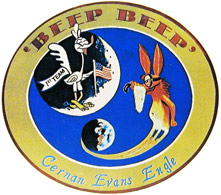 | | The backup crew patch design for Apollo 14 | 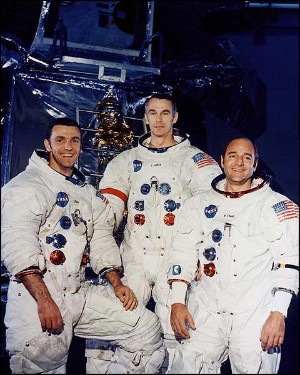 | | The backup crew for Apollo 14: Engle, Cernan, & Evans | 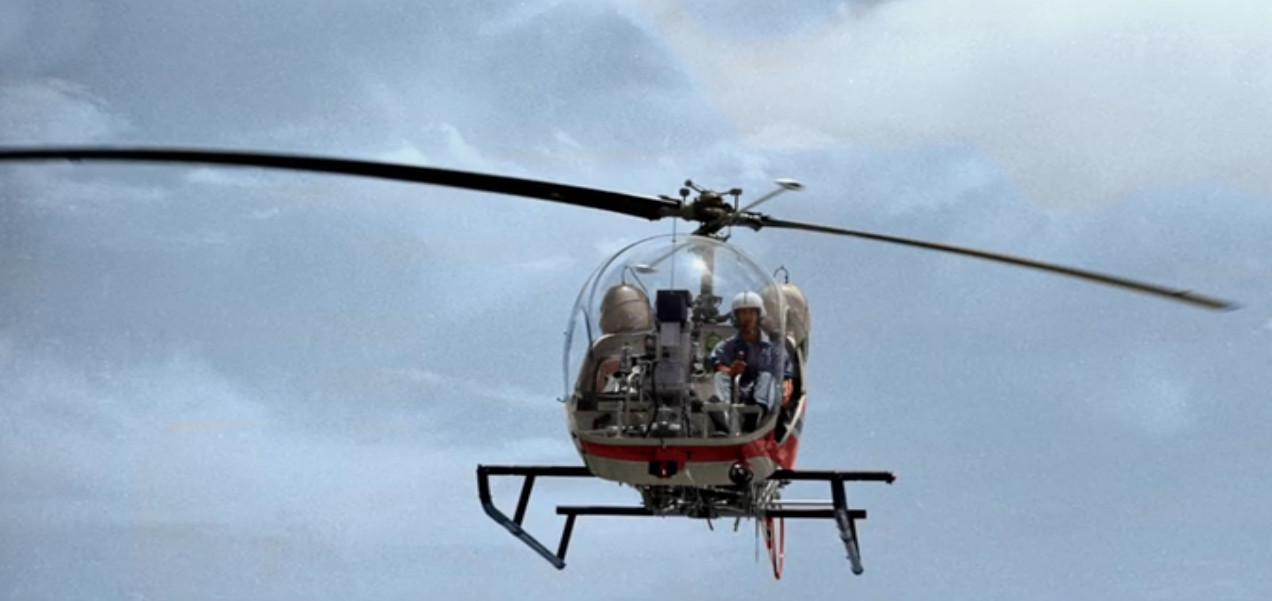 | | Cernan piloting a Bell 47 |
"We Choose to Go to the Moon..." Nine months after the “successful failure” of the Apollo 13 mission to the moon, Apollo 14 - the eighth manned mission in the Apollo program and the third mission to land on the Moon – was preparing for launch on January 31st, 1971. The mission's commander, naval commander Alan Shepard, was a veteran astronaut – but only with a total of 15 minutes, and 22 seconds experience. With him, on their first missions into space, were Stuart Roosa, as the Command Module Pilot, and Edgar Mitchell as the Lunar Module Pilot. With millions of dollars of equipment and planning at stake, NASA always maintains a backup crew, training in the same procedures and techniques, at the same time as the primary crew. For the Apollo 14 mission, the backup crew consisted of Gene Cernan as mission commander, Ronald Evans as the Command Module Pilot, and Joe Engle as the Lunar Module Pilot. "Beep-Beep" As a part of his Lunar Module training, Cernan flew several helicopter simulations, in order to keep his skills sharp in the event of the primary crew's inability to man the mission. Shortly after 9 AM, on January 23rd, 1971, Cernan took off from Patrick AFB for a short, one-hour, practice flight in a Bell 47G helicopter. Flying south from the base along the Banana River, he continued offshore over the Atlantic Ocean before turning west toward the Florida town of Malabar. As he overflew the middle of the Indian River, he charged his flight path to the northwest, while cruising at about 300 feet altitude. Cernan continued a gradual descent until the helicopter's left skid caught the water between a small island and the west shore of the Indian River. Impact! Bill Quinliven, who lived on the banks of the Indian River, just opposite the spot where the helicopter crashed, said the helicopter was hovering about four or five feet above the water when it suddenly plunged downward "with a terrific impact, tumbled upside down and the rotor flew off." "Within two or three seconds a fire broke out with an exploding 'swoosh'," he said "It burned very violently. I called to my wife to phone the sheriff and got my binoculars. Within one or two minutes I saw a person in the water. He appeared to be all right." The main rotor, tail boom and plastic canopy separated from the helicopter on impact, and the right fuel tank ruptured, and then ignited. The helo, still upright, then settled to the bottom of the river, in six feet of water. Cernan released his straps, surfaced, and swam upwind from the fuel fire. Cernan nearly drowned because he was not wearing a life vest and received some second-degree burns on his face and singed hair. 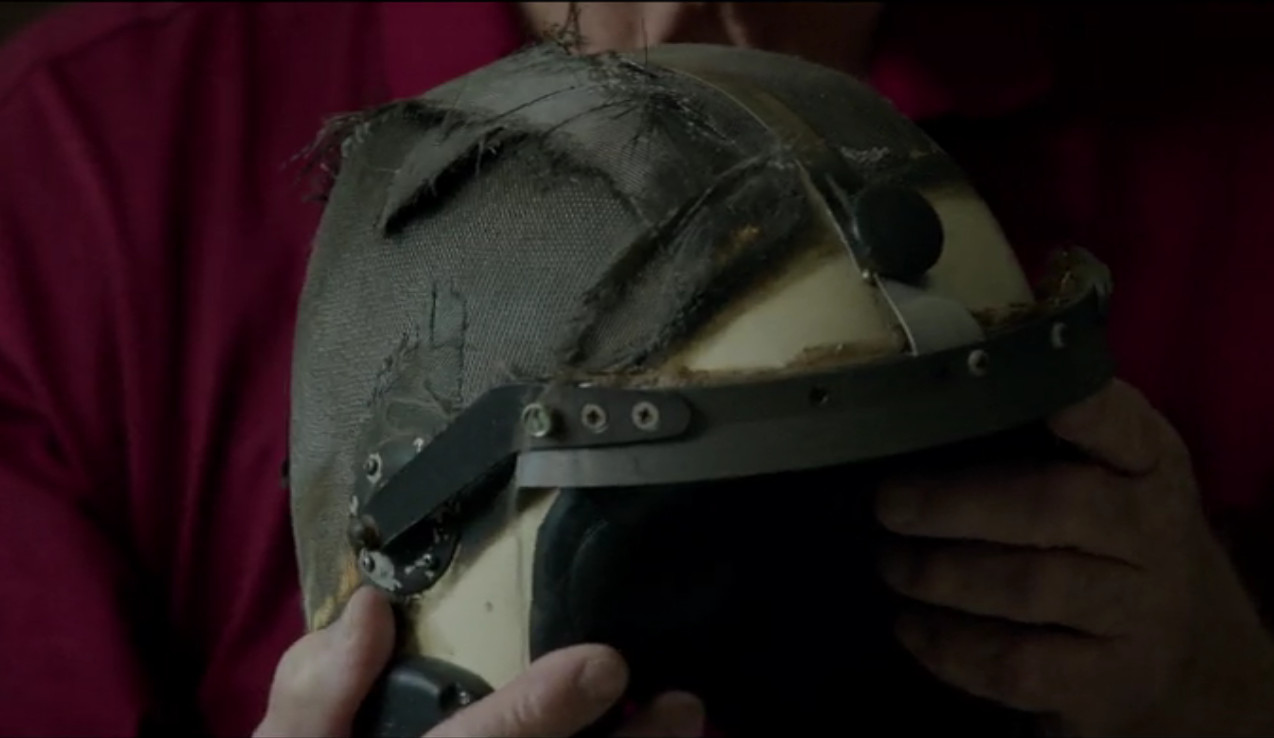 | | Cernan's flight helmet - after the crash. Note the charred top |
Terry Dickerson, a 19-year-old, was fishing in a boat with his mother, sped to Cernan's aid and took him to a marina where sheriff's deputies rushed him to the clinic back at Patrick Air Force Base "When we got there he was just floating in the water a little ways from the wreck," Dickerson said "He seemed shook up but not in shock or anything like that It was pretty cold so we gave him a windbreaker " Dr John T. Teegan, who examined Cernan, said he was "totally alert, and generally in fine condition following the accident. There is nothing to indicate any form of medical treatment other than observation Investigating the Cause... Astronaut James A. Lovell, the mission commander from Apollo 13, was the chairman of the investigative board, with other members of the investigating team being: Conway H. Roberts, Aviation Safety Officer at the Manned Spacecraft Center; Harold E. Ream, Senior Manned Spacecraft Center Pilot; Dick M. Lucas, Chief of Manned Spacecraft Center's Aircraft Maintenance and Quality Assurance Branch; and Astronaut Alan L. Bean. On October 18, 1971, a NASA press release stated that “misjudgment in estimating altitude” was the primary cause of the crash. The board listed possible mitigating factors which may have contributed to Cernan's failure to realize that he was flying into the water. These included a lack of familiar objects on the river surface to help him judge altitude, possible visual focusing on a false water surface because of the water's millpond smoothness and a change in sun reflection on the water cause by the change in course just prior to the accident. The board also conjectured that Cernan's extensive experience with high-speed aircraft may have contributed to his altitude misjudgment. The thought goes: the lower a pilot flies in a jet aircraft, the faster the surface appears to pass by. The effect is not as pronounced in a slower aircraft such as a helicopter. Reprecussions... James McDivitt, an Apollo Manager at the time, demanded that Cernan be removed from flight status and not be given command of Apollo 17, as the master Apollo manning plan called for. However, Cernan was defended by the chief astronaut, Deke Slayton, and given the Apollo 17 command. Upset by the decision, McDivitt resigned as an Apollo Manager shortly after the Apollo 16 mission in June of 1972. Gene Cernan went to the moon on the final mission of the lunar Apollo program. Cernan became "the last man on the moon" since he was the last to re-enter the Apollo Lunar Module during its third and final extra-vehicular activity (EVA). Shortly before his final steps, he spoke these immortal words: "As we leave the Moon at Taurus-Littrow, we leave as we came, and God willing, as we shall return, with peace and hope for all mankind. As I take these last steps from the surface for some time to come, I'd just like to record that America's challenge of today has forged man's destiny of tomorrow. Godspeed the crew of Apollo 17." Regarding his 1971 helicopter accident: in later accounts, one of which was written by Cernan himself in an autobiography, it is revealed that Cernan was flying too low and showing off for nearby boaters. Cernan often describes the experience as "Mr. Toad's Wild Ride." In 1976, Cernan retired both from the Navy as a Captain, and from NASA, going into private business. His career in aviation remained relatively calm, until a 2001 trip to the Czech Republic... when Cernan was flying, as a passenger, on another helicopter (story coming soon). | |
|