"One More Roll" - The Crash of Flint River 605 In the Gulf of Tonkin, near North Vietnam 03 February 1966 A Very Lonely Place... One night during a bombing raid on Hanoi, Prisoner of War (POW) Lt. Gerald Coffee peered out of his cell window at the 'Hanoi Hilton' prison and watched a flight of four F-105 "Thunderchiefs" during their bombing run. As they pulled up, it was obvious the lead plane was badly hit. Trailing smoke, he broke from the formation and Coffee watched the damaged Thud until it disappeared from sight. Naturally, he presumed the worst. As he lay there in his cell reflecting on the image in his mind, he composed a toast to the unfortunate pilot and all the others who had gone before and since him. Later, on New Years Eve, 1968, a fellow POW, Air Force Captain Thomas G. Storey (who's Air Force RF-4C Phantom had been shot down January 16th, 1967) and Coffee were in the Stardust section of the prison. Coffee whispered the toast under the door to Storey, who was enthralled and despite the risk of terrible punishment, insisted that Coffee repeat it several more times until he had it engrained in his memory. Storey then promised Coffee that, when the time came and they were again free men, he would give the toast the first opportunity he had. It would be something to look forward to, as the two men had arrived in that place via less modest means... A Very Public and Escalated War... Two months after the mid-November of 1965 “Battle of Ia Drang”, the United States had become fully invested into making the war in Vietnam a military success. Since March of 1965, the U.S., along with South Vietnam, had been conducting a massive aerial bombardment campaign, called “Operation Rolling Thunder”. The operation called for intense bombing of the manufacturing and transportation infrastructure of North Vietnam. Such as campaign would require vast amounts of intelligence being gathering, in order to assess and prioritize targets. After graduating from University of California at Los Angeles with a degree in Advertising Art, Gerald L. “Jerry” Coffee, a native of Modesto, California, joined the U.S. Navy, and entered flight training in the fall of 1957 (as well as became married to his wife Bea), earning his wings in August 1959. Flying the Chance-Vought RF-8A, an unarmed photo-reconnaissance version of the Navy's single-engine aircraft carrier-based fighter, he operated out of Cecil Field in Florida, and had been deployed twice aboard the USS Saratoga (CV-60) in the Mediterranean Sea. When the Cuban Missile Crisis sprung up in the fall of 1962, Coffee flew reconnaissance flights over Cuba, for which he received the Distinguished Flying Cross. Afterwards, he cross-trained as an instructor in the Vigilante RA-5C training squadron in Naval Air Station Sanford in Florida. But in late 1965, he was assigned to Reconnaissance Squadron 13 (RVAH-13) on board the USS Kitty Hawk (CVA-63), flying RA-5Cs on recon missions over North Vietnam.
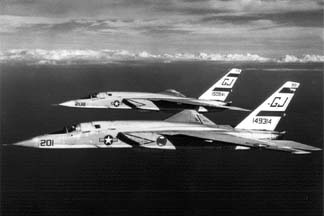 On February 3rd, 1966, only a little over a month after his arrival aboard the carrier, he and navigator, Lt. Robert T. Hanson, assigned the callsign “Flint River 605”, were on an intelligence gathering mission against a heavily defended portion of North Vietnam. After their first photo run of their target, they radioed that they were going to overfly it one more time. On February 3rd, 1966, only a little over a month after his arrival aboard the carrier, he and navigator, Lt. Robert T. Hanson, assigned the callsign “Flint River 605”, were on an intelligence gathering mission against a heavily defended portion of North Vietnam. After their first photo run of their target, they radioed that they were going to overfly it one more time. At 1313 local time, their aircraft, a RA-5C, Naval Bureau #151625, was hit by enemy fire. The primary damage, a hydraulic system failure, caused Coffee to lose control of the plane, and it spun out of control. It was observed to explode as it hit the water near the coast of North Vietnam, east of Nghe An Province, near Cap Bouton. No parachutes were seen, but the broadcast from an emergency survival radio beeper was heard by an escorting aircraft, callsign "Black Lion 112", and based on this information, a Search-And-Rescue (SAR) effort began. In what the North Vietnamese later called "The Battle of Quynh Luu", the naval destroyer Brinkley Bass (DD-887) and guided missile destroyer Waddell (DDG-24) fought against the North Vietnamese, with the Waddell taking the bunt of the counter-attack. In total, 33 Navy and Air Force aircraft were diverted to suppress enemy fire while an Air Force Grumman HU-16 "Albatross" attempted to locate the downed crew. However, no sign of the downed aviators were spotted by the American forces. Feet Wet... But, nevertheless, both Coffee and Hanson had successfully ejected and parachuted into the waters of the Gulf of Tonkin. Years later, Coffee, in the Naval publication “Capativity: The Extreme Circumstance,” he recalled one of the first sensations that experiencing immediately following his shoot down was “the feeling of floating in a sun-drenched ocean and the sounds of a loudspeaker in the distance announcing speedboat rides." For just a few moments, he imagined that he was back in the San Joaquin Valley, swimming next to his wife, Bea. He further imagined that he saw her dive beneath the surface, and she seemed to be pulling him down with her. His attempts to free himself were futile, because, for some reason, his right arm would not move. "What kind of fantasy was this? Where was Bea? What had become of the speedboats, and the amusement park, and the rides?” 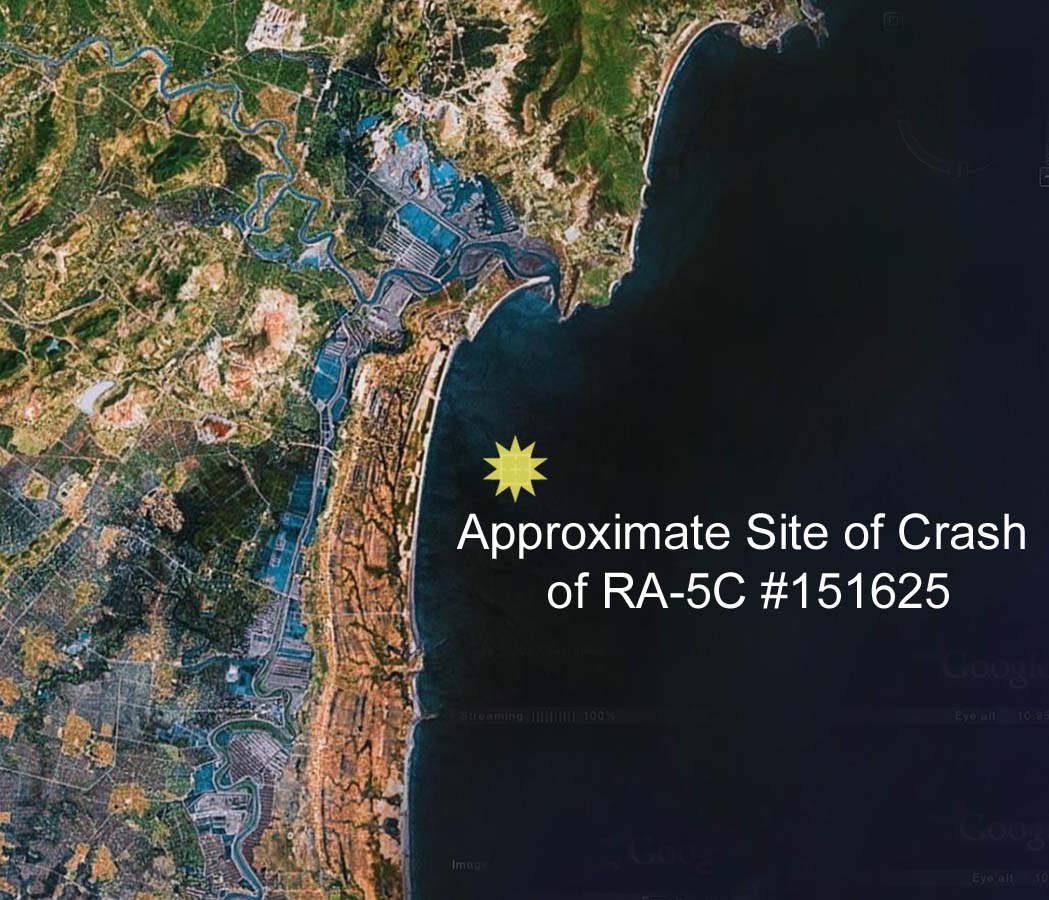 Both Lt. Coffee, who had endured a broken right arm & dislocated elbow, and Hanson successfully ejected and parachuted into the gulf. Several vessels were put out from the shore to capture the crewmen. Coffee was picked up by militiamen in one of the boats, the same Vietnamese who, moments before, had nearly killed him by firing a barrage of bullets into the water. He was now a Prisoner of War (POW). Both Lt. Coffee, who had endured a broken right arm & dislocated elbow, and Hanson successfully ejected and parachuted into the gulf. Several vessels were put out from the shore to capture the crewmen. Coffee was picked up by militiamen in one of the boats, the same Vietnamese who, moments before, had nearly killed him by firing a barrage of bullets into the water. He was now a Prisoner of War (POW).
Lt. Coffee recalled that he had seen his navigator alive in the water about 12 meters away and thought that he had been picked up in one of the other boats. Lt. Coffee also reported that, shortly after his capture, a guard indicated by gestures that Lt. Hanson was dead and had been buried on the beach. Coffee was shown his identification card. As Coffee was transported to Hanoi by night, bound for the infamous Hoa Loa Prison, he was severely tortured by the guards, at one point subjecting him to a mock execution. He was tied around the trunk of a tree, as a firing squad appeared. The signal was given in Vietnamese, "Ready, aim, fire." The slug from an M-1 came roaring toward Coffee's head, splintering the tree trunk next to his ear. A month after his capture, Lt. Coffee was permitted to tape record a letter to his wife, when he informed her that the prisoners could receive one letter a month addressed to "detention camp for captured American pilots in the Democratic Republic of Viet Nam."
Life in the "Hanoi Hilton"... 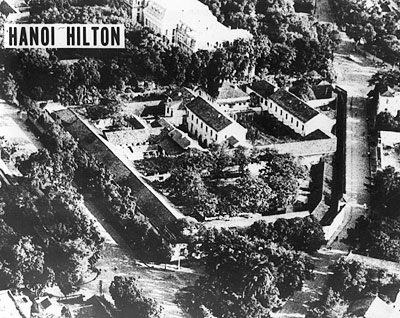 The conditions were miserable at Hoa Loa, and the POWs were fed food so bad that the prison was sarcastically nicknamed the "Hanoi Hilton," in reference to the upscale Hilton Hotel chain. The conditions were miserable at Hoa Loa, and the POWs were fed food so bad that the prison was sarcastically nicknamed the "Hanoi Hilton," in reference to the upscale Hilton Hotel chain.
He was heavily interrogated by the North Vietnamese. But, being bound by the American Military Fighting Man's Code of Conduct, the rules of the Geneva Convention, and his loyalty to the United States , he repeated only his name, rank, serial number and date of birth. Shortly before his release, an article in the February 1, 1973 edition of “Quan Doi Nhan Dan,” a daily Vietnamese paper, described the February 3, 1966 shoot-down, and stated that, "The militia ...managed to bring the two enemy pilots to shore." Hanson and Coffee's plane was the only aircraft lost within 45 miles of the Gulf of Tonkin that day. On February 12, 1973, Lt. Coffee was part of the first group of Prisoners of War released as a part of “Operation Homecoming” - the first flight of 40 U.S. prisoners of war left Hanoi in a C-141A. 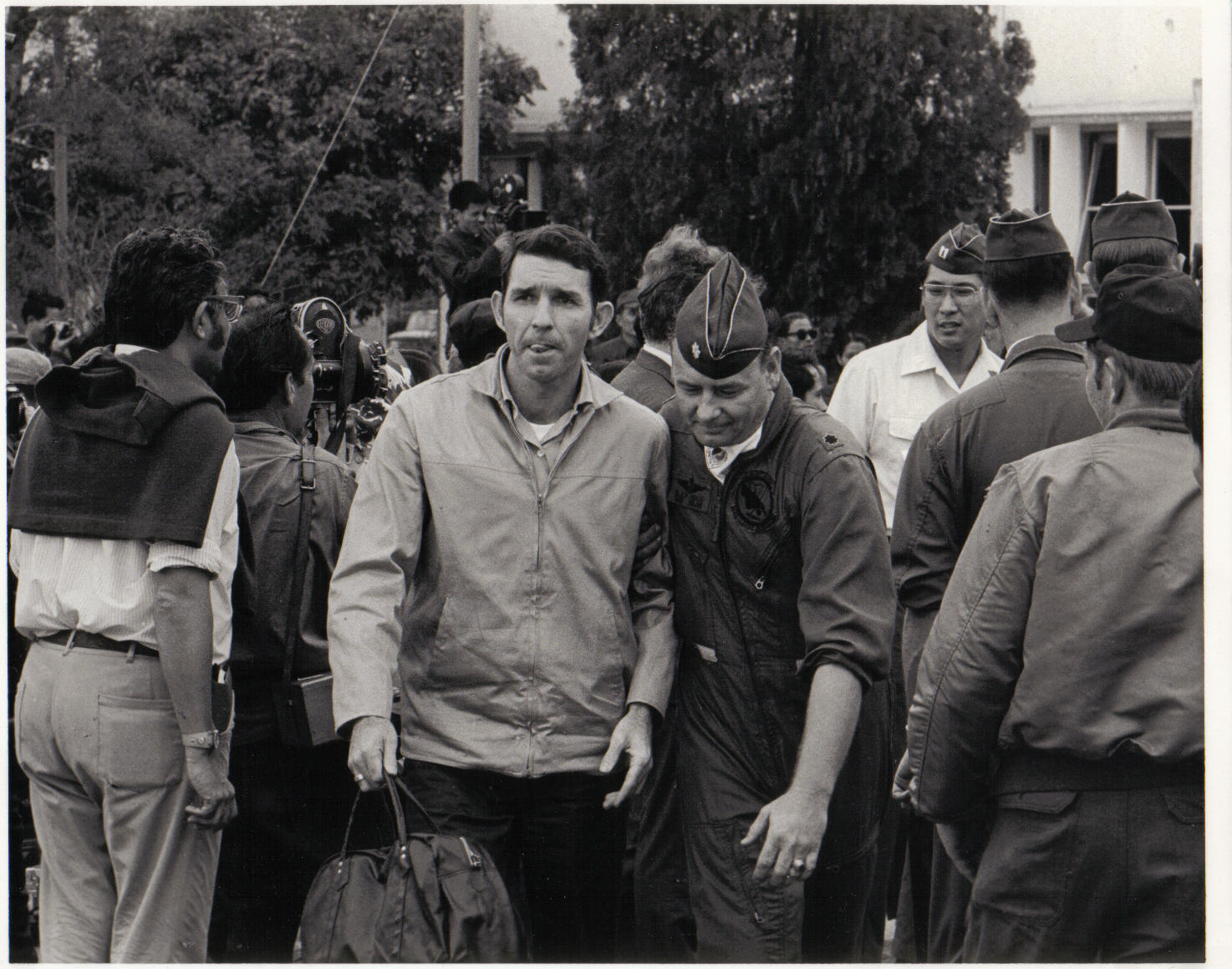 He had been held in captivity for 2566 days. He had been held in captivity for 2566 days. But only 591 POWs were released as a part of the negotiations. Another 2,100 personnel are listed as "Missing-in-Action" and many of them were last seen alive and in the hands of the North Vietnamese Army or the Pathet Lao. Hanson was expected to be among those released, but he was never seen alive again.
After “Homecoming”
Eight of ten squadrons of RA-5C Vigilantes also saw extensive service in Vietnam starting in August 1964, carrying out hazardous medium-level reconnaissance missions. Although it proved fast and agile, 18 RA-5Cs were lost in combat: fourteen to anti-aircraft fire, three to surface-to-air missiles, and one to a MiG-21 during Operation Linebacker II. Naval Reconnaissance Squadron 13 disbanded on June 30th, 1976. Storey’s first assignment following release in 1973 was to the Air Force Academy. During that same year, the Academy was host to the annual Air Force conference for General Officers and the associated Dining-In, an Air Force tradition. Somehow, Storey found himself seated with General Curtis Lemay and Jimmy Doolittle. As expected, the cheery clinking of glasses accompanied all the habitual speeches and toasts. Then it was Storey’s turn. Remembering his promise so many years ago, he proposed Coffee’s toast; now named “One More Roll...” When he was finished, there was total silence. | “One More Roll...” By Gerald Coffee - Hanoi - 1968 We toast our hearty comrades who have fallen from the skies, And were gently caught by God’s own hands to be with him on high, To dwell among the soaring clouds they have known so well before, From dawn patrol to victory roll, at Heaven’s very door And as we fly among them there, we’re sure to hear their plea, "Take care my friend, check your six, and do one more roll for me” |
On January 21st, 1974, Hanson, who had been promoted to Lieutenant Commander while his status was “Missing in Action,” was legally declared dead. On November 3rd, 1988, the Vietnamese, who had previously denied knowledge of Lt. Hanson, "discovered" and returned his remains to American authorities, who positively identified them as Hanson's on February 17th, 1989. His name appears on Panel 04E, line 135, of the Vietnam War Memorial in Washington DC.
|