Gagarin and Seregin… Near Kirzhach, Soviet Union (now Russia) March 27, 1968 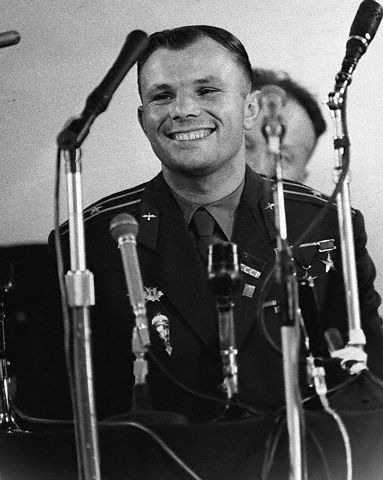 Hero of the Soviet Union... Hero of the Soviet Union...
It was a flight on a training combat plane. In the instructor pilot's cockpit was test pilot Vladimir S. Seregin who was instructed to check on Colonel Gagarin's preparedness for the resumption (after an eight-year-long interval) of independent flights on a fighter. Gagarin's resumption of flights could have given the start to a new fruitful period in his life. Many people say that he was tired of being a celebrated figurehead, of being demonstrated as a "museum relic". He dreamed of the second space flight, more challenging and a lengthy one. Eventually, Gagarin managed to get enrolled into a team of the first experimental space station.
At 10:19 in the morning, Colonel Gagarin, in the front seat and Seregin, in the back seat, took off on a training flight and in their MIG-15, serial number 612739 and callsign "625". The plane into the air moments after completing a re-confirmation radio exchange.
Seregin was a senior test pilot and decorated military hero who had flown more than 200 aircraft combat missions during World War II. The MiG the duet was flying was built at the Vodokhod factory in Czechoslovakia and delivered on March 19,1956. Over its service life, it had a 2100 hours on the airframe life, and had flown 1113 hours. The plane was flying between two thick layers of clouds. At 10.30, Gagarin completed an exercise and received an okay for flying back to base, landing at an airfield northeast of Moscow near the astronauts' training center at Zvyozdny Gorodok, or Star Town. They were at an altitude of 16,380 feet, between two layers of clouds, and were unable to see the ground.
On the radio from the control tower the two pilots heard that the altitude of the lower cloud layer was 3,500 feet - although, in reality it was 1,550 to 1,950 feet. After that communications broke off.
While Colonels Gagarin and Seregin were making their approach, a much larger jet, the Su-15 'Fishpot-C', passed within 2,000 feet of them. Its pilot was apparently unaware of the close call, but the turbulence of the Su-11's powerful jet wash sent the MIG-15 into an almost vertical dive.
In the Clouds...
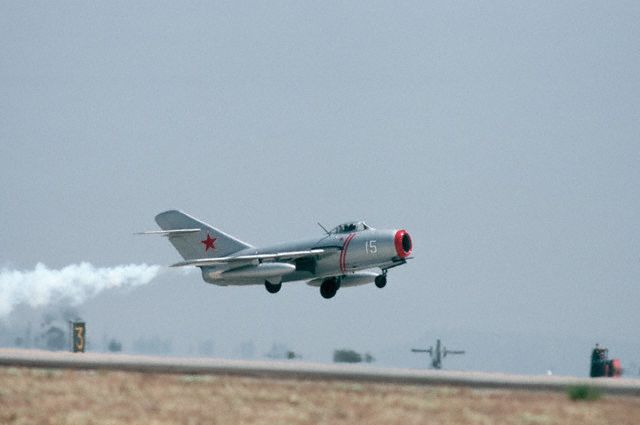 Still in the clouds, Colonels Gagarin and Seregin could not see the ground, but on the basis of the flight controller's latest information, they believed they were high enough to pull out of the dive without emergency measures. When they finally came out of the clouds it was too late by two seconds. Still in the clouds, Colonels Gagarin and Seregin could not see the ground, but on the basis of the flight controller's latest information, they believed they were high enough to pull out of the dive without emergency measures. When they finally came out of the clouds it was too late by two seconds. Aleksey Leonov, a fellow cosmonaut and friend of Gagarin, was training nearby for a potential lunar mission. "When I was in the air they asked me to radio Gagarin's plane. There was no answer. And when I landed I found out that it had been 45 minutes since they ran out of fuel and Gagarin had not come back to the base. I ran to the control tower. General Kamanin was already there and told me they were thinking the worst. They got a hold of Kirzhach and sent a helicopter there. It found traces on the ground. In two hours the search party was already there." By the evening of the same day the fragments of the plane and the remains of the pilots were discovered in a forest. Leonov recalled: "They found Seregin's remains right away. But they only found Yuri's wallet and his map board. So initially they thought that may he had catapulted. They were looking for him all night. In the morning they found pieces of his jacket. Then they knew for sure that Gagarin and Seregin had been killed." The investigators searched the area by plane, hunting the pilots' white dome-like parachutes - but they were nowhere to be found. The team later found the crater in the thick of the snow-laden forest. Within 6 hours, they cordoned off the crash site. The first specialists to examine the area on March 28 were shocked. The crew had no parachutes. Their straps were not torn. They had been cut off deliberately.
Digging for the Cause... The "State Panel for Determining the Circumstances Surrounding the Death of Soviet Pilot and Astronaut, Hero of the Soviet Union Colonel Gagarin and Hero of the Soviet Union, engineer and Colonel Seregin" was established by the Soviet Central Committee on March 28 – the day after the crash. The Panel consisted of four sub-commissions: - Flight Sub-Commission: examining the crew's flight preparation, checking the pilots' organization and safety on March 27;
- Engineering Sub-Commission: examining and analyzing the MiG-15UTI aircraft;
- Medical Sub-Commission: evaluating the pilots' condition before and during the flight, and the official identification of the deceased;
- KGB Sub-Commission: determining if the catastrophe was the result of a conspiracy, terrorism, or malicious Intent
Broken pieces of the MiG-15UTI were saturated in fuel, mixed with snow and dirt. Soldiers combed the forests repeatedly searching for clues of what transpired. They searched up to 5 kilometers from the crater to the east, south and west; and up to 12 kilometers to the north. Three days after the crash, KGB officers found the missing parachutes. The parachutes were found in one of the villages nearby. Villagers had found the crash site and cut the cords off and stole the parachutes thinking that their fabric could come in handy some day. The budding green grass was trampled by mid-April over a radius of three kilometers from the crater. The ground was combed with a tiny sift nearby. Remarkably, investigators were able to gather 90 percent of the aircraft. After the investigation, all the found parts of the wrecked MiG-15UTI were collected and stored in sealed barrels. State Honors... 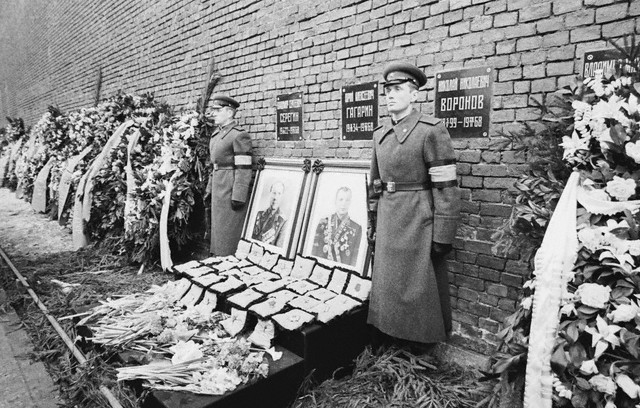 The remains of Gagarin and Seryogin were buried in the walls of the Kremlin on Red Square, amidst a huge state funeral. The remains of Gagarin and Seryogin were buried in the walls of the Kremlin on Red Square, amidst a huge state funeral.
Enquiries continued for more than a year and did not produce a clear answer. All cosmonauts flight training was suspended. In December of 1968, the State Commission investigating Gagarin's crash publishes it report citing that pilot error put the aircraft into a critical situation.
Nikolai Kamanin, the head of cosmonaut training in Soviet space program and the person ultimately responsible, received a formal reprimand. Without Gagarin and without any prospects of winning the space race, his own influence and influence of Soviet Air Force on the space program deteriorated - while American lunar program was steady under way. He retired in 1971.
Lingering Questions... The answer to the cause of the crash has never been fully revealed or determined - due in part to Soviet state secrecy. Numerous theories have been advanced over the years, from a bird strike to crew drunkenness. A1986 inquest suggested that the turbulence from a Su-11 ‘Fishpot-C’ interceptor using its afterburners may have caused Gagarin’s plane to go out of control. But, in 2003, KGB documents that were declassified revealed that actions of air base personnel contributed to the crash. The report stated that an air traffic controller provided Gagarin with outdated weather information, and that when Gagarin flew, conditions had deteriorated significantly. 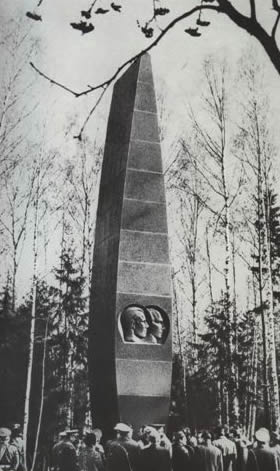 The documents also revealed that the ground crew also left 260 liter external fuel tanks attached to the aircraft. Gagarin’s planned flight activities needed clear weather and no outboard tanks. The investigation concluded that Gagarin’s aircraft entered a spin, either due to a bird strike or because of a sudden move to avoid another aircraft. The documents also revealed that the ground crew also left 260 liter external fuel tanks attached to the aircraft. Gagarin’s planned flight activities needed clear weather and no outboard tanks. The investigation concluded that Gagarin’s aircraft entered a spin, either due to a bird strike or because of a sudden move to avoid another aircraft.
In 2005, an original investigator into Gagarin's mishap, Igor Kuznetsov, hypothesized that a cabin air vent was accidentally left open. "The half-opened cock and the quick descent in diving was not the crew’s fault," Kuznetsov said. "The cock could have been left open either by the technician or the pilot who flew the plane before Gagarin. The men acted strictly according to instructions." In 2007, the Kremlin vetoed a new investigation into the death of Gagarin. At the plane's crash site, a memorial obelisk and park has been erected, in memory of the two aviators. |