Frank Hawks and the Gwinn Aircar Near East Aurora, New York August 23, 1938 Taking Flight to the People... In the later days of the “Golden Age of Aviation,” the interbellum period between World War I and World War II, many aircraft manufacturers were developing, designing, and building low-cost "everyman's airplanes." The idea was to bridge the gap between automobile driving and flying an airplane. 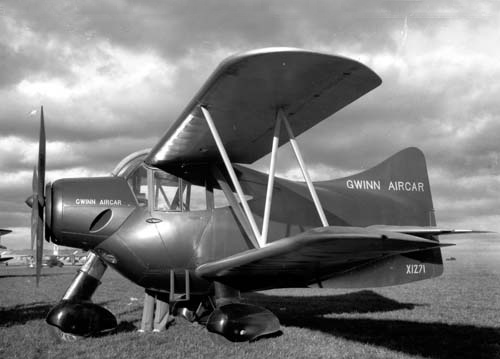 It was the opinion of designer Joseph M. Gwinn, Jr. that the major problem keeping the driving public from becoming the flying public was the need for the pilot to coordinate the operation of both the wing control surfaces and the tail control surfaces. He created a design while at Consolidated Aircraft in Buffalo, New York, but when the company decide not to sponsor it, he left his job there and formed this own company. Subsidized by the U.S. government in 1937, Gwinn's resulting design was the Aircar. It was the opinion of designer Joseph M. Gwinn, Jr. that the major problem keeping the driving public from becoming the flying public was the need for the pilot to coordinate the operation of both the wing control surfaces and the tail control surfaces. He created a design while at Consolidated Aircraft in Buffalo, New York, but when the company decide not to sponsor it, he left his job there and formed this own company. Subsidized by the U.S. government in 1937, Gwinn's resulting design was the Aircar.
The “Model-T of the Air”... With its wooden-frame, 24-foot wide wingspan, and a metal semi-monocoque fuselage, the Aircar was among the first designs to have a tricycle landing gear. It also had side-by-side seating for two, a steering wheel on the top of a control stick in front of the left-seat pilot that worked the wing-length ailerons, and had two throttles - one a pedal on the floor for driving and takeoff, and a traditional one intended for cruise flight. The design also had no rudder, and had limited function of the elevators. The design called for going full-speed down the runway with flaps up, then push the left pedal to the floor to put the flaps in takeoff position, forcing thhe Aircar to “jump” into the air, and letting the pilot slowly retract the flaps. Landing was achieved by a full-flap configuration, and the pilot slowly reducing the engine's power, all the way down the runway, and as the runway runs out, the pilot drives it off. It was affordable too, projected to costs $5000. Gwinn was able to built two prototypes of his Aircar. His first one, registered as NX1271, had a 90 horsepower British Pobjoy Niagara, a geared air-cooled radial engine, which he later had upgraded to 130 horsepower. The second prototype, registered as NC16921, was built with the same 130 horsepower Niagara V-7 engine, and featured several other upgrades over the prior prototype. But with a new idea, and an unrecognizable design, how do you sell the concept? 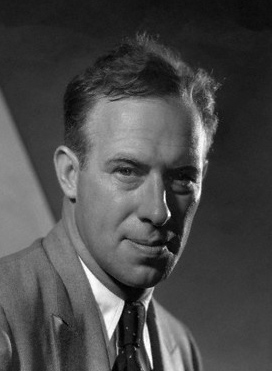 A Famous Face... A Famous Face...
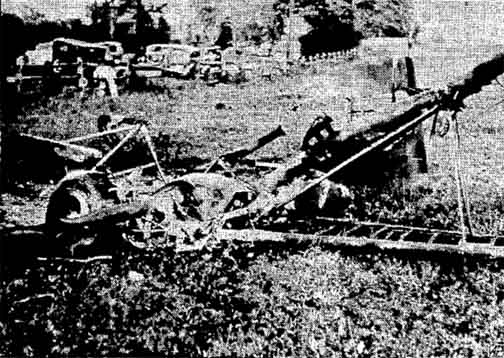
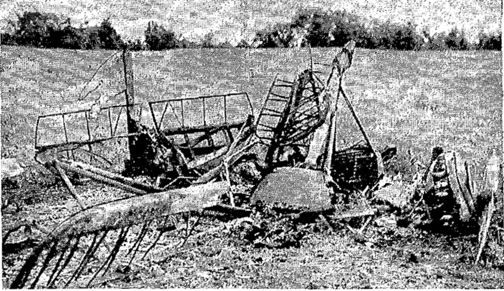
Born in 1897 in Iowa, and raised in California, Frank Monroe Hawks was one of the most recognized and talented air race pilots in the United States in the 1930s. As a boy in Long Beach, he used a ruse to reach the airways. He posed as a newspaper reporter, offering publicity to get a ride with a barnstorming flier. He confessed after he came down, and the pilot permitted him to be a ground assistant. He would go on to serve in World War I as a flyer. In many circles though, Hawks was best known for, in December of 1920, taking a 23-year-old Amelia Earhart on her first airplane ride, lasting ten minutes, at the airfield in Long Beach. In 1933, he set the west to east transcontinental airspeed record in his Northrop Gamma, flying from Los Angeles to Floyd Bennett Field, Brooklyn, New York in 13 hours, 26 minutes, and 15 seconds. It is said that he held as many as 214 point-to-point speed records in the United States and Europe. In 1937, Hawks retired from speed competition to his home in Redding, Connecticut, saying "I've had my day. I passed the 40-year mark the other day and I've decided to take it easy now." At the same time, Gwinn offered the vice-presidency, in charge of sales, of his company to Hawks, in order to lend credence to the design, which received Civil Aeronautics Authority Approval with Type Certificate 682. In trade, Hawks got to fly the Aircar to airports throughout the Eastern Seaboard to pitch the plane to the consumers that would buy and fly it. "Fool-proof," is how Frank Hawks described the Gwinn Aircar. "It will not spin and it will not stall. . . . With only an hour or two of instruction any average person (even the intelligentsia) can fly our ship. . . . A development that should go down in history as the greatest aviation contribution since the advent of the Wright Brothers." Fate Catching Up... On the afternoon of August 23rd, 1938, Hawks and his friend, M.R. Carlin, landed on the polo field of Edmund P. Rogers. Hawks offered to take Rogers or any of his guests for a ride. J. Hazard Campbell, 37, a New York stockbroker and a director in the Gwinn corporation, had returned from a trip to France the previous April, and was the first to climb aboard. "(Hawks) said he'd rather fly one of these than any other plane," Carlin said. "He had given up all other pilot ratings but the one he used on the Aircar." A few minutes before the takeoff, a friend gave Hawks a four leaf clover, for "good luck". With Hawks flying against a crosswind, Rogers recounted what happened next to news reporters: "The plane lifted in the air and Hawks tilted it 50 feet above the ground to enable it to pass between two tall trees. As he passed out of sight it looked as though he had not been able to gain sufficient altitude and was trying to bring the plane down.” The plane's wheels dangled into telephone and power lines, caught fire, and was hurtled, nose-over-tail, to the ground on the polo field of Seymour Knox, an internationally known polo player, and Campbell's brother-in-law, where it exploded. Onlookers pulled Hawks from the controls of the blazing ship and dragged Campbell from beneath a crumpled and burning wing, but the broken telephone wires forced the delay of hospital aid. Three hours later, at the hospital in Buffalo, Frank Hawks died. Campbell also died of the injuries he sustained in the crash. 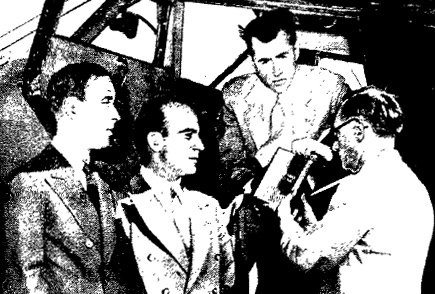 One Final Flight... One Final Flight...
Hawks' remains were cremated, in accordance with his final wishes, and the bronze urn carrying his ashes were carried by his private plane, piloted by Richard Benson, to his home in Redding, Connecticut, where it was buried. The resulting publicity effectively spelled the end for the Aircar. Joseph Gwinn closed his factory and went back to work at Consolidated and was able to persuade the company to build another easy-to-fly personal airplane, the Convair Model III, in 1946, but it was never put into production. Gwinn passed away in October of 1956 in Los Angeles, California. |