The Luck of the Kennedys Near Southhampton, Massachusetts June 19, 1964 The Youngest of Camelot... Born in the Boston suburb of Brookline in 1932, Edward “Ted” Kennedy was the youngest of the nine children of Joseph P. Kennedy - the American ambassador to the United Kingdom. Ted's oldest brother, Joseph P. Kennedy Junior, was killed during World War II, and his second-oldest brother, John F. Kennedy, was elected President in 1960. The next oldest, Robert F. Kennedy, was appointed Attorney General in 1961, and Ted Kennedy was elected to the United States Senate, from his home state, in 1962. 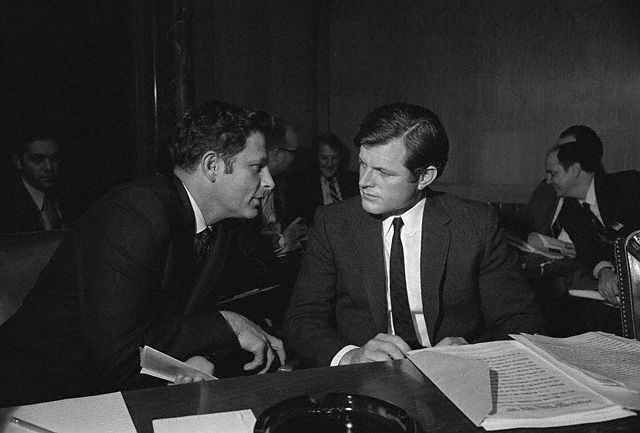 | Senators Birch Bayh (D-Indiana) and Ted Kennedy (D-Mass.) |
Senators Kennedy and Bayh had reason to celebrate - after 83 days of debate, the Civil Rights Act of 1964 had passed, with a vote of 73-27, in the Senate, and the pair were flying from Washington National Airport, headed to the Massachusetts State Democratic Convention, where Kennedy had planned to be on hand to accept his Senate re-nomination, followed by a weekend of speaking engagements. The junior senators, from Massachusetts and Indiana respectively, were accompanied by one of Kennedy's aides, 41-year-old Edward Moss, and Bayh's wife, Marvella. The plane, an Aero Commander 680, registered as N344S, was being flown by pilot Edwin T. Zimny, a 48-year-old commercial pilot, flight instructor, mechanic, and owner / operator of Zimny's Flying Service, of Lawrence, Mass. The plane's owner, Daniel E. Hogan – also from Lawrence – would lend the plane to the senators for their use to and from the District of Columbia. Things Are Not Always As They Appear... The Weather Bureau said visibility was less than 2 and a half miles and conditions were "marginal" even for an instrument landing by a plane. Shortly after 11 at night, and just before landing at Barnes Municipal Airport in Westfield, Massachusetts, the twin-engine plane made a sharp right turn. "My first thought," he said later, "was that the plane had been hit by lightning." He looked cautiously about. "I saw black things outside my window," he recalled. "I could see car lights, but the plane then began a steep climb.” Then the plane went down in the apple orchard atop a hill about three miles short of the runway. Senator Bayh pulled a badly injured Senator Kennedy from the wreckage, but Zimny and Moss were both trapped in the wreckage. Robert Schauer, who lived about a quarter-mile away from the crash site, was one of the first on the scene and commented about it later to news reporters. "There was Ted Kennedy laid out flat beside the wreckage of the plane - in deep pain ... but he was more concerned with the comfort of the others. When I reached the plane," Schauer said. "Senator Bayh was standing beside it trying to gel his wife out. I helped him and we got her free.” 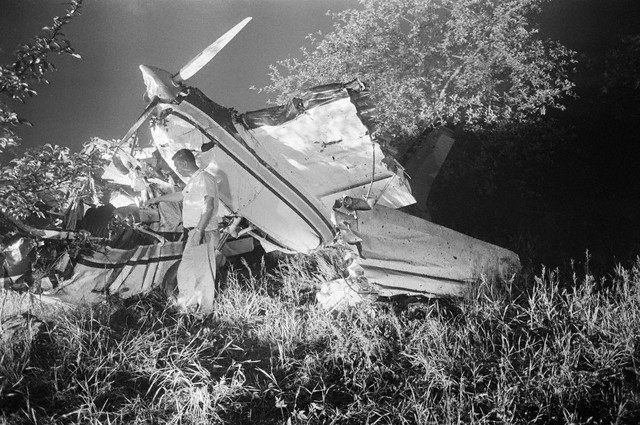 "Senator Kennedy said 'See that she's taken care of first.' He was on the ground near the plane. We walked Mrs. Bayh down the hill, her husband and I. We tried to get cars to stop for us, but 10 went by without stopping.” "Senator Kennedy said 'See that she's taken care of first.' He was on the ground near the plane. We walked Mrs. Bayh down the hill, her husband and I. We tried to get cars to stop for us, but 10 went by without stopping.”
According to Schauer, "I got them to my house, supplied blankets, called the police and fire departments and went back with some water for Senator Kennedy. When I got back to the plane, Senator Kennedy was still there. He was as cool as a cucumber. He said he had shoulder and back injuries.” Zimny was killed almost instantly in the crash, and Moss, who had been a New England Telephone Company executive before joining Kennedy's staff, died at 6:15 in the morning at the hospital while undergoing brain surgery. Assessments... Bayh stated that the plane's cockpit was "peeled right off and the nose was badly damaged." The plane was on its belly, the right wing nearly sheared off. The rose-colored plane, with black stripes, still had its red beacon light on the tail lit and rotating after the crash. When rescue workers got Kennedy to The Cooley Dickinson Hospital, he had no pulse and his blood pressure "was almost nonexistent." The doctors "took heroic measures including blood transfusions in a successful attempt to rally the failing senator and the efforts paid off," Press Secretary Edward Martin said, referring to the three units of blood and glucose that Kennedy was transfused with A team of army doctors flown from Walter Reed army medical center in Washington - lead by Brig. Gen. Henry S. Murphey - credited Doctor Thomas Corriden, the hospital's chief of staff, with saving Kennedy's life. 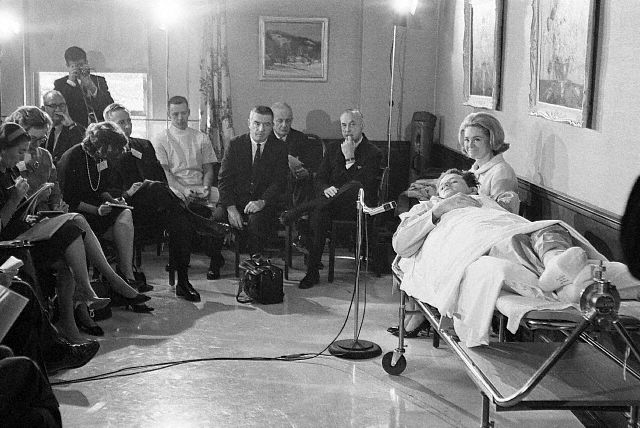
Taking the Pain... But Kennedy had to endure 10 days of immobility in an special orthopedic bed to permit his broken back, and two broken ribs, to heal, Senator Birch Bayh of Indiana suffered torn muscles in his right hip, and his wife suffered two small cracks in her lower back, extending into her spine. Schauer said also, "I heard the plane before it crashed. It was sounding normal. Then I heard it plow into the hill. I think they misjudged the hill. The plane was on top of the hill when I reached it." The Civil Aeronautics Board concluded that the probable cause of the accident was the pilot's improper operation in instrument conditions. |