Fights and Flights... The Crash of Rocky Marciano's Cessna August 31st, 1969 Near Newton, Iowa 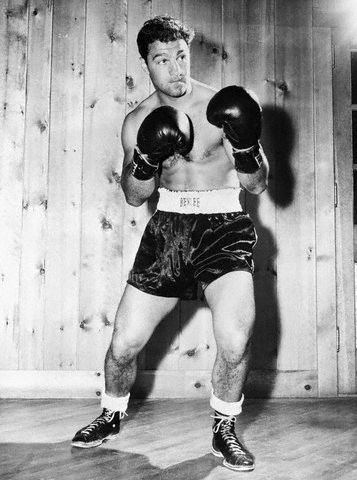 | Rocky Marciano in his prime |
The "Brockton Blockbuster"... Born in Brockton, Massachusetts, on September 1st, 1923, as Rocco Francis Marchegiano, Rocky Marciano was the heavyweight champion of the world from 1952 to 1956. The most popular boxer since Jack Dempsey, Marciano, an Italian-American with forty-three knockouts of his forty-nine victories, to his credit (at a knockout rate of 88%), remains the only heavyweight champion in boxing history to retire, without a defeat or a draw in his professional career. Marciano's last title bout was against Archie Moore on September 21st, 1955. The bout was originally scheduled for Tuesday, September 20th, but because of hurricane warnings it had to be moved to the 21st. Marciano was knocked down for two seconds, but he got up and knocked out Moore in the 9th round. Moore was also knocked down in the 6th and 8th round but was saved by the bell. There was a game before the boxing match and all the fights started late. When Marciano was proclaimed winner, it was already morning of September 22nd. Marciano announced his retirement from boxing on April 27th, 1956. He considered a comeback in 1959 when Ingemar Johansson won the heavyweight championship from then-champ Floyd Patterson in June of 1959. After almost a month of training, however, Marciano decided against it and never seriously considered a comeback again. After his retirement, Marciano moved to Florida, invested in restaurants, buying and selling boats, and dealing in real estate, apartments, and construction. And though many of his investments, such as buying Florida wetlands, were disastrous, he remained cheerful and genial - the money he gave to his friends was often not repaid, and Marciano would never say a word about it. He hosted a weekly boxing show on TV for a year and, for a brief period, he worked as a troubleshooting referee for wrestlers. He continued as a referee and boxing commentator in boxing matches for many years. Until, one day in 1967, when a Miami radio promoter and producer, Murry Woroner, had an idea... "The All-Time Computerized Heavyweight Champion of the World" | The original 8 boxer face-offs of the "All-Time Heavyweight Tournament & Championship Fight" | | Jack Dempsey vs Jim Corbett John L. Sullivan vs Jim Braddock Bob Fitzsimmons vs Jack Sharkey Jim Jeffries vs Joe Walcott Joe Louis vs Jess Willard Max Baer vs Jack Johnson Rocky Marciano vs Gene Tunney Muhammad Ali vs Max Schmeling | | Quarterfinals | | Jack Dempsey vs John Sullivan Joe Louis vs Bob Fitzsimmons Rocky Marciano vs Max Baer Jim Jeffries vs Muhammad Ali | | Semi-Finals | | Jack Dempsey vs Joe Louis Rocky Marciano vs Jim Jeffries |
Murry Woroner's idea was simple: Determine who the all-time great heavyweight champion of the world was - using a series of fantasy fights between boxing champions of different eras. Woroner sent out a survey to 250 boxing experts and writers to help determine which boxers would be used in the imaginary fights. Sixteen boxers formed 8 match-ups for the first round. Blow-by-blow details of the boxer's records during their prime were entered into an NCR 315 computer by Henry Meyer II. The NCR 315 was considered state-of-the-art at the time, with all printed circuit boards used resistor-transistor logic (vacuum tubes were still common in computers at the time) to create the various logic elements. The computer's base memory was 5k of hand-made core memory, which was expandable to a maximum of 40k in four refrigerator size cabinets. The main processor included three cabinets and a console section that housed the power supply, keyboard, output writer (a IBM typewriter), and a panel of lights that indicated the current status of the program counter, registers, arithmetic accumulator, and any system errors. The 58 factors programmed included such considerations as the boxer's strengths, weaknesses, fighting styles and patterns and other factors and scenarios that the boxers could go through were converted into formulas and entered into the memory banks of the computer built by the National Cash Register company. It took over 18 months for the computer, with over 160,000 "memory" positions, to determine the outcome of every round of each fight. Woroner's secret weapon, however, was Guy LeBow. A veteran radio announcer, the resulting "scripts" from the computer were read aloud, and set to the sounds of a live boxing match: crowd noises, the grunts and moans of boxers sparring, and the shuffle and crack of leather gloves, and then recorded for radio presentation. This became the backbone of a 16-week radio series, billed as the "All-Time Heavyweight Tournament and Championship Fight". The final match - which aired December 18, 1967 to an audience of 16 million, featured the fantasy bout between Rocky Marciano, and his hero in boxing, Jack Dempsey. In the 13th round, at 2:28 into it, Marciano floored Dempsey to the mat for the 6th and final time. Marciano won the match, and earned a gold and diamond championship belt, valued at over $10,000. But the fights were far from done... A Legend Returns to the Ring... Muhammad Ali, born Cassius Clay, was also a part of the computerized bouts, but was eliminated in the quarterfinals for Jim Jeffries. The electronic defeat stung the pride of the boxer, and Ali sued Murry Woroner, seeking $1 million in damages for defaming his reputation. However, Ali, who was 27 at the time, had been stripped of the heavyweight title a year earlier for refusing to be inducted into the U.S. Army. The suit was eventually settled in court for the token sum of $1. But all the legal wrangling gave Woroner another idea: If 16 million people would listen to a computerized bout staged for radio, how many would pay to watch one on television?! 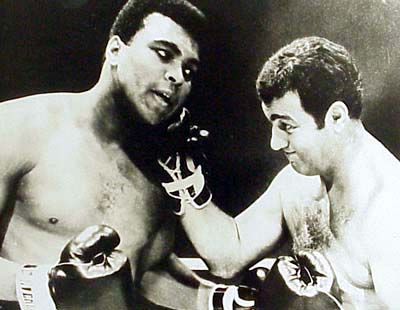 | | Ali and Marciano - Sparring for the camera |
As part of the settlement - the Miami producer asked both Marciano and Ali: How would they like to act out a bout for the camera, based on a computer-written script, and show the world who might win such a "Super Fight" between 2 living undefeated ex-champions in their primes? Two boxers agreed - delighted by the prospect of $5 million in gate money from the closed-circuit televising of such a bout. Marciano said he would take a flat fee for his part; Ali asked for 25% of the profits. In the end, Ali agreed to get $9,999 or 10 percent of the fight's revenue, whichever is higher. In addition, Ali signed an agreement that should he lose to Marciano, he will not sue the promoters again for a loss of image. Once again, the NCR-315 computer was fed 129 variables on each boxer; and once again it began to whirl, blink, and spew out round-by-round results of an imaginary conflict. Before the computer had reached its decision, the fighters were ready to battle for the four ringside cameras. And so, in the summer of 1969, Marciano participated in the filming of the fantasy, "The Super-Fight: Marciano vs. Ali" in a North Miami television studio, Studio City. The two boxers were filmed sparring, referred by famed Miami promoter Chris Dundee, then the film was edited to match a computer simulation of the hypothetical fight between them. Marciano lost 50 pounds, and sported a toupee for the match, while Ali maintained his image, despite his revoked boxing license. The two boxed for several days, and fought about 75 one-minute rounds, with every possible outcome being filmed: each boxer winning by a KO, a TKO, or a decision, plus a draw. Marciano could still do damage to an opponent - Ali complained to Woroner about injuries endured during the bouts, and received an additional $2,000 for his troubles. With over eight hours of filmed sparring, the filming wrapped in early August of 1969. "All my Bags are Packed..." 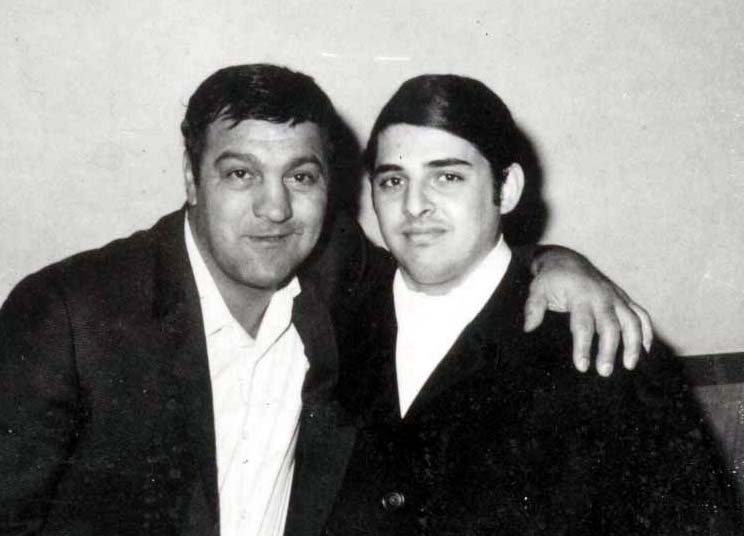 | Rocky Marciano and Frank Farrell, in a photo taken shortly before the crash |
On August 31st, 1969, at 6PM, on the eve of his 46th birthday, Marciano departed from Midway Airport in Chicago as a passenger aboard a 1967 green and white Cessna 172, registered as N3149X, headed to Des Moines, Iowa. Marciano's stop in Des Moines was a short stop to give a speech to support a friend's son - and attend the surprise birthday celebration waiting for him. He was coming from a dinner in Chicago at STP Oil president Andy Granatelli's home where he supposedly gave Granatelli's son, Andy Jr, a brief boxing lesson (Marciano had done a television commercial for STP prior). Seated in the right chair of the plane, Marciano was looking forward to getting home to Florida. He and his wife were planning to celebrate their birthdays together, and his adopted 17-month-old son, Rocco Kevin, also had learned to walk while he was away - Marciano would have witnessed the development for the first time. Flying with Marciano, in the back seat, was Frankie Farrell, 28, the oldest son of Lew Farrell, a former boxer (with alleged mob ties) who had known Marciano since childhood. The 37-year-old pilot of the Cessna, Glenn Belz, was not experienced with night flying, nor flying in bad weather. Having earned his pilot's license in February of 1968, Belz ignored warnings of a storm system building on his route of flight. But with only 35 hours of flight time at night, and no instrument rating, his continued flight into bad weather could result in the loss of his pilot's license. So, rather than continue on to Des Moines, he diverted the single engine plane to Newton, Iowa Low and Slow... At 8:50 PM, Belz contacted the Des Moines Radar Approach Control. The plane was stuck on the wrong side of a layer of clouds, and he was unable to see the Newton Airport. He requested radar assistance from the controllers to find the airport, but moments later, he radioed that he had broken out of the clouds, and was setting up to land. 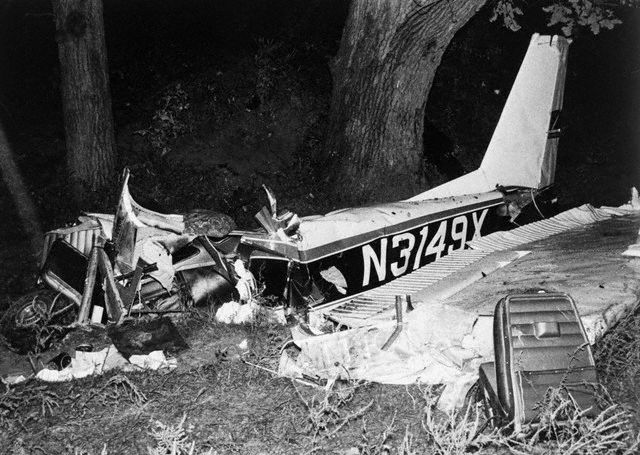 | The Cessna's wreckage, under a tree |
The pilot, with only 230 hours of flight time logged, tried to set the plane, low on fuel, down at a small airfield outside Newton, lying barely 100 feet off the ground when it entered a rolling bank of clouds. Reappearing once, it rose and disappeared again. A witness to the accident, Mrs. Coleen Swarts, saw the lights of the plane as it passed overhead in an overcast. She said the plane appeared to have reversed its westward course and ''seemed to be swinging toward the airport" when she lost sight of it behind a grove. But the sound continued. She said the plane's engine stopped, then '"kind of sputtered again. Then I heard this awful thud and I knew it had crashed." The plane impacted into a lone oak tree in the middle of a corn field, and bellied into a small ravine in the weedy field about two miles south of Newton on the Henry Eilander farm. One wing of the plane was sheared off when it hit a tree. Bits of the plane, flight maps, and weather charts were strewn some 250 feet from the tree to the point where the fuselage came to rest. Marciano's body was pinned beneath the main wreckage of the four-place plane and a piece of debris pierced his skull. Jasper County Medical Examiner Dr. John Maughan said all three men were killed instantly. The bodies of Belz and Farrell were thrown forward more than 30 feet, with the plane's engine coming to rest on Belz' chest. Swarts stated, "I hope I never hear anything like it again. I never dreamed anybody like Rocky Marciano was in it." Lasting Tributes to a Legend... The National Transportation Safety Board accident investigation concluded that the probable cause of the mishap was, "the pilot attempted operation exceeding his experience and ability level, continued visual flight rules under adverse weather conditions, and experienced spatial disorientation in the last moments of the flight." Marciano died without a will, and was survived by his wife of 19 years, Barbara, and their two children, Rocco Kevin and Mary Anne. He is interred in a crypt at Forest Lawn Memorial Cemetery in Fort Lauderdale, Florida. Marciano's wife, Barbara, died five years after him at the age of 46, and is entombed next to him. Five months after Marciano was killed, on January. 20, 1970, "The Super Fight" played to packed Loew's and RKO theaters around the United States, South America, and in Europe, grossing $5 million dollars domestically. In the simulation, Marciano won the bout - knocking out Ali a minute into the 13th round. After viewing the fight, Ali is quoted as saying "That computer was made in Alabama." In 1990, 21 years after his death, Marciano was inducted into the International Boxing Hall of Fame. After being shown in theaters the one time, the film was never to be seen again and all prints of the fight were slated to be destroyed, except for one. However, during the late 1970's, it is reported that the fight was shown on ABC's World Wide Sports show, and it is thought that several prints avoided destruction and were shown in theatres on a "hush-hush" basis. But in the eye of the public, the fight wasn't seen for over 35 years. However, in 2005, a DVD of the fight was produced from a remaining print. The DVD also includes a documentary about the film, audio of the original radio fantasy fights, archival interviews with the fighters that were chosen and other features.
|