| A Bomber Without a War... The B-17 'Flying Fortress' served with distinction in the skies over Europe during the second World War. After V-E Day, the dropping of the atom bombs on Japan, and victory in the Pacific theatre, these venerable craft overnight became "soldiers without a fight". After all, the Flying Fortress' main purpose was as a heavy bomber. But, being incapable of carrying nuclear payloads, and not having as great a range or lift capacity as the new B-29 'Superfortress', B-17 bombers are quickly relegated to other duties such as cargo transport, refueling, and even as target drones - many still fresh from the factory as they were produced too late to see combat action. 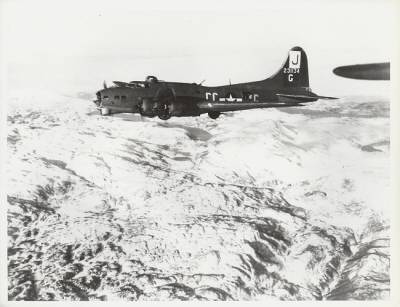 But chief among its post-war functions was the task of passenger transport. But chief among its post-war functions was the task of passenger transport.
Another Routine Flight... Lockheed/Vega B-17G (Block 95) "Flying Fortress" serial number 44-85510 fell among this group of late builds. Being one of the last Flying Fortresses to rolling off the assembly line, and costing the taxpayers over a quarter of a million dollars each, it was built by Vega under license by Lockheed with all the improvements recommended by use in combat, such as improved gun sights and mounts, increased gunner ammo, and much more. The flight took off from Clovis Army Air Field in New Mexico, bound for Hamilton AAF in Marin County. The plane stopped at Mines Field in Los Angeles, refueled, retook to the skies at 11:17 PM, and was due to arrive at Hamilton at 1:17 in the morning, but the pilot, according to the Army investigation, lost his way while trying to locate Hamilton Field. . At around 2 in the morning, and five minutes from its destination, the pilot radioed Hamilton Field for radar assistance in landing. But, shortly after 2 AM, the engines of the bomber, starved of fuel, quit, and the bomber smashed into a 1300-foot peak of White's Hill - nine miles short of the airfield. Striking the hill only six feet below its top, the plane bounced over the top, thudded across the rough terrain, and slid to a grinding halt that churned up earth and rock for more than 100 yards, and scattering wreckage for 300 yards. "Service Before Self..." 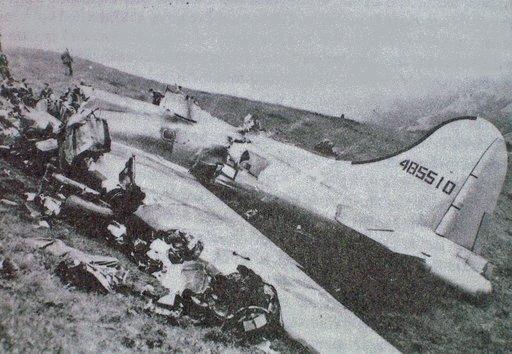 Dazed, confounded, and startled by the crash, the pilot and co-pilot extricated themselves out of the wreckage of his once-proud aircraft. Still trapped in the wreckage were five of their crew. Stumbling and clawing their way through the morning darkness towards the city lights they saw in the distant, they reached a retirement home, from which they alerted the airfield. Dazed, confounded, and startled by the crash, the pilot and co-pilot extricated themselves out of the wreckage of his once-proud aircraft. Still trapped in the wreckage were five of their crew. Stumbling and clawing their way through the morning darkness towards the city lights they saw in the distant, they reached a retirement home, from which they alerted the airfield.
Click here to see the crew and passenger list of Army #85510 Killed instantly in the First Lieutenant Milton M. Souza, 25, of Santa Clara. CA. and Master Sergeant E. B. Nichols, of Clovis, NM. Rescuers chopped a hole through the wreckage with an axe to extricate a Lieutenant Colonel from the fuselage. He was then strapped on a litter with his parachute shrouds and brought down the hillside. It took a total of six hours to free the five trapped men from the plane, two of whom were seriously injured. Causes and Questions... The accident investigation concluded that: "The pilot, due to lack of judgment, common sense and apparent disregard and/or unfamiliarity with facilities available to him, failed to properly follow instructions in preparing for let down. It is believed that the accident was 100% pilot error." The Army maintained secrecy in the investigation, with a cordon of military police around the wreckage for a mile and a half. A spokesman for the Army said that, although the plane came from Clovis, a training base for Flying Fortresses to be used at the atom bomb test, known as "Operation Crossroads", at Bikini Atoll, but the plane had no connection with plans for the test. And yet, many in the general public still think that the military's response to the crash, and the prompt removal and burial of much of the wreckage at the crash site, leads them to the conclusion that something illicit remains there. |