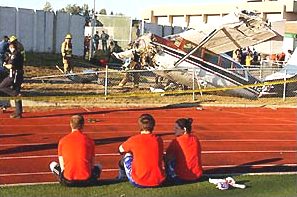
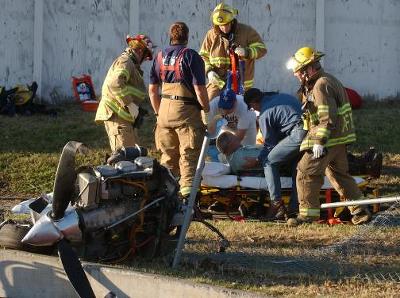
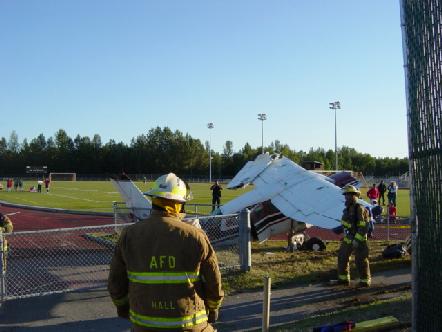
The "Baseball Game Crash" at Mulcahy StadiumAnchorage, AlaskaJuly 31st, 2003The Land of the Midnight SunThe long summer nights of Alaska mean there is seemingly more time for everything. More time for work, and more time for play, including baseball. And it was at a home game for the Anchorage Bucs, playing against the visiting Alaska Goldpanners of Fairbanks, that work and play nearly met a deadly collision of fate. It was the top of the third inning, with the Bucs in the field, and the Goldpanners on their eighth at-bat, with Jeff Culpepper, a native of Woodinville, Washington, edging up to the batter’s mound. The bases were loaded, and the pitcher, Chuck Withers, was winding up. His team may have been down 7-0, but it was still early in the game. Then, at 8:13 PM, the referee standing behind Culpepper waved off the pitch. A Cessna 207 Skywagon, was descending rapidly towards the ball field, and the crowd of over 500. "Will Fly For Food"A commercial pilot with nearly 2,000 hours of flight experience, Brian Mason was a bush pilot. Having flown for nearly six years for Spernak Airways, Mason had flown all over Alaska, ferrying people and payload. His fare that day was a pair of brothers from Colorado, Ronald and Marc Fisher, whom were returning from a two-day fishing trip at the Chuit River Lodge, as well as Seth Siver, an auto mechanic and employee of the lodge. After departing the Beluga airport, the aircraft's engine cut out 30 minutes into the flight. Mason activated the auxiliary fuel pump, and for a moment it looked as though the problem had been solved. But then the engine continued to lose power and fail. The propeller windmilling, the high-winged vessel slowly glided downwards, from its altitude of 800 feet, while over Anchorage. His field of vision filled with buildings, Mason directed the plane towards the closest open field - the stadium complex. The plane came in from the west very low and struck the left field fence in front of the brick dressing rooms at the north end of the track at the ajoining football & soccer stadium where a coed soccer match was also in progress. The impact with the fence sheared the engine off from the rest of the plane. The fuselage continued moving by flipping once, and then came to rest on its belly on grass just off the north end of the track. The plane's tail was crumpled and the tip of its left wing snapped in two. No one on the ground was injured, however Marc Fisher suffered a dislocated ankle, several broken ribs, a shiner and multiple bruises and cuts, and his brother Ronald endured a broken right arm. And the entire event was captured on film. Caught on Tape...Cameraman and producer Todd Dennis was taping the game for PannerVision, the Goldpanner's official game chronicler. Gero von Dehn, "The Voice of PannerVision," made the call of the pilot making a "Crazy Landing" as the plane struck the ground. The video of the crash would became a valuable tool to investigators on the post-impact sequence of the crash, as well as appear on ESPN, CNN, and various news and sports programs across the globe. After a 47-minute delay, the baseball game continued. The soccer game did not. Culpepper hit the first pitch over the wall in the same spot as the plane crashed, for a double, sealing the 10-2 victory for the Goldpanners. Culpepper would go on to become the Goldpanner's Most Valuable Player for the 2003 season. The National Transportation Safety Board's investigation found about 30 gallons of fuel were in the left wing-mounted fuel tank after the crash, while only 0.8 gallons remained in the right fuel tank. When asked by investigators if the pilot attempted to switch the fuel selector valve from the right fuel tank to the left tank, Mason responded "No." The pilot stated shortly after the crash that he routinely flew the route between Beluga Airport and Merrill Field in Anchorage using only the right fuel tank. Mason said that fuel stored in the left fuel tank was considered a reserve tank. However, that morning, another pilot had flown the Skywagon prior to Mason's flight, and usually, when an airplane returned to Spernak, line service personnel would typically fill the right fuel tank, readying the craft for the next flight. Thus, prior to departing on the outbound leg of the flight from Anchorage to Beluga, Mason did not visually check the fuel quantity in the right wing fuel tank. The NTSB concluded that the likely cause of the crash was "(t)he pilot's incorrect positioning of the fuel tank selector valve to a nearly empty tank, which resulted in a loss of engine power due to fuel starvation, and subsequent emergency landing at an off-airport site. Factors associated with the accident were the pilot's inadequate preflight inspection, and his inadequate remedial action." The Crash Site Today 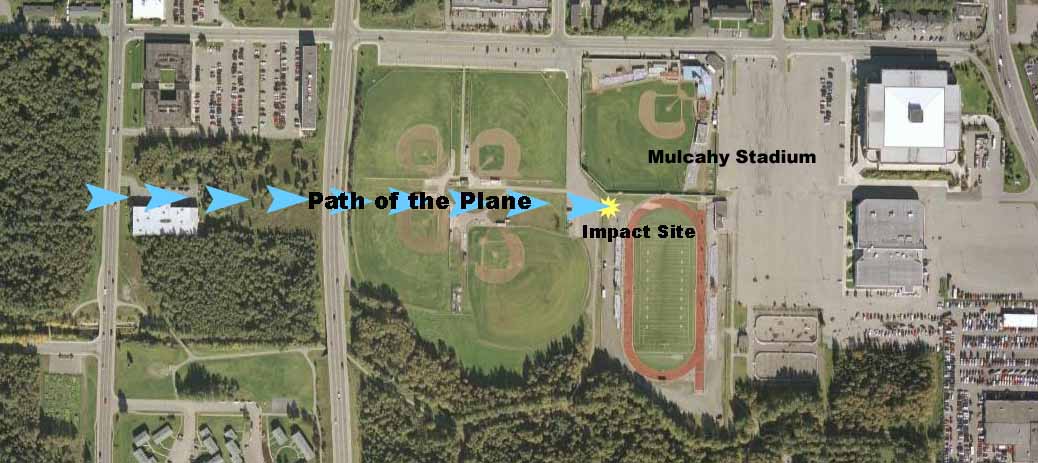
Mulcahy Stadium remains today the largest outdoor baseball stadium in all of Alaska. Recent efforts to replace the structure, originally built in 1953, have gained little traction. The 5,300 seat stadium stands as a constant reminder of a lucky set of circumstances combining to advert a potential disaster. |