Becoming a Part of the Game... In Baltimore, Maryland December 19, 1976 "The World's Largest Outdoor Insane Asylum"Baltimore’s Memorial Stadium was built after World War II, and completed in 1950, as a major league baseball arena for the Baltimore Orioles. In 1953, the National Football League’s Baltimore Colts chose the stadium as their home turf, and played their visiting opponents there. Such was the case on the evening of December 19, 1976, when the Colts played the Pittsburgh Steelers in the AFC divisional title game. The game had been brutal to the Colts, and ended in regulation with a final score of Steelers 40-14. It was the Colts' first home postseason loss ever, and their second straight loss the Pittsburgh. Marching to the Beat of a Different Drummer… 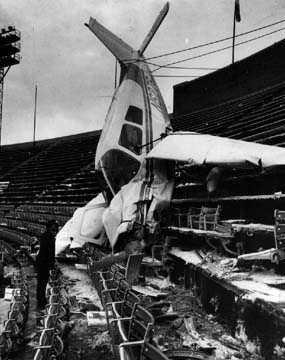 However, about ten minutes after the conclusion of the final quarter of the Sunday game, at 5:07 PM, a low-wing Piper Cherokee buzzed over the stadium. However, about ten minutes after the conclusion of the final quarter of the Sunday game, at 5:07 PM, a low-wing Piper Cherokee buzzed over the stadium.
In the week leading up to the game, a white, low-wing, plane with blue trim had been reported to the Federal Aviation Administration twice for flying too tow over the stadium. However, officials added that witnesses were not able to transcribe the plane's tail registration number. Now, it appeared the plane was going to pull some stunt. Witnesses said the plane entered the open end of the horseshoe-shaped stadium and tried to rise as it approached the closed portion. "The plane circled the field and had gone through where the band sits (at the other end of the stadium) and then came back into the stadium," said Yvon Tyler of Baltimore. "It tried to climb and it banked, but it couldn't make it," "I thought it was a kamikaze pilot from Oakland," quipped Ray Mansfield. Flying low, the white plane, with blue trim markings, stalled: "It was so scary. We couldn't duck, we couldn't run, we didn't know what to do," according to Tyler. The plane, registered as N6276J, dropped in the upper rows of the stadium's upper most deck of seats, Sections 1 & 2, positioned with its nose pointing downward, its left wing fractured, fuel spilling out, and its right wing damaged just above the baseball press box, which was being used as an auxiliary press facility for the game The poor performance of the home team had resulted in most of the nearly 60,000 football fans in the stands having left the stadium, and no one on the ground was seriously injured. Police pulled the pilot from the wreckage dazed but seemingly unhurt. Inside the plane's cockpit, police found a roll of toilet paper, a can of yellow spray enamel paint, a can of spray snow and a note to a Colts' quarterback, "To Bert Jones, QB, from Blue Max. Good luck, you B-more Colts." Under the Stadium...Meanwhile, deep in the bowels of Memorial Stadium, Ted Marchibroda, then in his first tenure as a coach for the Colts, recalled that the crash spared the team some embarrassment. "We were in the locker room and somebody said, 'A plane crashed into the stadium!' We went out in the dugout and, sure enough, we looked up in the second tier and there it was. I think now it really saved me some embarrassment because we lost that game, but everybody was paying attention to that plane." 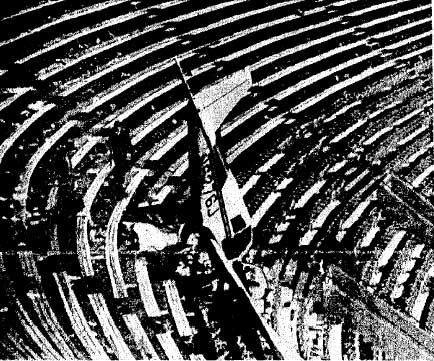 Maryland Governor Marvin Mandel, who had attended the game, inspected the crash site shortly afterwards and said, "If it had been a close game there would have been people up there and they would have been falling out of the stadium," Maryland Governor Marvin Mandel, who had attended the game, inspected the crash site shortly afterwards and said, "If it had been a close game there would have been people up there and they would have been falling out of the stadium,"
The Mad Hatter…The plane's pilot, 33 year old Donald N. Kroner, who had worked as both a flight instructor and an air control tower operator, had been arrested the prior week on a warrant for reckless flying, littering, and making a bomb threat against Bill Pellington, a former linebacker for the Colts, at his restaurant. Rolls of toilet paper and a bottle were dropped on Pellington's restaurant the week before, according to detectives. Kroner was later released on $2,100 bail. After the crash, Kroner was admitted to Union Memorial Hospital, along with two Baltimore policemen - officers David Williams, 29, and Joseph Sacco, 31 – who were first police on the scene of the crash, and had suffered smoke inhalation and minor cuts. Later, Kroner was admitted to the Clifton T. Perkins State Hospital in Jessup, Maryland, for psychiatric evaluation. He was charged at Northern District police station with malicious destruction of property, reckless flying and violating the law that prohibits flying over the stadium. Ex Post Facto…In court testimony afterwards, Kroner stated that he had been in attendance at the game, but at halftime because “the Colts were having such a terrible time.” Investigators later determined that Kroner has planned to land the plane on the field, and take off as well. Officials determined the feat was impossible, given the Piper’s performance range. 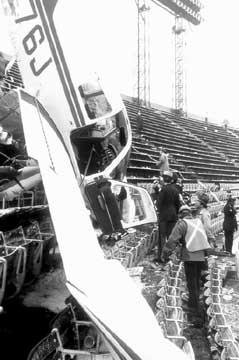 In February of 1977, Kroner was found guilty on two charges of malicious destruction of property and one charge of reckless flying. He was sentenced in mid-March of 1977 to two years in prison for his crimes, and served three months before he was released in June. Shortly afterwards, it was publicly revealed he had worked as a federal narcotics informant for the Customs Service after two men asked him if he could fly a small plane into South America low enough that he would be undetected by radar.. In February of 1977, Kroner was found guilty on two charges of malicious destruction of property and one charge of reckless flying. He was sentenced in mid-March of 1977 to two years in prison for his crimes, and served three months before he was released in June. Shortly afterwards, it was publicly revealed he had worked as a federal narcotics informant for the Customs Service after two men asked him if he could fly a small plane into South America low enough that he would be undetected by radar..
Kroner was later, in 1980, charged with stealing a Greyhound bus from Dulles International Airport. In 1983, he was charged with omitting his reckless flying conviction from a federal application when he applied for a new medical certificate from the FAA and, in 1987, he was arrested by Anne Arundel County Police and was charged with breaking & entering after he was found wandering in a garage. The NTSB found the probable cause of the 1976 crash was the pilot's poor judgment and misjudgment of his plane's distance, speed, altitude or clearance. The accident had the disaster potential akin to several Hollywood movies of the time. In "Black Sunday ," Arab terrorists plot to crash a blimp filled with explosives into the Super Bowl. ," Arab terrorists plot to crash a blimp filled with explosives into the Super Bowl. In the movie, "Two-Minute Warning ," a sniper spreads terror among a sellout crowd al a large stadium. ," a sniper spreads terror among a sellout crowd al a large stadium. The Colts moved to Indianapolis in 1984, and Memorial Stadium was demolished in 2001. Donald Kroner passed away on November 4th, 2013. |