DeKalb, Texas – one of the hundreds of non-descript towns that dot the landscape of America’s second-largest state. Located near the borders of Oklahoma, Arkansas and Louisiana, for one winter’s night in late December of 1985, a farm pasture there would become the focal point of the entire nation as the location of one of America’s early rock-and-roll legend’s – Ricky Nelson – untimely demise.
An American Life...
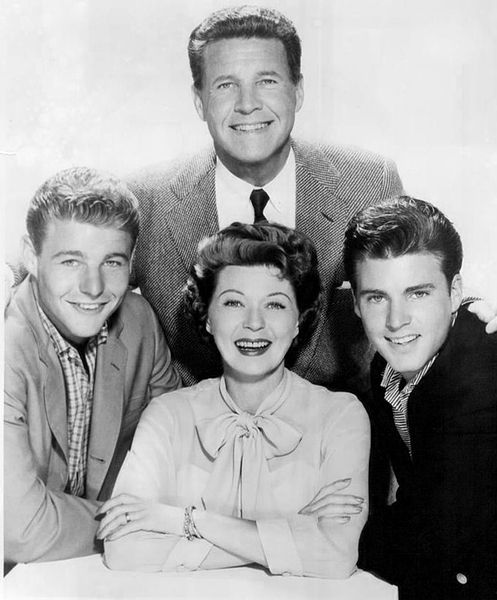
Eric 'Rick' (aka 'Ricky') Hilliard Nelson was first introduced to the American public on his parent’s radio show in 1949, and grew up as a teen idol on his parents' television series, “The Adventures of Ozzie and Harriet.” On the show, many of the episodes were based on the family’s true-life experiences, which comprised Ricky’s father, big-band leader Ozzie Nelson, mother / singer Harriet Hilliard Nelson, along with Ricky's older brother David. Considered by some to be 'America's Family', the show represented a simple, honest idealization of 1960s American life, and provided the youngest Nelson the springboard that would later launch him into becoming a part of the vanguard of 'country rock' artists. He first performed on his parent’s show doing the Fats Domino hit "I'm Walking" in April 1957 – laying claim to the honor of being the first music video stars as, within a week of the television airing, the record reportedly sold a million copies
He was known for being likable & easy-going, although shy at times. He married 17-year-old Kristin Harmon, daughter of football great Tom Harmon, in 1963.
As a singer, some of his hits included: "A Teenager's Romance," "Be-Bop Baby," "Stood Up," "Waitin' In School," "Believe What You Say," "My Bucket's Got a Hole In It," "Poor Little Fool," "Lonesome Town," "Never Be Anyone Else But You," "It's Late," "Travelin' Man," "Hello, Mary Lou," "Teen Age Idol," "It's Up To You" and "Garden Party."
But, in the mid-1960s, Nelson's music became eclipsed by the British pop invasion, and in 1966, “The Adventures of Ozzie and Harriet” was canceled. While he continued to record and sing, he could not regain the success he once had, as audiences were drawn towards newer, faster musical genres. In 1977, a bitter divorce started between him and Kristin, in which she eventually won custody of their three children, twins Matthew and Gunnar, and daughter, Tracy.
The year 1981 opened for Nelson with the release of his first record, “Playing to Win,” in more than three years and his fifth label with Capitol Records, resulting in his music enjoying a revival, and he also had met a fan named Helen Blair, who became a constant companion, eventually becoming his fiancée.
It's Good to be the King...
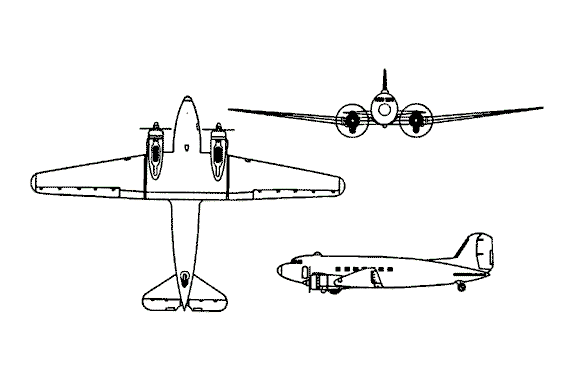
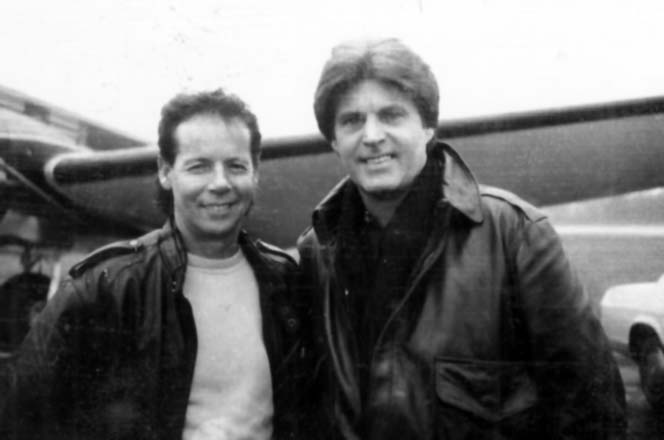
As the demand for Nelson’s music resurged, so did the need for reliable and quick transportation. Accustomed to using a Learjet, in May of 1985, he “upgraded” to a 14-seat Douglas DC-3, built in 1944, and painted white, with gold and black trim. The airplane had had quite a history of owners, from the wealthy Richard C. DuPont, to retired rocker Jerry Lee Lewis. Paying $118,000 for the historic aircraft, and despite a general rule favoring jets over propeller-driven planes, the need to economize his purchases overruled this and he learned to enjoy the old warbird. According to singer Frankie Avalon: "He (Nelson) was so enthused about it, telling me how much better it was that the LearJet he had been flying. It had been modified to make it almost homey."
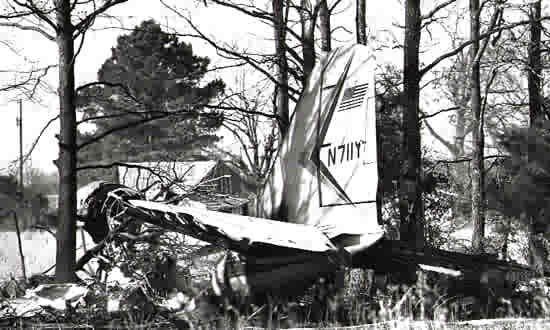
But Nelson, or whoever he had handling the purchasing paperwork for the DC-3, the plane was never properly re-registered under Nelson's name, according to Federal Aviation Administration records. And in the time of Nelson’s ownership, the plane, registered as N711Y, the plane would start having documented problems.
Residing in the former Erroll Flynn estate on Mulholland Drive in Los Angeles, with his fiancée, Helen Blair, and his now-college-bound daughter Tracy, he needed to make a lot of cash quickly. A new record contract had been inked with MCA/Curb records, and his agent started booking a series of tour dates – resulting in Nelson being on the road an average of 250 nights per year with a new band, the Stone Canyon Band, comprising lead guitarist Bobby Neal, Los Angeles rockabilly drummer Rick Intveld, bass player Pat Woodward, and former Steppenwolf keyboardist Andy Chapin.
But, on June 4, 1985, an incident forced the DC-3’s pilot, 33-year-old Brad Rank, and co-pilot Thomas Ferguson to make an unscheduled landing in Lancaster, California after an engine failed in flight. National Transportation Safety Board (NTSB) investigators believed that there were serious questions needing to be answered about this potential mishap as, according to the investigation afterwards, “Sworn testimony and conversations with a fixed base operator (FBO) related an occurrence of the pilot having run the right engine with the oil shutoff pulled at the firewall during a maintenance check. Without ascertaining the damage this caused the engine, Rank subsequently boarded a full compliment of passengers, and departed for a business engagement. The flight experienced an engine seizure and required and emergency landing".
More disturbing were questions related to the 33 year-old pilot's knowledge of the airplane's systems, as an NTSB investigator, Frances A. Sherertz, noted: "Co-Pilot Ferguson's statement that when Rank noticed the low oil indication during the incident noted above, Rank directed his co-pilot to 'check circuit breakers'. DC-3 oil pressure gauges are not dependent upon circuit breakers".
More Problems...
Over three months later, on September 20, 1985, Nelson flew aboard N711Y to Memphis after completing some West Coast engagements to appear with an all-star cast recording session comprising of Johnny Cash, Jerry Lee Lewis, Roy Orbison, and Carl Perkins. The session, arranged by producers Chips Momen and Sam Phillips, with the four surviving Sun Records artists and Nelson, was dubbed “Class of ‘55” and was attended by mother-daughter duo The Judds, June Carter-Cash, Dave Edmunds, Toni Wine, Paul Davis, Rebecca Evans, and John Fogerty is background vocal roles.
After the sessions, Nelson learned that Fogerty was flying to Indiana to rehearse with John Cougar Mellencamp for a Farm Aid concert in Champaign, Illinois. Nelson invited several people to travel aboard the DC-3 for the Indiana rehearsal. Johnny Cash guitarist Marty Stuart accepted, but arrived only to witness the DC-3 rumble down the runway. Both engines reportedly backfired and died. So, the Nelson entourage left the airplane in Memphis for repairs and booked commercial flights to California.
Band members shared fears with their families about the DC-3's airworthiness. Lead guitarist Bobby Neal's wife Phyllis urged him not to board the airplane. Bassist Patrick Woodward told his wife Jodie about the two emergency landings. "He said he was going to die in that airplane and he said it seriously", she recalled.
Lori Russell, wife of sound technician Clark said, "I hated the plane because every time he went on it I thought it would be the last time. The band hated the plane".
Laurie Barzie, sister-in-law of pianist Andy Chapin, added, "He didn't want to go on that airplane". Barzie said Chapin told her "that it was a real bad plane. he didn't trust it. He always talked to my husband about it, that he didn't trust the airplane, that all the guys felt the same in the band".
Although Nelson's personal co-pilot, Ken Ferguson stated there "were no areas of major safety concerns" with the plane.
On October 31, the Nelson party flew commercially to London for an 18-day tour of the British Isles, including two shows at London's Royal Albert Hall on November 17. Having signed a new record deal with MCA/Curb records, Nelson discussed taking only a few dates in 1986 and considered a new television series. Back in the United States, his touring schedule resumed in Orlando, Florida, on December 27, 1985, with their next engagement slated for New Year’s Eve in Dallas.
Pat Upton, a former guitarist and singer for Nelson who now owned the bar in Guntersville, Alabama. Nelson's manager Greg McDonald had worked with Upton earlier, so he called and set up the shows. Nelson would play for the admission charge, and he and Upton would be able to reminisce.
"They were in Orlando, and to sit on the road costs a lot of money," said Upton. "They were going to have to fly to Los Angeles and then go back to Dallas."
Don Dudley, the general manager of Executive Air Charter at Orlando Executive Airport, said the DC-3 took on only fuel and oil before leaving for Guntersville, but pilot Brad Rank told workers he was having problems with the aircraft. "(Rank) said all they had to do is get the plane back to California and they wouldn't need it after that. I imagine what he meant is that they were going to sell it"
New Year’s Eve Weekend, 1985…
On Saturday, December 28, the band soldiered on from Orlando to Guntersville, Alabama, to play at P.J.'s Alley, a 4,000 square foot converted tire store and warehouse, that Upton owned. The DC-3 made an uneventful landing around dusk, and quickly taxied to a stop. The air stairs of the DC-3 were lowered, and the band began to unload all of their gear before hitching a ride into town with two locals.
Nelson and The Stone Canyon Band took the stage erected in front of a bare brick wall and played two sold-out performances (Pat Upton was given a citation by the local fire department for overcrowding) over the weekend. Upton asked Nelson to stay for a third show on Monday night, to which he agreed, staying at the nearby Holiday Inn, with a view of Lake Guntersville.
On Monday afternoon, Nelson and his fiancée visited the Upton family, reminiscing for about an hour. Upton noted that Blair was quiet and withdrawn. This corresponds with Iris Harris's recollection that although Blair seemed very pleasant, she stepped aside whenever photographs of Nelson were taken so as not to "take any attention away from him".
The opening act that Monday night was a local songwriter named Janet McLaughlin, who finished her set and came to PJ's basement to meet the headliner. "So often when you're the opening act for someone, there's some level of isolation, but it wasn't that way at all," she recalled some years later. "It was a very upbeat vibe - just a fun, festive, exciting kind of night - and I remember how gracious he was to me."
Another sold-out night, Nelson ended by singing a rendition of Buddy Holly's song, Rave On. Ironically, Holly himself had chosen this song to close what would be his last performance at Clear Lake, Iowa, on February 3, 1959 – “the Day the Music Died…”. Nelson’s final words on stage that evening were, “Rave on for me!” as he and his band departed.
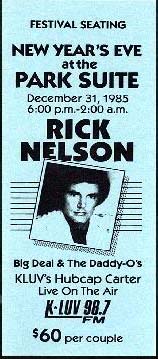
After another night in Room 106 at the Guntersville Holiday Inn, Nelson and his entourage would be flying to Dallas the next morning - New Year’s Eve, 1985 - to entertain at the Park Suite Hotel. It was a date they would never make.
That morning, the flight crew intended to depart Guntersville around 10 am. However, there were problems with the plane that required some mechanical repairs. According to Guntersville Airport Manager Dick Lusk: "They had a little (fuel) primer problem. That's all". Nevertheless, the repair work delayed the departure by four hours, during which time, Nelson and his party stayed in the airport terminal, playing video games, and eating lunch.
The travelers re-boarded N711Y at about 2pm, and started to leave Guntersburg. But, one of the passengers, sound man Clark Russell, had left a briefcase in the office at the Guntersville airport. As the DC-3 taxied down the short runway, Damon Johnson – then 19-years old and a guitarist who drove Nelson and his band to the airport, rushed toward the plane.
"They saw me and they waved and they opened the door," he said. "They lowered the ladder, and I ran up in there to them."
He remembered that they told him to come with them to Dallas, as "it would be hopping.” But Johnson refused, as he had his own show to play that night at P.J.’s.
Aloft...
Bound for Dallas’ Love Field, some 450 miles away, the DC-3 took off with pilot, Brad Rank, 34, and co-pilot, Kenneth Ferguson, 40, Ricky Nelson, 45, his fiancee' Helen Blair, 29, sound technician Donald 'Clark' Russell, 35, and his entire Stone Canyon Band - Andy Chapin, 30, pianist; Rick Intveld, 22, drummer; Bobby Neal, 38, guitarist; and Patrick Woodward, 35, bassist, all aboard.
But, three hours and eight minutes into the flight, while at an altitude to 6,000 feet, the flight crew contacted Fort Worth Center. "I think I'd like to turnaround, head for Texarkana here. I've got a little problem".
The controller provided N711Y’s crew with radar vectors to several airports. However, a short time later, pilot Brad Rank advised the controller that he would be unable to make those airports. At 5:11pm, Rank radioed that smoke was in the cabin.
Two Stories – One Result...
According to testimony from Rank and Ferguson given to the National Transportation Safety Boards, their accounts of the mishap and its circumstances are contradictory. As pilot-in-command and the final authority for the plane's safe operation, Rank told investigators that his co-pilot, Ferguson, was flying the DC-3 while he stood about mid-cabin, talking to some of the passengers, when he noticed smoke near the last two seats on the cabin's right. that he was checking on the passengers when he noticed smoke in the middle of the cabin, where Rick Nelson and Helen Blair were sitting. Even though he never mentioned a problematic heater, Rank stated that he went to the rear of the plane to check the heater, saw no smoke, and found the heater was cool to the touch. After activating an automatic fire extinguisher and opening the cabin's fresh air inlets, Rank said that he returned to the cockpit where Ferguson was already asking traffic controllers for directions to the nearest airfield.
Ferguson, however, recalled that during the flight the airplane's passengers requested heat, so the switch for the cabin heater (separate from the gas-fueled Stewart-Warner 20,000BTU cockpit unit) was turned on. The overheat light then came on several times, On each occasion the pilots would turn off the switch and wait for the rear cabin heater to cool down before turning the switch back on. The heater would alternately blow cool air or the overheat lamp would appear again. According to Ferguson, Rank left the cockpit to 'troubleshoot' the heater, then either signaling Ferguson to activate the switch or walking forward to the cockpit to activate it himself. This may have occurred four or five times. "One of the times, I refused to turn it on," said Ferguson. He continued, "I was getting more nervous. I didn't think we should be messing with that heater enroute."
Shortly thereafter, one of the passengers came forward and reported smoke in the cabin. Ferguson stated he turned off the switch and initiated a 180-degree turn for Texarkana. Rank then returned to the cockpit to begin the emergency descent, trailing flames and black smoke from its right engine into the evening sky.
Chasing Smoke...
In radio transmissions to the Fort Worth Regional Air Traffic Center, he said he heard the pilot choking on smoke. “During the flight he was distressed but not panicky. He appeared to be having difficulty with his speech, said they had smoke coming in the cockpit.`` Ruggles stated.
"He said smoke was filling up his cockpit and that he was having difficulty. Then he asked how many miles it was to Texarkana", said Ruggles. "They had been told by the tower that there was an airstrip nearby. But I think they were having difficulty seeing with the smoke. I think the pilot was just trying to land the plane anywhere they could".
At 5:14 in the afternoon, Rank and Ferguson attempted to land N711Y on Market Road, just south of DeKalb. When the DC-3 narrowly missed David Jones's house, the crew had turned west when the leading edge of the vertical stabilizer below the anti-collision light severed utility wires on the east side of the highway. A utility pole inside the field's east perimeter fence was severed by the left and right wing leading edges outboard of the engine nacelles immediately before the initial touchdown.
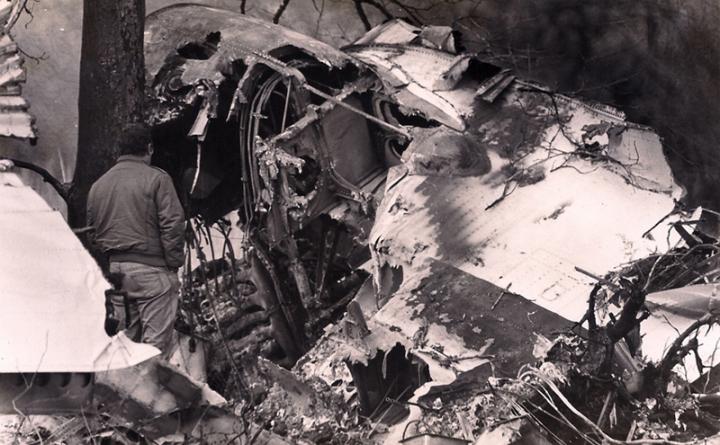
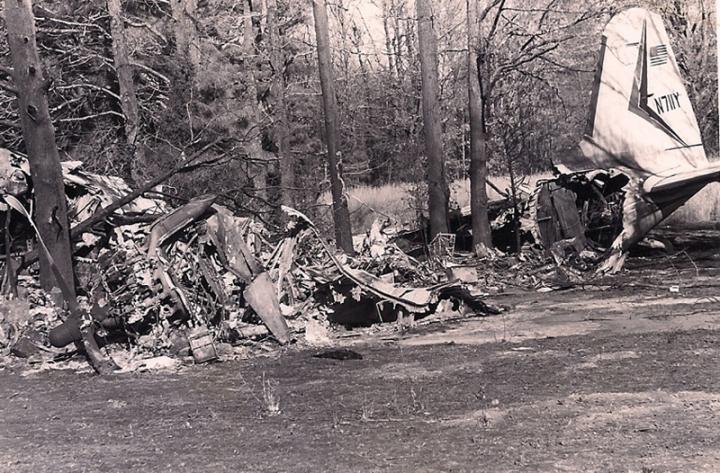
Though damaged, the wing leading edges did not separate until the aircraft struck a small island of trees at the field's west perimeter fence line. Truck driver Tommy Reed, on the highway, then saw the DC-3 touched down only to become airborne again, leaving a two-wheel touchdown 40 feet in length. Slightly aloft, the DC-3 again flew before its final two-point touchdown only 50 feet in length before encountering trees about 2 feet off the ground, shearing off both outboard sections of the wings, but leaving the left engine idling while the rest of the plane exploded.
Bob Allison, a helicopter rescue pilot, was dispatched to the site, landing there at 5:30, 16 minutes after the crash: "All I saw was a ball of fire", he said later. "I couldn't make out anything but a fiery mass".
Escape!
Pilot Brad Rank and co-pilot Kenneth Ferguson escaped the burning plane through a window on to the cow pasture owned by Nolan and Novelle Woodward. They shouted to the passenger cabin, but there was no response. Ferguson and Rank backed away from the plane, fearing explosion. Ferguson later said that Rank told him, "Don't tell anyone about the heater, don't tell anyone about the heater."
Don Ruggles, along with his wife Mary, landed near the wreck. They found the surviving duo about a hundred yards from the fire. "They were black from the burns", Ruggles testified to the NTSB."I took their vital signs. Then one of the pilots said he thought he was going blind, and I told him to close his eyes". Ruggles continued: "Even if they had been at a larger airport, I don't believe there was anything that could have been done to get them out. It was a horrible thing seeing seven people perishing in that plane and there wasn't a thing we could do about it. ... I just regret that we couldn't have gotten him and the others out".
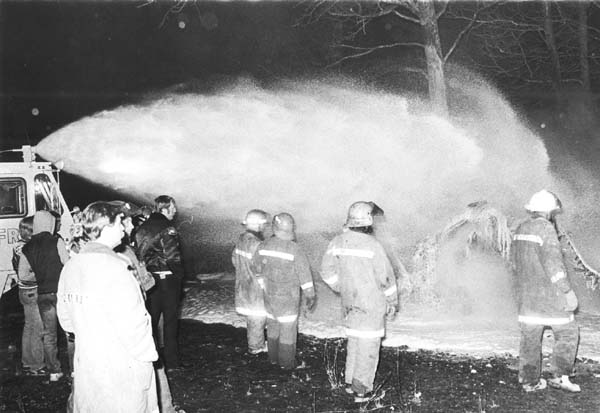
It took firefighters more than two hours to extinguish the inferno - propelled by the fuselage's magnesium construction - and the victim's bodies were recovered by the following morning.
Rank, who suffered second and third degree burns over 10 percent of his body, was in serious but stable condition at the University of Arkansas Medical Center in Little Rock, Arkansas., Wednesday. The co-pilot, Kenneth Ferguson, 43, was in critical and guarded condition with burns to his face, hands and back (40 percent of his body) at St. Michael`s Hospital in Texarkana, Arkansas,
However, all nine people in the passenger section perished. "All the bodies are there at the front of the plane. Apparently, they were trying to escape." according to Lewis Glover, one of the first on the scene.
Telling the World...
Subsequent television news reports revealed that Nelson's 71-year-old mother, Harriet, had heard of her son's sudden death in her California home while watching CNN News. Meanwhile, it seemed that almost an entire nation was numbed by the accident. Expressions of sympathy from President Ronald Reagan and fellow entertainers, such as Bobby Vinton and Frankie Avalon, poured in.
Nelson's remains were lost in transit from Texas to California, delaying the funeral for several days. On January 6th, 1986, 250 mourners entered the Church of the Hills for funeral services while hundreds of fans gathered outside. Attendees included 'Colonel' Tom Parker, Connie Stevens, Angie Dickinson, and dozens of actors, writers, and musicians. Nelson was privately buried days later in the Forest Lawn's Hollywood Hills Cemetery in Los Angeles, California in the Revelation section, Plot 3540.
Kris Nelson threatened to sue the Nelson family for her former husband's life insurance money and tried to wrest control of his estate from David Nelson, its administrator. Her bid was rejected by a Los Angeles Superior Court Judge. Nelson bequeathed his entire estate to his children and did not provide for Eric Crewe, Helen Blair, or Kris Nelson. Only days after the funeral, rumors and newspaper reports suggested cocaine freebasing was one of several possible causes for the plane crash. Those allegations were refuted by the NTSB.
Ultimately, Rank was criticized by the NTSB for not following the in-flight fire checklist; opening the fresh air vents instead of leaving them closed, not instructing the passengers to use supplemental oxygen, and not attempting to fight the fire with the hand-held fire extinguisher that was in the cockpit. The NTSB also said that while these steps might not have prevented the crash, "they would have enhanced the potential for survival of the passengers."
According to NTSB investigator Frances A. Sherertz, "It is possible that the rapidity with which the fire spread simply panicked the passengers, and precluded them from thinking about anything other than getting the airplane on the ground and getting out of it".
Honors...
In 1987, he was posthumously inducted into the Rock and Roll Hall of Fame by singer/songwriter John Fogerty. He was also inducted into the Country Music Hall of Fame, and the Rockabilly Hall of Fame. After Rick's death, his friend Bob Dylan paid tribute to him while on tour, with a moment of silence and a version of Rick's hit song "Lonesome Town" at each concert.
On the Hollywood Walk of Fame, Ricky Nelson’s star can be found at 1515 Vine Street, commemorating his achievements in music, television, and radio. Worldwide, Nelson in excess of 50 million albums, was ranked #2 in TV Guide's list of "TV's 25 Greatest Teen Idols" (January 23, 2005 issue) and was voted the 91st Greatest Rock 'n' Roll Artist of all time by Rolling Stone magazine. He earned 18 "Top 10" singles and over 53 Billboard charted records., and is ranked the 4th singles seller of all time.
The Holiday Inn on Lake Guntersville has created a shrine to Ricky Nelson. The hotel’s lobby features a permanent wall shrine entitled “The Last Two Days”, and has various memorabilia, including photos and mementos from his final performances. Room 106, where he spent his finals nights, has been deemed the ‘Rick Nelson Room’.
The tail wreckage of N711Y resides in the DeKalb Museum.



 After another night in Room 106 at the Guntersville Holiday Inn, Nelson and his entourage would be flying to Dallas the next morning - New Year’s Eve, 1985 - to entertain at the Park Suite Hotel. It was a date they would never make.