The Crash of the "Big Bird" Mojave, CaliforniaJuly 2nd, 1982 Building a Dream... In 1974, Tom Jewett, an aeronautical engineer, and Gene Sheehan, a tool and die maker, began designing an airplane that would provide "more flying enjoyment for less money" than other homebuilt aircraft designs popular at that time. Burt Rutan assisted Jewett and Sheehan in the initial design work and the first Quickie was finished, flight tested, and ready for its public debut in April of 1978. 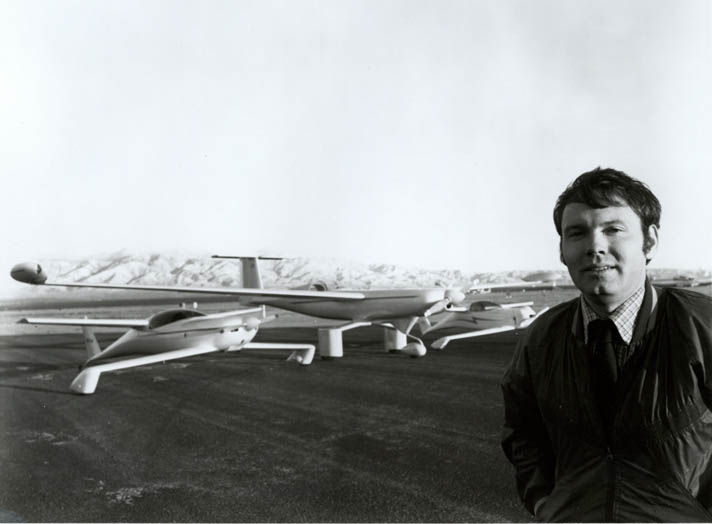 Two months later, in June of 1978, the Quickie Aircraft Corporation (QAC) was founded in by Jewett and Sheehan in Mojave, California, to produce, market, and sell the Quickie homebuilt aircraft models - the Quickie, Quickie Q2, and Quickie Q200 - out of the airport's Hanger 68. Two months later, in June of 1978, the Quickie Aircraft Corporation (QAC) was founded in by Jewett and Sheehan in Mojave, California, to produce, market, and sell the Quickie homebuilt aircraft models - the Quickie, Quickie Q2, and Quickie Q200 - out of the airport's Hanger 68.
The pair flew the prototype Quickie to the Experimental Aircraft Association's annual gathering at Oshkosh, Wisconsin, that summer, where the Quickie drew intense public interest and won the Outstanding New Design award. By 1980, QAC had sold 350 kits. But Jewett was moving on to bigger and better things - flying a record breaking distance, presumably for an around-the-world flight without refueling The aircraft, officially called the "Free Enterprise" but nicknamed "Big Bird", was built for only one purpose - flight endurance. Big Bird is an updated version of the concept used by Jim Bede's BD-2 Love One, also designed for a global flight: both aircraft use modified sailplane wings , but Big Bird is rather smaller and less powerful than the BD-2. Quickie's aircraft is based on the bonded-aluminium wings of a Laister Nugget sailplane, modified with tip and integral fuel tanks and mated to a new glassfibre/foam fuselage and T-tail. 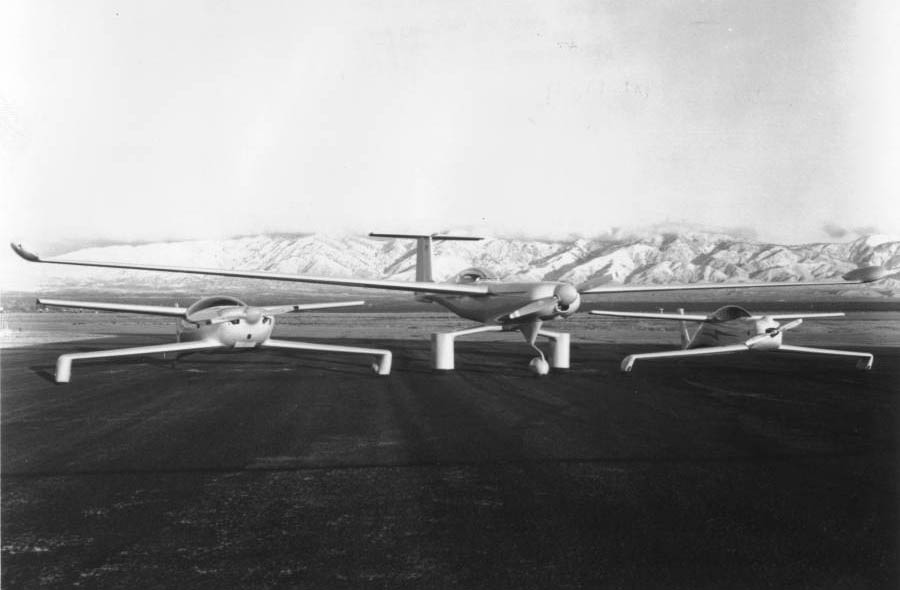 Powered by a Polish-built Pezetel-Franklin 135 horsepower PZL-F 4A-235 four-cylinder engine, but designed to carry only one person - the pilot - the plane featured a full autopilot system, a specially developed S-Tec AFCS with a three-axis alarm system to warn of excursions from track, with alarms that enabled the pilot to sleep for short periods, while being supplied oxygen from a cryogenic liquid oxygen, rather than the typical gaseous oxygen. Jewett planned to carry 10 gallons of drinking water and follow a low-residue diet similar to that used by astronauts. Powered by a Polish-built Pezetel-Franklin 135 horsepower PZL-F 4A-235 four-cylinder engine, but designed to carry only one person - the pilot - the plane featured a full autopilot system, a specially developed S-Tec AFCS with a three-axis alarm system to warn of excursions from track, with alarms that enabled the pilot to sleep for short periods, while being supplied oxygen from a cryogenic liquid oxygen, rather than the typical gaseous oxygen. Jewett planned to carry 10 gallons of drinking water and follow a low-residue diet similar to that used by astronauts.
The "Big Bird" took off using a jettison-able dolly, landed with the aid of a ventral skid, carried 350 gallons of fuel, and the planned world flight was slated to both begin & end in Houston, Texas. A lightweight Litton Omega/VLF navigation system and lightweight weather warning equipment were also installed, helping the plane cruise at 24,000 feet at 175 knots. A Simple Test Flight... On July 2nd, 1982, Tom Jewett took "Big Bird" on a test flight. But immediately after takeoff, Jewett radioed the chase plane that he had some minor problem & was going to land. After turning final, about 200 feet above the ground, he reported "Something broke, I'm going in..." and the aircraft crashed at a slight nose down attitude a half mile short of the end of the runway. The NTSB investigation found that the continuity of flight control was established & no evidence of preimpact flight control was evident. Unfortunately, there were no drawings or design data available for the aircraft, and its fuselage & empennage had not been static tested. The investigators also concluded that a break at the rear of the cockpit appeared to be in an area of poor design and the composite structure behind the cockpit rails looked questionable in its cross-sectional area to handle the bending loads in this area. The NTSB determined that an in-flight separation of the fuselage at the rear of the cockpit by as much as a single inch could have placed the stabilizer in a three-degree nose up pitch angle rendering the elevator insufficient to hold the nose up. Postscript On October 26, 1982, the pilot of one of Quickie's homebuilt kits, was on a flight to accumulate flight time on the home built aircraft near Erie, Colorado. A mayday call was received on the airport's Unicom frequency, and several witnesses indicated that the pilot was trying to land on the runway when the plane entered a left bank, and suddenly crashed. Several witnesses reported that the plane stalled and spun into the ground. None of the witnesses reported hearing the engine. Shortly after the aircraft crashed, it began burning and most of it was destroyed by fire. An examination of the items that were not destroyed revealed no pre-impact failures, and the National Transportation Safety Board was unable to determine the probable cause of the accident, but concluded the pilot’s airspeed was inadequate, causing an inadvertent stall of the aircraft.  The Litigiousness of Society... The Litigiousness of Society...
Nevertheless, Mullan sued QAC - citing negligence, product liability, and warranty issues on the part of Quickie. The jury found Quickie Aircraft to be liable, and awarded $155,000 to Mullan - but on the basis that an exculpatory clause in the sales contract between Mullan and Quickie was "unconscionable". In the legatee of judicial handling that followed, the Tenth Circuit Court of Appeals reversed the lower's court decision to strike a disclaimer of liability provision in the sales agreement entered into by Mullan and Quickie (797 F.2d 845, 848), pointing out that Mullan was familiar with the product as a certified pilot, was an expert woodworker who made airplane propellers commercially, a member of the Experimental Aircraft Association, and very familiar with the Quickie Aircraft product line. Mullan also modified portions of the preprinted sales agreement, and had alternative sources to purchase a similar plane kit. It did not rule on whether there could be a waiver of strict product liability, instead certifying the question for the Colorado Supreme Court. One sentence of the decision does stand out, " The nature of the contract between Mullan and Quickie Aircraft Corporation is for the sale of unassembled goods,..." In the end, Quickie Aircraft Corporation - leaderless and fiscally strapped - went bankrupt. |