Codename: Norjak
The Skyjacking of Northwest Flight 305
Over the states of Washington & Oregon
November 24, 1971
The Holiday Rush... Northwest Airlines flight 305, a Boeing 727-051, registered tail number N467US, departed Portland International Airport in Oregon, carrying 36 passengers, and 6 crew members, en route to Seattle, Washington, early on the afternoon of November 24th, 1971 - just one day before the Thanksgiving holiday. The flight had originated in Washington, D.C., and stopped at Minneapolis, Minnesota: Great Falls. Montana; Missoula, Montana; Spokane, Washington, and Portland. The flight's pilot, Captain William Scott, 51, had been flying for Northwest for 20 years. Also abroad was First Officer Robert "Bob" Rataczak; Flight Engineer Harold E. Anderson, and three flight attendants, Alice Hancock, Tina Mucklow, 22, and Florence Schaffner, 23.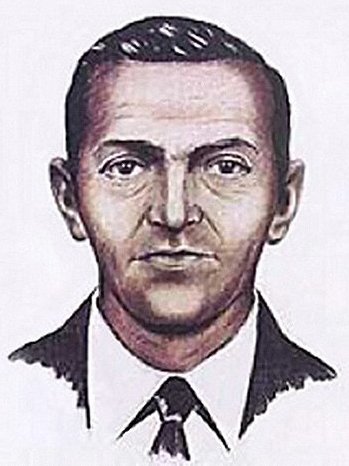 Just minutes into the flight, at 2:58 PM, a middle-aged man in seat 18E, wearing a black raincoat and loafers, a dark suit, white shirt, black necktie with a mother-of-pearl tie pin, and black sunglasses, and who had registered for the flight under the name, "Dan Cooper", after drinking a couple of whiskeys - for which he paid cash - handed stewardess Tina Mucklow a note for the captain. An Innocent Slip of Paper... The stewardess initially disregarded the passed note. But Cooper persisted that she read the note. It read: "I have a bomb in my briefcase. I will use it if necessary. I want you to sit next to me. You are being hijacked." He opened the case, and revealed to the stewardess a set of "red sticks", with a large battery and electric wires. The man in seat 18E handed Mucklow a series of clean, pre-written notes which detailed his demands: Two hundred thousand dollars, in twenty-dollar bills, and four parachutes - two military type, and two sport parachutes. In exchange, he offered to spare everyone on the plane and two of the flight attendants. Basically everyone, except for Mucklow and the flight crew.
Northwest Airlines decided to cooperate with the hijacker, and contacted the FBI for assistance. The airline handled gathering the parachutes, while the FBI gathered the ransom cash. All of the ten-thousand $20 bills were photographed with a high-speed Recordak machine to create a microfilm later to be used to prepare a list of serial numbers. Two of the parachutes, both chest-mounted reserve chutes, were from Issaquah Skyport, which was owned by Linn Emirch, and the two main backpack parachutes were provided by Earl Cossey, an FAA Master Parachute Rigger and parachuting instructor, from his home. Special Delivery... In Seattle, at 5:39 that afternoon, the jet landed and taxied to a remote portion of the airport tarmac, devoid of light and several hundred yards from the airport terminal. The only persons allowed near the plane were fuel truck operators and a man who delivered the cash, from Seattle First National Bank, and parachutes. 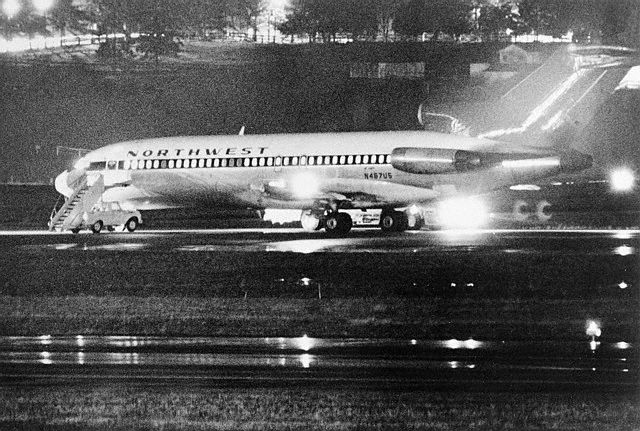 After the money and parachutes were brought aboard, the 35 other passengers, along with 2 of the stewardesses - Schaffner and Hancock - were released. The man in 18E instructed the plane to take off again. He directed that the plane's route pass over Portland and Medford in Oregon, and Red Bluff, California, before landing in Reno, Nevada, to refuel. Then, on to Yuma, Arizona, to refuel again, and then head to Mexico. He also instructed the pilots that the aircraft was to remain below 10,000 feet, maintain minimal airspeed, and keep flaps and landing gear lowered. After the money and parachutes were brought aboard, the 35 other passengers, along with 2 of the stewardesses - Schaffner and Hancock - were released. The man in 18E instructed the plane to take off again. He directed that the plane's route pass over Portland and Medford in Oregon, and Red Bluff, California, before landing in Reno, Nevada, to refuel. Then, on to Yuma, Arizona, to refuel again, and then head to Mexico. He also instructed the pilots that the aircraft was to remain below 10,000 feet, maintain minimal airspeed, and keep flaps and landing gear lowered.
About two hours later, the demands had been met and the 727 retook to the skies, bound to Reno. Less than a half hour later, he ordered Mucklow to the cockpit, as he locked himself in the rear compartment. Cooper then used the cords from the second set of parachutes to bind the bag of money to his midsection.
Within minutes, an on-board warning light indicated that the rear cargo door had been opened, and the cabin temperature dropped to -7 F. It is generally assumed that Cooper jumped from the exit ramp of the Boeing 727 at 8:13 PM. However, as he jumped into the torrents below, a legend was born... A pair of Air Force F-106A, assigned to the 318th Fighter Interceptor Squadron at McChord AFB, Washington, were flying about two miles behind the 727, keeping it within sight. But the pilots never saw anything drop from the 727. The crew continued on to Reno, not knowing if they still carried Cooper or not. On landing, the air-stairs scraping the runway, sending sparks everywhere. Five minutes after touchdown, receiving no answer over the intercom, they exited the flight deck and found the passenger deck empty except for the mangled remains of the second parachute, his black tie, his mother-of-pearl tie tack, eight Raleigh cigarette butts, and 66 possible fingerprints. 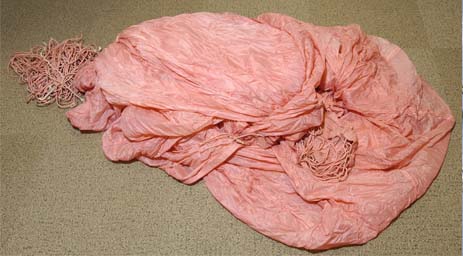 The Game is Afoot... The Game is Afoot...
FBI Special Agent Harold Campbell said in Las Vegas, Nevada, that one of two chutes found onboard the Boeing 727 when it landed without the hijacker in Reno, Nevada, had been opened. But, the supplier of four parachutes delivered to the hijacker revealed the following night that one of the reserve chutes was a ground training model that could not have opened. Cossey said he had packed the other three chutes and was sure they were functional - the chest pack used as the reserve could not have been fastened on the main parachute harness because it lacked D-rings, and had been delivered to the hijacker at Seattle-Tacoma International Airport only by mistake. 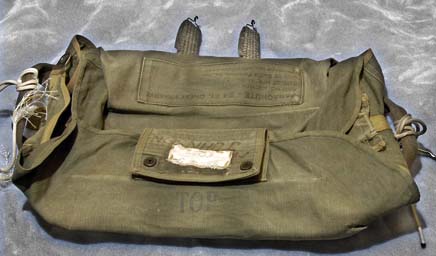 Julius Mattson, agent in charge of the Portland office, said the search by Army Reserve helicopters and light planes would proceed south from the Amboy area. "It's not a bad spot to land if the guy knows what he's doing," Julius Mattson, agent in charge of the Portland office, said the search by Army Reserve helicopters and light planes would proceed south from the Amboy area. "It's not a bad spot to land if the guy knows what he's doing,"
The search for Cooper started with a Lewis County sheriff deputy patrolling a 25 mile section of the Randle-Trout Lake road, and expanded into the northern section of Clark County, concentrated between Woodland and north of the Oregon border in Southwest Washington. From there, the entirety of southwest Washington state, north of the Columbia River, was scoured by ground searchers, boat, and air for nearly 3 weeks. "Either he's hung up in the branches of a tree somewhere and we won't find him until next deer season," said Woodland Police Chief Joe May, "or he's home watching us on television, laughing his fool bead off." Other were less optimistic: "We're either looking for a parachute or a hole in the ground," said Clark County Undersheriff Tom McDowell. Hundreds of soldiers from nearby Fort Lewis tore through foliage, looking for any sign of the skyjacker. But no trace of "Dan Cooper" was found. Authorities were quick to surmise that the lone skyjacker was dead, and the search was called off. | On Thanksgiving, the FBI mounted a search of its national crime records for known felons named Dan Cooper, just in case the hijacker had been foolish enough to use his real name. The agency sent an agent in Portland to the police headquarters there to investigate the rap sheet of a local man, D.B. Cooper. Clyde Jabin, a UPI news wire service reporter, heard that the FBI was nosing around, and inquired to a records clerk as to why. The clerk told Jabin that the agents were checking on D.B. Cooper regarding the hijacking, and so Jabin reported that to his bureau chief. . The man was cleared, but the appellation "D.B. Cooper" was now synonymous with the hijacker. Out of the Woodwork... Having seemed to devise the perfect crime, copycats tried their hands at replicating Cooper's feat. None succeeded without getting caught. The most notable attempt took place on April 7th, 1972, four months after D. B. Cooper's hijacking, when a passenger, registered as "James Johnson" boarded United Airlines flight 855 during a stopover in Denver, Colorado. The aircraft was a Boeing 727 equipped with air stairs, the same type used in the Cooper skyjacking, which Johnson used to escape after giving the crew similar instructions (Johnson did ask for more money - $500,000) as Cooper had. Johnson was carrying a novelty grenade and an empty pistol. He also left his handwritten message, and his fingerprints on a magazine he read on the plane, which the FBI later used to make his real name - 29-year-old Richard McCoy, a decorated veteran of the Vietnam War and a college student at Brigham Young University,. Two days after the hijacking, McCoy was arrested, convicted, and sentenced to 45 years imprisonment. In prison at the Federal penitentiary at Lewisburg, Pennsylvania, and with access to the prison's dental office, McCoy fashioned a fake handgun out of dental paste, which he, and a crew of convicts, used to escape on August 10th, 1974, by stealing a garbage truck and crashing it through the prison's main gate. On the run, McCoy's crew robbed at least one bank in North Carolina. Three months later, the FBI located McCoy in Virginia Beach, Virginia. On the night of November 9th, agents attempted to apprehend him, but McCoy pulled out a revolver, and fired. FBI agent Nicholas O'Hara reportedly fired back with a shotgun, killing McCoy. Out of the Muck... In November 1976, federal authorities realized no one had ever charged Cooper with a crime, so they quickly sought an indictment in Portland just before the statute of limitations expired. So a "John Doe", a.k.a. D.B. Cooper, indictment was issued by assistant U.S. attorney in Portland, Jack Gore Collins, against the hijacker of Northwest flight #305. | The 1980 Copycat On July 11, 1980, a Cooper copycat - right down to the mirrored aviator sunglasses - attempted to hijack a Boeing 727, Northwest Flight 608 abound for Portland, at the Seattle Airport as it was taxiing. 17-year-old Glen Kurt Tripp claimed to have a bomb and demanded a ransom of $100,000 and two parachutes. A quick-thinking stewardess slipped three Valiums into Tripp's drink, and the plane never left the ground. ''It's easy to feel sorry for these guys,'' said Marsha Roberts, who was a flight attendant aboard the hijacked plane. ''This boy was telling us how bad his life had been, how nothing had ever gone right for him.'' During the ten hour standoff, Tripp lowered his demands, and released all 52 of the passengers, settling for three cheeseburgers and a demand to be driven from the airport in a rental car by the two pilots left with him. When the on-scene FBI negotiator, Ron Beiner, said the cheeseburgers would take awhile, Tripp responded, "Forget the cheeseburgers. You said before you'd get the plane and you didn't, so you'd better get the car — this is your last chance." The car arrived, and moments later Tripp came down the steps. In seconds he was jumped by three FBI agents hiding under the plane. The briefcase was shoved up against his chest and snatched away. Later, it was revealed that the suitcase had no bomb - only a jacket. He has convicted of first-degree kidnapping and extortion, but was sentenced to only 20 years probation. If At First You Don't Succeed... However, on Thursday, January 20, 1983, while on probation for his 1980 skyjacking attempt, Tripp - now 20 - tried hijacking the same flight, Northwest Flight 608, as it approached Portland International Airport from Seattle. This time, he was armed with a shoebox, and he was only demanding to be flown to Afghanistan, after complaining that the United States was not helping "his people" and had not been able to see his wife and child there, as he claimed to have been in prison the last 10 years. His story later was discounted by law enforcement officials. After a three hour standoff, at 4:30 pm, he had agreed to unload half of the 35 passengers, who were exiting the plane via the exit ramp, as two FBI agents, standing on shoulders of others, climbed through the cockpit windows. Surprised, Tripp made a sudden motion with the box as if to throw it at the agent, and the agent fired a single shot from his .38 caliber revolver, killing Tripp instantly, and ending the three hour standoff. His story about Afghanistan was later easily discounted by law enforcement officials. Tripp was buried in Escondido, California, with his family. |
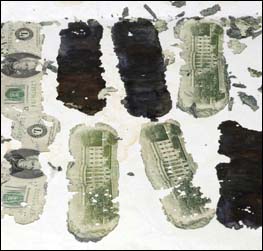
| The trail for Cooper went cold until February 10th, 1980, when an 8- year-old Vancouver, Washington, boy, named Brian Ingram, found a decomposing pack of Twenty-dollar bills on the shore of the Columbia River, at a place named "Tena Bar." The FBI confirmed by serial numbers that the bills were from Cooper's ransom. But the location of the discovered loot gave investigators pause. A hydrologist figured that this money had been deposited on the river bank in August of 1974, nearly three years after Cooper's jump, and speculated that it probably was carried along by the river current and deposited where it was found. Or was the money "planted" on the site by some with access to the stolen
money? Perhaps even Cooper himself... Click Here to Search the Serial Numbers of D B Cooper's Loot "Cooper Fever..." The town of Ariel, Washington, which is near the area where Cooper is believed to have jumped, has a yearly "D.B. Cooper" festival during Thanksgiving week - a tradition which dates all the way back to 1976. The May 18, 1980, eruption of Mt. Saint Helens covered much of the area with ash, making the search for Cooper's trail, and his loot, much more difficult. 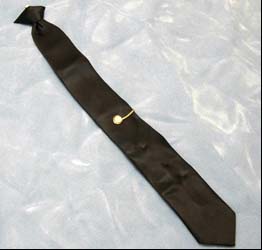 But not impossible. Scientific advances in the field of forensics have yielded genetic material, or DNA, from the thin, black, clip-on tie that Cooper wore, and removed before he jumped. According to the current FBI Special Agent in charge of the investigation, Larry Carr, "Unfortunately, the DNA right now is such that we can only exclude individuals, not really include them. But, it's still a very powerful tool because it can eliminate suspects." In February of 2007, the DNA evidence was used to eliminate suspect Duane Weber, who was a favorite amongst amateur Cooper sleuths, from consideration. But not impossible. Scientific advances in the field of forensics have yielded genetic material, or DNA, from the thin, black, clip-on tie that Cooper wore, and removed before he jumped. According to the current FBI Special Agent in charge of the investigation, Larry Carr, "Unfortunately, the DNA right now is such that we can only exclude individuals, not really include them. But, it's still a very powerful tool because it can eliminate suspects." In February of 2007, the DNA evidence was used to eliminate suspect Duane Weber, who was a favorite amongst amateur Cooper sleuths, from consideration.
Also in 2007, a "Citizen Sleuth" team was established, in cooperation with the FBI to investigate the evidence of the 1970 hijacking. Their findings can be found on this website. A Unique Contribution... Dubbed the "Cooper vane", it is a very simple device consisting of a spring-loaded paddle connected to a plate. When the aircraft is on the ground, the spring keeps the paddle perpendicular to the fuselage, and the attached plate does not block the stairway. But as the aircraft takes off, the flow of air pushes the paddle parallel to the fuselage, and the plate is moved underneath the stairway, preventing it from being lowered. Once the airflow decreases on landing, the spring-loaded paddle returns to its initial position, thus allowing the stairs to be lowered again. Although this device was intended to prevent hijackings aboard the 727 and other aircraft equipped with an air-stair, many airlines sealed the air-stair entirely, never to use it again. Epilogue... The Boeing 727-051 used by Northwest (and Cooper) was sold to Piedmont Air in 1978, and re-registered as N383N. and borne the name "Mt. Mitchell Pacemaker". It was later acquired by Key Airlines in 1984, and re-registered as N29KA. It was then acquired by WorldCorp Leasing after Key went under in 1993, was flown to Mississippi, and was scrapped by "The Memphis Group". A commemorative plaque had been installed aboard the plane, denoting it connection to Cooper's jump. Clyde Jabin, who's mistake applied "D.B." to Cooper's name, spent more than three decades with UPI, but died in a 2001 car accident at age 73. Today, the FAA has numerous safety precautions and security procedures in place D.B. and Tripp's attempts would not have gotten very far. Airports and airplanes are now equipped with security cameras, and standards, policies, and procedures to maintain transportation safety are under continuous review. Numerous books have been written on the caper, including one, written by the lead FBI agent on the case, Ralph Himmelsbach, and entitled Norjak - the Investigation of D B Cooper . Himmelsbach retired from the FBI in 1980. . Himmelsbach retired from the FBI in 1980. In 1981, a film named "The Pursuit of D.B. Cooper", starring Treat Williams as Cooper and Robert Duvall as Cooper's fictional former military commander, offered a heavily fictionalized account of Cooper's jump and pursuit.. The hunt of Cooper's loot was also the driving force in the 2004 movie, Without A Paddle. On July 12th, 2016, the FBI's Seattle field office announced that, "Following one of the longest and most exhaustive investigations in our history, on July 8, 2016, the FBI redirected resources allocated to the D.B. Cooper case in order to focus on other investigative priorities. During the course of the 45-year NORJAK investigation, the FBI exhaustively reviewed all credible leads, coordinated between multiple field offices to conduct searches, collected all available evidence, and interviewed all identified witnesses. Over the years, the FBI has applied numerous new and innovative investigative techniques, as well as examined countless items at the FBI Laboratory. Evidence obtained during the course of the investigation will now be preserved for historical purposes at FBI Headquarters in Washington, D.C." Cooper's likeness now adorns numerous items - click here to purchase |
|