Northwest Airlines Flight 255 Romulus, Michigan August 16, 1987  What is in a Name? What is in a Name?
Northwest Airlines was founded in 1926 by Colonel Lewis H. Brittin,an engineer working for the St. Paul Association, a business and civic organization. He had assembled a group of investors from Detroit and St. Paul, and incorporated the venture under the name "Northwest Airways". Like many other early airline ventures, Northwest's early focus was not in hauling passengers for hire, but in flying the airmail under contract for the United States Post Office Department. The fledgling airline started carrying the mail on October 1st, 1926, at the contract rate of $2.75 per pound along the contract mail route (CAM 9) between Minneapolis and Chicago, using open cockpit biplanes such as the Curtiss Oriole. The company began flying passengers in 1927, going international the following year with service to Winnipeg, Canada. The airline continued to expand, with a particular focus on east Asian destinations after World War II, going so far as to re-brand itself as "Northwest Orient Airlines", although the legal name of the company remained Northwest. In October of 1986, Northwest purchased its competitor, Minneapolis-St. Paul-based Republic Airlines and adopted its three-hub network centered around Minneapolis-St. Paul, Detroit, and Memphis. Northwest dropped the word 'Orient' from its brand name after the merger.
An Awkward Acquisition...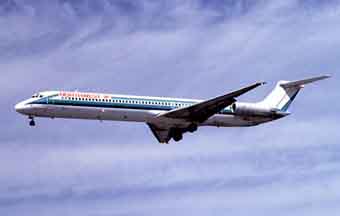 | A photo of MD-82 tail number N312RC, painted in Northwest livery, taken before the crash |
Northwest Airlines' aircraft fleet, before the merger, consisted of only Boeing airplanes and McDonnell Douglas DC-10s. With the merger, Northwest acquired a fleet of 134 DC-9s (several of the MD-80 series variants), 3 Boeing 727s, and 6 Boeing 757s from the assets of Republic. Among the DC-9s, was a MD-82, tail number N312RC. It had been completed by McDonnell Douglas on October 15th, 1981, and delivered to Republic Airlines on December 8th, 1982. The MD-80 (also called the DC-9-80) series is a mid-size, medium-range airliner that was introduced in 1980. The design was the next generation of the DC-9, with a longer fuselage and two rear fuselage-mounted Pratt & Whitney JT8D 200-series turbofan engines, small, highly efficient wings, and a T-tail design. The MD-82 (also known as a DC-9-82) was a further variant, featuring stronger engines and a greater range than a standard MD-80. Since the pre-merger Northwest Orient Airlines did not operate DC-9 type airplanes, the former DC-9 training staff at Republic Airlines, except for some procedural changes in chain-of-command structure and reporting, remained intact throughout the changeover. Most of the flight crewmembers from Republic also stayed on after the merger. With few pilots at Northwest trained to fly DC-9s, MD-80s, and the like, the former Republic pilots and staff had a fairly secure position in the new organization. 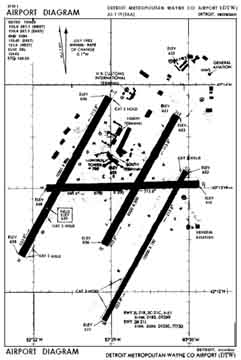 | | An FAA layout diagram of Detroit-Metro in 1987 |
The Buckle of the "Rust Belt"... Originally opened as a small regional airport in 1930, and located about about 15 miles south of downtown Detroit, in the suburb of Romulus, Michigan, the Detroit Metropolitan - Wayne County Airport was the United States 12th busiest airport, handling 15 million passengers in 1986. Lying at a field elevation of 639 feet above sea level, "Detroit-Metro" became the major hub for Republic Airlines, operating out of the James M. Davey terminal building, in 1984, and was in a state of growth, having recently begun non-stop flights to Tokyo, and was preparing for the construction of a new cross-wind runway. However, on March 4th of 1987, a CASA 212-200 "Aviocar", tail number N160FB and operating as Northwest Airlink Flight 2268, crashed near Concourse F of the Davey terminal building. Killing 9 of the 19 aboard the plane, and injuring 10 on the ground, including 2 in a Sky Chef catering truck, the plane crashed as a result of the captain's inability to control the airplane in an attempt to recover from an asymmetric power condition at low speed. Fire-fighting and rescue crews from the Detroit-Metro airport fire department responded to the blaze. It would not compare, however, to the accident awaiting them five months later. Sunday Services Northwest Flight 255 was a regularly scheduled passenger flight of a MD-82, that day being N312RC, between Saginaw and Santa Ana, California, with en route stops at Detroit and Phoenix, Arizona. At about 6:53 PM, on Sunday, August 16th, 1987, Flight 255 departed Saginaw and, at 7:42 PM, arrived at its terminal gate at the Detroit-Metro Airport. About 15 minutes before the flight was due to depart the gate, a company transportation agent brought the flight release package to the airplane. He was met by the first officer who told him that the captain was not on board. The first officer inspected the package which contained the dispatch documents, signed the release, and returned the signed copy to the agent. As the agent left the airplane, he met the captain who had been conducting a walk-around inspection of the airplane and showed him the signed copy of the flight release. The captain studied the release, told the agent that it was all right, and thanked him. At 8:32 PM, the aircraft pushed back from its gate, D-15, and a minute later started its engines, and taxied for takeoff on Runway 3C, a 8,500 feet long, 200 feet wide, strip of concrete and grooved asphalt, following a magnetic heading was 33.5”. Having been advised of the possibility of low level wind shear, a potentially deadly weather phenomenon, causing a sudden change in wind's speed of 15 knots, and/or a change in direction of 30 degrees or more, a thunderstorm had also been reported about 18 miles away from the airport, and a light drizzle of rain falling at the airport. 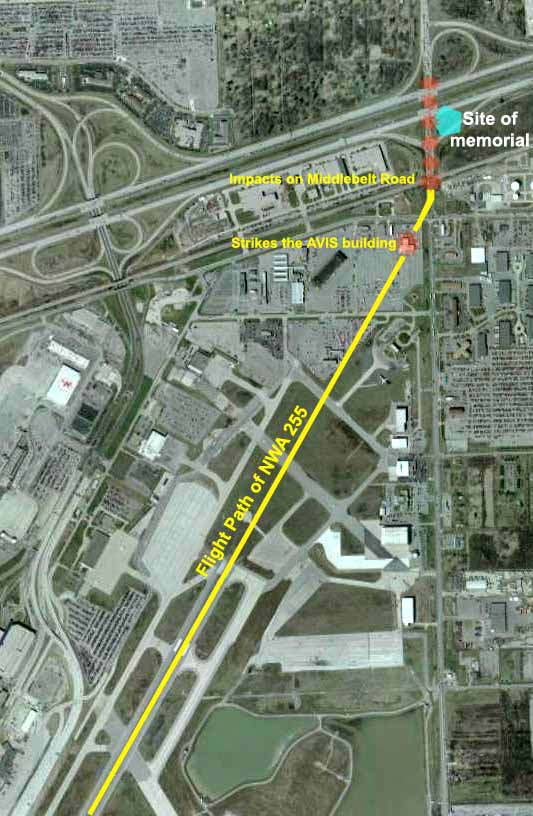 On the Roll... On the Roll...
At 8:44 PM, Northwest 255 was cleared for takeoff. The flight crew advanced the throttles, began their takeoff roll, and rotated skyward at exactly 8:45 PM. Twenty seconds later, the unthinkable would happen. According to witnesses, Flight 255 began its takeoff rotation about 1,200 to 1,500 feet from the end of the runway, very late in the roll, and lifted off near the end of the runway. After liftoff, the wings of the airplane rolled to the left and the right about 35 degrees in each direction. The airplane's left wing collided with a light pole to the northeast of the runway, ripping away a 15-foot long section of the wingtip. Continuing forward, the airplane struck other light poles, the roof of the Avis Rental Car building, and then slammed into the ground. Propelled forward by its sheer mass and inertia, the fuselage, burning from the ignition of 6,000 gallons of Jet-A liquid fuel, continued to slide along a path aligned its the takeoff runway. The airplane, shattered from the impact, broke up as it slid across the ground, leaving flaming gas and burning debris in its wake. Jim Zagan, a resident near the airport and with his face still red from exposure to the intense heat, told newspaper reporters shortly after the crash, "I started to run toward the fire, then there was a huge whoosh and a red fireball coming toward me. I couldn't keep going because of the heat and fire," He then added, "Middlebelt Road was on fire from the fuel. Seven or eight streams of fuel, on fire were running down the road. It was unbelievable." 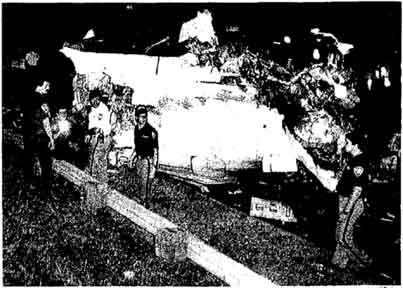 | 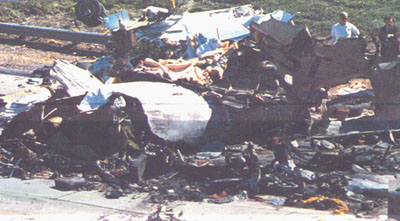 | | Investigators examine a piece of the MD-82s fuselage | A large section of fuselage, showing the plane's exterior, lies burned on the roadside. | 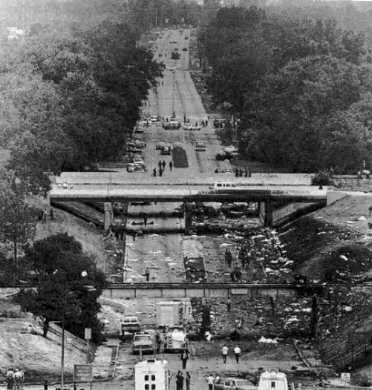 | 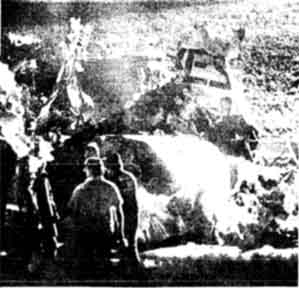 | | Looking down the debris field on Middlebelt Road | In a downpour, rescue workers comb the wreckage |
In The Wake of Disaster... Of the persons aboard Flight 255, 148 passengers and 6 crewmembers were killed. Of note, one of the passengers on the flight was Nicolaas "Nick" Vanos, a center for the Phoenix Suns basketball team for two seasons. Drafted by the Suns out of Santa Clara University in 1985, Vanos was a 7-foot-2-inch tall, 260-pound player with great potential, and the team's hope for the years ahead. He had spent four days in Plymouth, Michigan, vacationing with a friend. On the ground, two persons driving travelling northbound on Middlebelt Road were killed, one person was injured seriously, and four persons suffered minor injuries. Click here for a list of those killed in the crash of Northwest Flight #255 Three occupied vehicles on a road adjacent to the airport and numerous vacant vehicles in a rental car parking lot along the airplane’s path were destroyed by impact forces and fire. Detroit Edison stated that between 1,500 and 2,000 homes and businesses were without electricity in the area near the airport. State police closed eastbound Interstate 94 and Interstate 275 near the airport following the crash. Conspiracy?! FBI agents were sent to the scene based on a report that there might have been an explosion before the crash. However, Joseph Jackson, the assistant agent in charge of the FBI's Michigan's operations, described the agency's presence as routine and said "there's absolutely no indication of anything other than an accident." Investigators viewing the wreckage of the aircraft, were quickly drawn to the flaps and slats, which were found retracted and not extended. Without their deployment, an airplane would behave exactly as the DC-9 had. It might get off the ground, but wouldn't climb significantly. An analysis of the plane's cockpit voice recorder showed that the crew hadn't initiated the standard taxi checklist. The first item on the list: extension of the flaps and slats. Click here to hear the final seconds of Flight 255's Cockpit Video Recorder. Northwest Airlines had recently changed its procedures to eliminate the flap setting from the pre-takeoff checklist, although it continued to be part of the checklist conducted while taxiing. Prior to the merger, Northwest had included the flap setting as part of its taxiing checklist, while Republic had used the pre-takeoff checklist, according to FAA spokesman Fred Farrar. FAA regulations require the setting to be included in only one of the checklists.A Drop of Hope in a Sea of Despair... A fire fighter for the Romulus Fire Department, Dan Kish, heard the sound of a muffled whimper in the strewn wreckage. He and his fellow rookie firefighter, John Thiede, began to search to its source among a field of yellow blankets, used to cover the deceased, when Thiede lifted up a airplane seat, and spotted movement - the small arm of a little girl. Amidst such terrible destruction, there was a survivor! The pair called over Roy Brindamour, a volunteer firefighter and emergency medical technician who, as a day job, worked for Northwest Airlines. He cut away the girl's seat belt and quickly examined her. Some paramedics and rescue workers on the scene originally assumed she may have been traveling in a vehicle rather than in the plane. An ambulance crew -staffed by paramedics Pam Davidson & Tim Schroder - rushed over to help the girl, taking her to Oakwood Annapolis Hospital in the nearby city of Wayne. The young girl was Cichan, a 4-year-old traveling, in seat 8F, with her parents and older brother, on a return flight from a visit to her grandparents in nearby Warminster. She had third-degree burns over 30 percent of her body, suffered a broken leg, and experienced difficulty breathing. "Her survival was due to being padded by her mother, at least we assume it was her mother," said Pam Davidson, one of the paramedics present when Cichan was found. "There was debris everywhere and there was no way to determine if the wreckage was part of the plane or another vehicle." However, in mid-December 1987, when files of the National Transportation Safety Board's investigation of the accident became available, it was revealed that the girl had been found still strapped in her seat 35 yards away from the body of her mother and 6 to 8 feet away from any other bodies. Early press accounts identify Donald Daughenbaugh, only 21 years old, and rookie Romulus volunteer firefighter, as Cichan's rescuer. But Daughenbaugh was not connected with the rescue of Cichan until a press conference 3 days after the crash. The media confused accounts of the rescue, and gave Daughenbaugh sole credit for locating and helping Cichan receive treatment. The Romulus Fire Department elected not to miscredit him, and simply included him as one of the rescuers. In March of 1991, Daughenbaugh died suddenly in line of duty. A Ticket to Ride...  A wide receiver for the Detroit Lions football team, Pete Mandley, and his wife Teresa, 7-year old son, DeJhown, and infant daughter Treazure , attended a Lions' football practice that same day at Oakland University, and had reservations on Flight 255. The Lions lost to Indianapolis the previous Saturday night, in an exhibition at the Silverdome, and Treazure had had a reaction to some medication. The decision to stay another day in Detroit, instead of returning to their home in Arizona, saved their lives. A wide receiver for the Detroit Lions football team, Pete Mandley, and his wife Teresa, 7-year old son, DeJhown, and infant daughter Treazure , attended a Lions' football practice that same day at Oakland University, and had reservations on Flight 255. The Lions lost to Indianapolis the previous Saturday night, in an exhibition at the Silverdome, and Treazure had had a reaction to some medication. The decision to stay another day in Detroit, instead of returning to their home in Arizona, saved their lives.
The day after the crash, at 3 PM, Teresa, DeJhown and Treazure boarded their flight home -- on United Airlines -- but there was more distress awaiting them. Teresa's mother, Fay White, had been rushed to a Mesa, Arizona, hospital with a mild heart attack after hearing the initial news reports - she hadn't known they changed flights. Mandley was joined the Kansas City Chiefs in 1988, and retired from professional football, after 7 seasons, in 1990. After the Smoke Settled... The death toll from the crash made it the nation's second worst in the nation's history at the time, surpassed only by the crash of an American Airlines DC-10 on May 25, 1979, at Chicago's O'Hare International Airport, killing 275 people. The National Transportation Safety Board ruled the plane's crew failed to set the wing flaps properly for takeoff. The board also said a cockpit warning system failed to alert the crew to the problem. After an 18-month long trial, and 16 days of deliberation, the federal jury ruled that Northwest Airlines should bear 100 percent of the responsibility for the crash, saying the flight crew's negligence contributed to the crash. The jury also said Northwest was negligent in its training and supervision of the crew. Northwest Airlines had contended that the maker of the plane, McDonnell-Douglas, was responsible for errors in design and construction of the craft. Click here to read the ruling regarding NWA# 255 In June of 1988, the Phoenix Suns filed a suit in Federal court in Detroit against Northwest Airlines and the McDonnell-Douglas Corporation, asserting that Nick Vanos, who was under a long-term contract, was irreplaceable to the team, despite him averaging only 2.9 points in 57 games in the 1986-87 season. In 2007, Santa Clara University retired his jersey & number, #32, in his memory. Cecelia Cichia underwent four successful skin-graft operations at the University of Michigan Medical Center, and was released from the hospital in October of 1987. Due to media attention, she received nearly 2,200 gifts, mostly stuffed animals, more than 30,000 cards and over $150,000 in donations. Her grandparents, Tony and Margaret Cichan, asked that the mountain of gifts be sent to charities and hospitals in Philadelphia, Phoenix and the Detroit area, because they were the hometowns of their family members, and the Detroit area because of the hospitality and generosity of residents there. Cecelia would live with her mother's sister, Rita Lumpkin, and Rita's husband, in Birmingham, Alabama. In January of 1988, when her parents estate was probated, the court file was sealed so, in the words of Judge John Kirkendall of Washtenaw County, she would be allowed to ''grow without the glare of publicity." Lasting Tributes... Author Rose Weite, whose husband was killed in the crash, was forced to confront death head-on. In an effort to cope with the loss, she wrote the book, After the Crash. Her first-person account describes her struggle to come to terms with her personal tragedy & to grow spiritually from it. The tome takes an honest, and sometimes painful journey through the labyrinth of emotions that death leaves in its wake. The result is not a morose, self-pitying diary but an uplifting testimony to the resilience of the human spirit & the life-affirming lessons that even death can teach. In memory of the victims of the crash, a black marble memorial stands, surrounded by Blue Spruce trees, near the Middlebelt Road & Interstate 94 Overpass. On the memorial , a pair of etched doves with a ribbon in its beak reads "Their spirit still lives on..." and has the names of those who perished in the crash. The remains of many of the 156 killed when unidentified (based on the technology of the time). Their remains were interred at the United Memorial Gardens, near Plymouth, Michigan. Eleven caskets were buried, and bronze markers were placed. Nearby, a bronze statue of little girl swinging in a swing set, and a flagpole, were placed, as well as two memorial tablets - one commemorating those lost in granite which reads:"Memory Comes to Life - When we recall the date August 16,1987 and the air tragedy at Metropolitan Airport seconds after takeoff, 156 persons were ushered into another world. Four year old Cecilia Cichan received a most precious gift, Life. Her name will be recorded in aviation history as the sole survivor of flight 255.", and another recognizing donors to Children's Hospitals in bronze. An online memorial to those lost resides at http://www.flight255memorial.com/ |