Last of the Giants… Near Palisade, Nebraska February 6th, 1970 Global Reach... Powered by four Pratt & Whitney T34-P-9W turboprop engines, each producing 7,500 horsepower, the Douglas C-133B ‘Cargomaster’ could carry up to 110,000 pounds of cargo. The airframe, and its 179 feet wingspan, and 157 feet of length, was even massive enough to transport the Atlas, Titan and Minuteman families of ballistic missile, and could fly at a speed of over 300 knots for a range of up to 3,560 miles. The C-133 was for many years the only aircraft capable of hauling very large or very heavy cargo. Despite the C-124 Globemaster's capabilities, there was much cargo that it could not carry because of its configuration with a cargo deck 13 feet off the ground and its lower, though substantial, engine power. The Air Force purchased fifty of the airborne behemoths as the backbone of their Military Air Transport Service. A Transcontinental 'Milk Run'... The mission that Thursday night was a sortie from Travis AFB, California, to Harrisburg, Pennsylvania, to transport several Lycoming T53 and T55 engines in sealed transport containers, and one Boeing CH-47B Chinook (possibly #67-8487), all bound for the US Army Depot in New Cumberland, Pennsylvania. The flight crew, part of the 1501st Air Transport Wing at Travis AFB, consisted of: Pilot and aircraft commander Major Harold W. Tabor, 44, and a native of Grand Junction, Colorado. His co-pilot, 1st Lt. Duane D. Burdette, 24, was from Gahanna, Ohio. The flight loadmaster was Staff Sgt. Ira E. Bowers, 38, of Plymouth, New York, and the two flight engineers aboard were Master Sgt. Joseph P. Tierney, 34, Fairfield, California, and Tech Sergeant James J. Clouse of Vacaville, California. 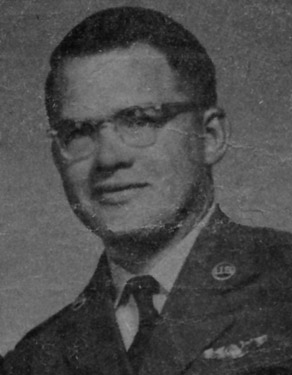 | Technical Sergeant James J. Clouse |
Making the Family Proud... Originally from Eddyville, Nebraska – James Clouse, a devout Catholic, was a husband and father to seven children. He enlisted in the Air Force in July of 1952. He had served in the Air Force nearly 18 years to that point, and served in Korea, and two tours in Southeast Asia – one in Vietnam, and the other in Thailand. While in Vietnam, on January 19, 1969, Clouse was flight engineer aboard a Special Operations CH-3E helicopter (tail number #63-09689, and callsign 'Knife 26') that was refueling at Nakhon Phanom Royal Thai Air Force Base when it was asked to respond to a fire northeast of the air base. Co-pilot Captain Tryon S. Lindabury initiated the aircraft’s approach while the pilot, then-Captain Phillip J. Conran, covered the pre-landing checklist. Lindabury, disoriented as a result of focusing exclusively on the ground fires, developed vertigo and went from a straight-in descending approach to a nose-high unusual attitude. Before Conran could take corrective action, the helicopter settled into one hundred foot trees. The blades striking, the aircraft then fell to the ground like a rock, and the helo rolled on its side and caught fire. Conran, Lindabury, and Clouse escaped, but after hearing screaming coming from the rear of the helicopter, Conran and Clouse returned to the fiery wreck. Although the flames were intense, and ammunition was exploding around them, the two Americans managed to extricate a fourth crewmember - gunner Bill Sawyer - trapped in the helicopter. The helicopter blew up as soon as Conran and Clouse took the immobile crewman from the area. Clouse received the Airman’s Medal - the highest decoration an Air Force member may be awarded for non-combat heroism - along with Major Conran for their actions. A month later, in late February of 1969, Clouse again displayed heroism when, near the South Vietnam DMZ, he penetrated intense hostile fire to rescue five crewmembers from certain death who had been shot down for enemy forces. For his actions, Clouse was awarded the Distinguished Flying Cross "Like Fireworks Going Off"... 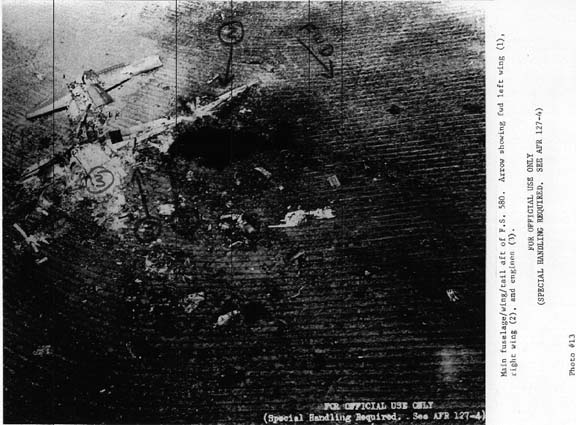 | Aerial view of the crash site of #59-0530. Number 1 is the plane's left wing, #2 is the right wing, and #3 is the engines. (USAF Photo) | 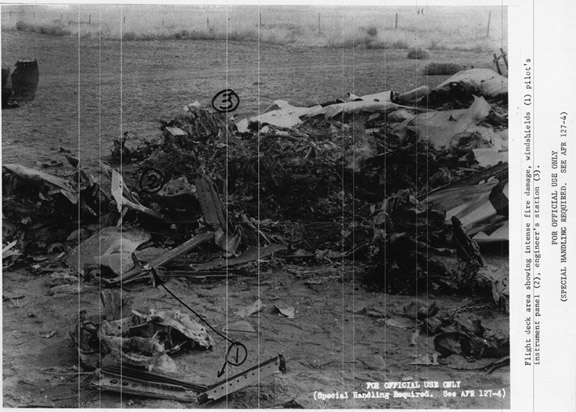 | Fire damage to the flight deck of #59-0530. Number 1 is the plane's windshield, #2 the instrument panel, and #3 is the engineer's station. (USAF) | 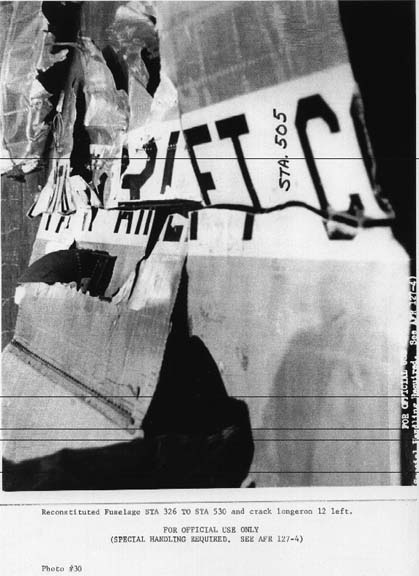 | The reassembled fatigue crack in the plane fuselage. It had gone unnoticed due to the aircraft's paint. (USAF) |
At about 2:25 a.m. early Friday morning, Cargomaster #59-0530 crashed and exploded in rolling pastureland on the Earl Smith ranch five miles northwest of Palisade, Nebraska, a town of about 540 population. All five of the Air Force crewmen aboard, including James Clouse, were killed. "It looked like a big ball of fire and then like fireworks going off," said Wayne Carse, a farmer, who witnessed the crash from eight miles away. He further stated the plane apparently exploded on impact. A team of Air Force accident investigators from Offutt Air Force Base near Omaha combed through the wreckage that very afternoon to determine the cause of the crash, sealing the crash site off from the public. Torn Asunder... An engineer and designer for Douglas, Roy Isaacs, flew to Nebraska to help with the investigation. There, while standing on the stage of the town’s National Guard armory and looking at the wreckage that had been assembled there, he noticed something. “You could see all the jagged pieces, but here was a straight line by the side cargo door,” he says. Isaacs used a jeweler’s loupe to examine the edge of a long split about a foot above the side cargo door. Clearly, the metal had fatigued and failed. The Air Force investigation found that an existing 11" crack above the left side door, and hidden under the aircraft’s paint, suddenly expanded lengthwise, resulting in further tearing of the upper forward fuselage skin for a length of nearly 17 feet. This rapid crack development in the fuselage set off an explosive decompression of the plane's cabin, as the plane was cruising aloft at 23,000 feet. This caused large sections of the aircraft aluminum skin, from both the top and right side of the fuselage, to be peeled back and away, blowing portions straight back, and into the right inboard engine - setting it ablaze. The resulting stresses tore the plane apart, and rained ruin down on the Nebraska countryside. James Clouse was buried at St. Patrick's Catholic Cemetery near Kennebec, Nebraska, in Lot #13 of the cemetery's western half. Calling It Quits... To prevent further airframe stress failures during the remaining months of the Cargomaster’s service, ground crews attached 16 “belly bands,” four-inch metal straps, around the exterior of the fuselage. By 1971, a year after this final crash of a C-133B, and shortly before the introduction of the T-tailed Lockheed C-5 Galaxy, the Cargomasters still in service were deemed obsolete and worn out (their original airframe duty life of 10,000 having been extended three times, first to 15,000, then 17,000, and finally 19,000 hours of flight time) and were all slated for withdrawal from duty by the Air Force. Over their service life, severe vibrations from the 18-foot in diameter propellers that the Cargomasters used had caused critical stress corrosion of the airframes to the point that the aircraft were beyond the point of economical operation. However, the Air Force managed to maintain and keep many of the aircraft in its fleet of C-133s in service until the C-5 finally entered squadron service in October of 1970. The final C-133 flight took place in 2008, when a civilian Cargomaster, registered as N199AB, flew from Alaska to California to become part of the Travis Air Museum’s collection. We are currently searching for more photos of the crash site taken during the investigation. If you have any - please contact us. |



 ) at Amazon.com