The Last Flight of Liberator 41-1133April 22, 1942 "Rendezvous with Tragedy"George Van Hoozer, the flight engineer, opened the access panel, reached in, and pulled the auxiliary bomb door valve handle which retracted the B-24's bomb bay doors. He stepped up into the bay, opened all four fuel valves, and checked to see that the bomber had been properly refueled. With 2100 gallons on board, the ship was almost up to its 2348 gallon main tank capacity. After the fuel check, Van Hoozer started the auxiliary power unit (APU). The aircraft commander, Robert Redding, and the instructor co-pilot, Jonas Ruff, were just completing their walkaround inspection of the B-24D Liberator. They, along with two observers, Lieutenants Roland Jeffries and Charles Reynard, and a passenger, H.F. Blackburn, then clambered up to their stations. Ruff gave Van Hoozer the OK sign that the master switch and all ignition switches were off whereupon Van Hoozer and Corporals Duane Peterson and Phillip Macomber started pulling the large, 3-bladed propellers through two complete revolutions to clear any accumulated gas and oil from the engines' lower cylinders. Peterson and Macomber kicked the wheel chocks into place and then entered the bomber, leaving Van Hoozer standing outside with a fire extinguisher by the number three engine. In the meantime, the pilots had been going through their pre-takeoff rituals of removing the control lock, checking the controls for free movement, turning the battery switches to "on," confirming the generator switches as "off," flipping on the master and ignition switches, and setting the brakes. The checks continued: avionics master switch, on; automatic flight control, off; altimeter, set to field elevation; de-icer and anti-icer controls, off; intercooler shutters and cowl flaps, open; prop controls into high RPM; turbo-superchargers ("turbos"), off; mixture controls, in idle-cutoff. The actual starting sequence called for good coordination as the co-pilot flicked on the fuel booster pumps, and reached for the accelerator switch just as the pilot was advancing the number three engine throttle to about one-third open. The co-pilot pushed the accelerator switch, held it there, and jabbed intermittently at the priming switch. Following a few shots of prime, the co-pilot then pushed the crank switch. In a few seconds, after some coughing and a few wisps of smoke, the engine caught whereupon Captain Redding moved the mixture control into auto-lean. As soon as the other three big Pratt & Whitney Twin Wasps were running, Van Hoozer pulled away the wheel chocks, entered through the bomb bay, retracted the doors, and cut the APU. After quickly checking the oil pressure, vacuum pumps, anti-icers, and de-icers, Redding taxied the big ship out to the active runway, held short, and went through the last series of checks: prop controls cycled and returned to high RPM; aircraft trimmed for takeoff, mixture controls into auto-rich; fuel pressure and booster pumps checked again; oil pressure/temperature and magnetos checked at 2000 RPM; superchargers engaged; flaps down 20 degrees; generators on; cowl flaps to one-third open; and landing gear pressure checked. Redding turned onto the active runway, set the directional gyro to the runway heading, and advanced the four throttles which sent vibration throughout the ship as the engines' 4800 horses started bellowing at full power. The co-pilot called out the airspeeds as he held the throttles against the stops. At 90 mph, the control column was eased back, and at 110 mph, the "Lib" broke ground. The pilots shortly went through another checklist sequence by raising the gear, reducing manifold pressure and RPMs, retracting the flaps, trimming the ship for climb, and cycling other system switches. It was just a few minutes after 8 AM, Wednesday morning, April 22, 1942. The place: Kirtland Field, Albuquerque, New Mexico. The mission: a navigational, round trip training flight to Kansas City. The mission, tragically, would not be completed since the Liberator would crash in the Cimarron Mountains, and become known to generations of Philmont campers as "the bomber wreck on Trail Peak." Later accounts of the crash suggested that the crew was testing a new radar system. This is most unlikely since the only American Liberators which were radar-equipped in early 1942 were a squadron of LB-30s (the export version of the B-24) which had been modified with British radar for use in Panama Canal Zone defense. The radar connection is also unlikely considering the unit to which the ill-fated Liberator was attached. The B-24 was allocated to the Combat Crew Training School (CCTS), one of several units assigned to Albuquerque's Kirtland Field. The base was on one of the many municipal airports whose facilities had been leased by the Army Air Force during the military build-up in 1941. The CCTS was also known as the "Four-Engine School," since its original purpose was transitioning Air Transport Command ferrying crews to the four-engine Liberator. Kirtland's primary mission, however, was training bombardiers, a role that was swiftly expanded in 1942. The Four-Engine School, opened in the autumn of 1941, would depart Kirtland in May of 1942 when it was transferred to Smyrna, TN. With the tension of takeoff behind them, and the boredom of flight starting to set in, the crew may have started chattering on the intercom about the recently opened professional baseball season, the latest base scuttlebutt, or the war news. The war was not going too well for the Allies in late April 1942. The important naval battles at Coral Sea and Midway were a few weeks away, and American air forces were fighting defensive battles in the southwest Pacific and China/Burma/India theaters. In Europe, the Luftwaffe and Royal Air Force were trading their heaviest blows at night while the air war on the Russian front was in a lull. Only over the island fortress of Malta in the Mediterranean Sea was the air war red-hot as the hard-pressed RAF fighter pilots denied aerial supremacy to the Luftwaffe and Italian Regia Aeronautica. Very few B-24s, other than those operated by the Royal Air Force in specialized transport and maritime reconnaissance roles, were involved in the allied effort at that point. It would be nearly a year before the Liberator showed up at world fronts in numbers. But, it would eventually dominate aircraft production -- more B-24s were produced than any other type of American aircraft during the war. The one aircraft type that was most in the news on April 22nd was the B-25 Mitchell medium bomber. Jimmy Doolittle's Raiders, flying sixteen Mitchells, had bombed Tokyo and other Japanese cities just four days before. Robert Redding would not have been destined for such an operational assignment in the immediate future, nor would have Ruff or Van Hoozer. Captain Redding was a civilian employee of TWA as were Ruff and Van Hoozer. TWA, with its wealth of experienced, multi-engine pilots, operated the CCTS under contract to the Army Air Force. Darkly handsome and with the veteran pilot's commanding presence, Redding was an instrument instructor pilot, the operations officer of the CCTS, and a highly seasoned pilot with an Airline Transport Rating acquired in the early 1930s, nearly 4200 hours total time, 230 hours in the previous month, and 150 hours in Liberators and LB-30s. Redding, age 27, had been consumed by aviation since his teenage years. He had learned to fly and secured advanced ratings at Love Field in Dallas following his 1931 graduation from high school in Minitare, Nebraska. In the following years, Redding flew transport aircraft throughout the western United States and Central America, but also maintained a small farm just northeast of Minitare. Although not on active duty at the time of the accident, he was a rated military pilot with the rank of Captain in the Air Force Reserve. At 32, Jonas Ruff was the oldest pilot on board. Like Redding, he was an Army reservist, but participating on this flight solely as a TWA instructor. Prior to his affiliation with TWA, Ruff had been a civilian employee and instrumentation specialist for both the Army and Navy in Washington, DC. Ruff, a pilot of twelve years standing, was a native of San Jose, CA, and, after becoming a licensed pilot, had participated in a number of air tours (long distance, cross country aerial rallies). He had worked briefly in the Peruvian mining industry while in South America in the mid-1930s, and, in subsequent government service, had been assigned to temporary duty in the Panama Canal Zone which is where he may well have met Redding for the first time. Their particular B-24 (Liberator Serial # AAF 41-1133) was practically brand new; it had been accepted from the manufacturer, Consolidated Aircraft, only six weeks earlier, and had been flown less than 120 hours. The '24 was a good looking ship -- when viewed from head-on. From any other perspective it looked like a great wallowing beast right out of some Jurassic barnyard. With its deep, slab-sided fuselage and barndoor twin tails, the Liberator could not approach the graceful appearance of the "Queen of the Skies," the Boeing B-17 Flying Fortress. The B-24 was not designed for beauty; rather, it was designed to haul a very heavy load of bombs, very high, and very far -- a job at which it performed admirably. Shortly after 11:30 AM, Redding initiated the descent into Kansas City, and with his co-pilot, ran through the checklist routine which would place them on the downwind leg at approximately 150 mph. Various pressures were checked, gear lowered, auto-pilot confirmed off, cowl flaps closed, mixture controls moved into auto-rich, intercooler shutters verified open, booster pumps turned on, flaps lowered to half, turbo controls shut off, props switched into high RPM, and flaps finally dropped fully down on final approach when making the field was assured. Eyes fixed on the runway, the pilot gently pushed, pulled, and turned the controls in a series of coordinated movements so as to directly align the bomber with the runway centerline at 120 mph and in position to touch down on the first quarter of the runway. Lt. Roland Jeffries, age 21, probably was looking out to the southeastern horizon and the Ozarks on that clear, sunny day. The visibility was good, and he may have seen certain bluffs along the Osage River which held special memories. There, he had been an active member of the Tribe of Mic-0-Say, the honor camper program at the Kansas City Area B.S.A. Council's Camp Osceola.* * Kansas City's Tribe of Mic-O-Say was founded in 1929 by that legendary professional Scouter, H. Roe "Chief" Bartle who would later lead the tribe in establishing Camp Osceola's impressive Mic-O-Say Memorial Lodge which was built in honor of members who perished in WWII and the Korean War. Mic-O-Say remains as a major force in today's Kansas City-based Heart of America Council which sends large contingents to Philmont where tribesmen invariably climb Trail Peak.
He had become a "brave" in 1935, and a "hardway warrior" in 1936. His tribal name was "Little Oak." He had also served on the 1936 camp staff as a nature counselor. A member of Kansas City's Troop One, he was an Eagle Scout who had been selected with 20 other Eagles in 1937 to join the TWA-sponsored "Sky Troop 12," a unit which specialized in aviation. Jeffries was the youngest of four children born to James and Myrtle Jeffries. His surviving friends remember him as a tall, easy-going handsome young man who had an interest in science and was a very good singer. He graduated from Westport High School in 1938, re-registered with Troop One as an Assistant Scoutmaster, and went to work for Central Surety & Insurance. Like many other post-depression households, the Jeffries' could not afford college for Roland, although it is clear that he took night classes or somehow built up enough college credits to meet the two year college minimum required for acceptance into the Army Air Force Cadet program in 1941. While Philmont had only a couple of camping seasons to its credit, and as the first archeological investigation of the North Ponil Canyon was underway, Roland Jeffries started primary flight training in July 1941 on that wonderful old bi-plane, the PT-17 Stearman. Three months later he started basic, and then advanced flight training at Thunderbird Field near Phoenix, AZ, where he flew BT-13 and AT-6 Texan aircraft. Jeffries earned his lieutenant's commission and pilot's wings in early 1942, and was assigned to heavy bomber transition training at Salt Lake Army Air Base prior to the temporary duty at Kirtland. Although the April 22nd mission order listed Jeffries and Reynard as "observers," they were, in fact, learning to fly the Liberator before assignment to an operational squadron. Reynard was flying the bomber under Redding's direction on this leg; Jeffries would turn over navigation duties to Reynard on the return leg, and then take his turn as pilot. However, there was something more important on Jeffries' mind than Scouting days or flying on that pleasant April morning. Her name was Mary Casey. A brunette, Jeffries' fiance had a slender figure, lovely eyes, and a captivating smile. Lt. Charles Reynard, the other "observer," and Jeffries had three things in common: Reynard also was engaged (to a young lady in Boston), was musically talented, and had enjoyed Boy Scouting as a youth. Reynard had been a Star Scout in his hometown, Hiram, Ohio, Troop 61 where his older brother, George, had attained Eagle rank. "Charlie" had attended Western Reserve Council's Camp Skudiweecook, and enjoyed nights of lean-to and tent camping around Hiram. He was also an outstanding basketball and baseball player in high school. Reynard was educated well above Air Force Cadet minima, and had been an extremely popular undergraduate at Hiram College where he was president of the senior class, an intramural sportsman (and determined Hiram football player), and an officer in numerous student government, musical, and religious organizations. His record at Hiram earned him a scholarship to Harvard where he received his master's degree in June of 1941. A month later, he was in California as a cadet taking primary flight training at Mason Field which was followed by basic and advanced at Mather Field, near Sacramento. Upon graduation with Class 42-B in February of 1942, he was assigned to heavy bomber transition, reported to Salt Lake Army Air Base, and was almost immediately transferred to Kirtland's Four-Engine School in late March. Shortly after passing the approach end of the runway, the throttles were smartly closed as the pilot began the flareout followed by raising the nose, and trying to hold the ship off the runway. In a few seconds, there were the welcome "chirp-chirp" sounds and puffs of white smoke as the mains touched down followed shortly by a soft "thunk" as the nosewheel was lowered onto the runway. "Navigational training" had always been a good excuse for a little sightseeing or a trip home, and several other members of the crew had Kansas City ties. Blackburn was TWA's station manager in Albuquerque where he was also in charge of the Four Engine School, and was back in town for meetings at the company's Kansas City offices. Providentially, he would not be part of the return flight. George Van Hoozer also called Kansas City "home," and Captain Redding was well-known in Kansas City aviation circles, both military and civilian. Since they were not scheduled for takeoff until late afternoon, the crew had time on its hands -- to see family and sweethearts, to enjoy a nice meal in a restaurant instead of the base mess hall, or possibly to take in a movie. "Gone with the Wind" was still playing, but most moviegoers were more interested in seeing Marlene Dietrich and Fred MacMurray in "The Lady Is Willing" or Lana Turner and Robert Taylor in "Johnny Eager." By 4 PM local time, all except Blackburn had returned to the field. Captain Redding would have checked in at operations for a weather briefing. There was not too much to be concerned about -- it was a lovely day in Kansas City with only a few scattered clouds, although some late afternoon industrial smoke and haze were starting to reduce visibility. There was an overcast ceiling of 6000 feet in the Albuquerque area with excellent visibility except in thunderstorms around Tucumcari. Surface winds were southerly at 15 to 20 mph over the entire route of flight. Around Las Vegas, NM, the weather was going down with poor visibility in rainshowers and cloud bases dropping below 800 feet, but ceilings and visibility were very good over western Kansas and southeastern Colorado. For an experienced crew, however, the forecasted weather would pose no problems on a direct flight back to Albuquerque. Jeffries' family and attractive fiance had come to the municipal airport to see the young pilot off in his B-24 -- a very impressive ship in those, the war's early days. At 5:02 PM Central time, the Liberator was airborne on the flight back to Albuquerque. 45 minutes later, they radioed their position as 25 miles northwest of Newton, KS. At 7:35 PM, Redding requested an instrument clearance and reported his position as 25 miles east of Las Vegas where the ceiling had dropped to 300 feet in rain. At 7:53, a garbled report was received in which the position was interpreted as 75 miles northwest OR northeast of Las Vegas, and that they were on instruments and climbing to 14,000. Twelve minutes later (shortly after their ETA back at Kirtland), they checked in again, but did not report any difficulties. Clearly, the flight was beginning to unravel since they were to crash into Trail Peak 24 minutes later in the midst of a roaring thunderstorm. At 8:45 PM, not having arrived within 45 minutes of its ETA, the Liberator was declared overdue. At midnight, when fuel exhaustion would have occurred, the ship's status was moved to "missing." A search was organized, but the plane's whereabouts went unknown for nine days until H.M. Kincheloe, another Kirtland pilot flying a '24, found the wreck. On Saturday, May 2nd, a search party arrived at the crash sight. The group included military authorities from Kirtland, CCTS representatives, police, and several local civilians. The party's guide was a young man who would soon be entering the military himself. He was Elliott "Chope" Phillips, son of Philmont's donors. Also among the searchers was the lucky Hal Blackburn who had remained behind in Kansas City on the 22nd. There were no trails up Trail Peak then; several decades would pass before there were any paths cut into the mountain. The "Trail" in Trail Peak is derived from its being the dominant peak along the "trail" from Crater to Rayado Lodge at Fish Camp (via Fowler Pass and then Webster Pass). It was tough going because the spring of 1942 was wet: since the jeep trail was impassable, the search party rode horses from headquarters to Trail Peak which was covered with deep snow. Before initiating the technical investigation at the crash site, several facts could be deduced by looking at the damaged trees. The '24 was in nearly level flight when it flew into the mountain, and on a true heading of 80 degrees with the port wing slightly low. The search party deduced that the number four (starboard outer) engine was dead before impact since its propeller showed no sign of revolving contact with trees as did the other props. Sixty feet after hitting the first tree, the bomber slammed into the mountain which has a grade of approximately 35 percent. Five indentations were made in the mountain -- one for each engine and one for the 24's nose which was demolished back to the rear of the flight deck. Then, the ship careened on for another 250 feet before coming to a stop. Both wings were sheared off at the roots, and the fuselage was broken in two just in back of the wings with the aft section rolling inverted. The fuselage forward section came to rest pointing approximately north while the engines, with their momentum, tore free of the mounts and were hurled another 100 feet ahead of the wreckage. One engine disintegrated and scattered parts down the mountain's north slope. Pack horses had been brought along to carry out the crew's remains. Lt. Jeffries had been in the pilot's seat and was found 60 feet ahead of and to the left of the wreckage. Captain Redding was located 70 feet in front and to the right of the shattered cockpit. Corporal Macomber had probably been sitting in the little jump seat behind the pilots, was also thrown clear, and found about 25 feet in front of the nose. Van Hoozer, the TWA flight engineer, was located next to the fuselage on the left side as was the instructor co-pilot, Jonas Ruff. Lt. Reynard and Cpl. Peterson were found in the crumpled fuselage. Due to the snow and delays, the bodies would not be packed out that day; the party returned the following day for that task. The bodies were then taken to Albuquerque for subsequent shipment to hometowns. Examination of the aircraft established a few facts, but raised even more questions. Corporal Macomber's was the only watch found on a body; it was not damaged, and had stopped at 10:27. The instrument panel clock could not be found, but the radio panel clock was located, and ran perfectly after winding. However, a wrist watch with its hands firmly intact and indicating 8:29 PM was found in the flight deck wreckage. The back of the watch was missing, so it was accepted as the best evidence of the time of the crash. "The Aftermath"The crew had been expecting the worst. Parachutes were attached and adjusted. Normally, 'chutes were stowed near one's station, and grabbed only in an emergency. The bomb bay doors had been retracted since the door piston rods were found fully extended. Although the '24 had a number of emergency exits, standard procedure was to set the ship on autopilot, and bail everybody out from the bomb bay. Not all of the flight instruments could be found. One of the altimeters suggested they had been flying at 12,500 feet, but since its pointers were loose, it was not accepted as good evidence. The altimeter on the pilot's side was found; although the mechanism was broken, the pointers were tight, and indicated 10,050 feet -- about 200 feet too low to miss the Peak. What remained of the engine controls (throttles, turbo-supercharger levers, mixture controls, friction locks, and prop switches) confirmed the suspicion that the number four engine had indeed been shut down. The throttles and turbo controls for engines one through three were wide open, not something that would be expected in cruise -- even with one engine dead. The engine instruments were either hopelessly damaged or not found, thus masking clues as to the cause of engine failure. The aileron trim wheel was found, and it indicated that the port wing had been set one degree low (the proper procedure for losing an engine on the opposite wing). De-icer and anti-icer controls were in the off position. The landing lights were partially extended, and had presumably been pushed into a semi-retracted position by the impact. Turning landing lights on except during approaches almost certainly suggests that the pilots were looking for snow or examining the wings and intakes for the presence or extent of structural ice accumulation. Considering the airspeed and temperature at altitude, carburetor ice was probably not a factor. The intercooler controls, which would have pointed to the possibility of carburetor ice, were damaged beyond recognition anyway. The fuel controls could not be found. Had they been available, they might have shed more light on the ship's fuel state, and if there had been a crisis in which Van Hoozer would have been very busy at the crossfeed controls. There was no evidence of explosion and fire upon impact which was the typical result of such crashes -- even with a minimum of fuel on board. Fuel starvation was unlikely since three engines were developing full power when the Lib hit Trail Peak. Perhaps the 35 percent grade, trees, and torrents of rain eliminated the fire potential. Based on the power settings and familiarity with similar crashes, the investigators suggested that the ship had been doing close to 200 mph at the time of impact, or probably 50 mph faster than operating procedures would have called for during the stresses encountered in the average thunderstorm. The B-24's wings were not at all well regarded for their ability to carry ice, and a Liberator carrying even the lightest load of structural ice, especially on three engines, could not maintain 200 mph in level flight, so we have to assume that icing was not the primary cause of the accident (although staying below the freezing level robbed the crew of a safety margin considering the mountainous terrain over which they were flying). The navigational equipment raised more questions. The artificial horizon indicated level flight while the directional gyro, although not in good condition, suggested a magnetic heading in the vicinity of 65 degrees. The radio compass dial indicated 250 degrees or roughly the heading that would take them to Kirtland, although the frequency was set for Las Vegas, not Albuquerque. Why were they heading east when Kirtland was southwest? Fly into a thunderstorm to give the trainees some realistic practice? Doubtful. Purposefully fly below the minimum enroute altitude and off the airways in instrument conditions? Captain Redding, the veteran pilot, had too much experience for that, had earlier requested an instrument clearance, and was climbing to 14,000. What went wrong? Lapse in airmanship? Mechanical problems? The weather complicated matters, especially the way it would have interfered with that era's radio navigation instruments which became nearly useless in the vicinity of thunderstorms. To this day, the Air Force Aerospace Safety Directorate censors accident reports regarding airmanship errors (as they should considering how painful complete disclosure might be to surviving family members). The official accident report, in this case, lists weather and the loss of an engine as contributory factors, and implies that pilot error was another reason for the "collision in full flight with objects other than aircraft." Since Captain Redding was unable to testify before the board of inquiry, the precise cause of the accident can never be known. Indeed, over three decades were to pass before aviation science would acquaint accident investigators with such hazards as downburst, microburst, and windshear, thus reducing some of the kneejerk tendency to immediately write many weather-related accidents off to "pilot error." Therefore, it is pretty much an educated guess as to what actually caused Liberator 41-1133 to crash into Trail Peak. There are a number of scenarios which involve structural icing, the dead engine and crosswind moving them off course, autopilot failure, poor reception of their radio direction finder, and the distraction of a potential fuel crisis. Those problems may actually have contributed to the crash, but, even collectively, they were situations that an experienced, multi-engine instructor crew could have managed. What really happened? Nobody will ever know for sure, but the loss of nearly 4000 feet, the aircraft's attitude and speed at impact, and the probability that icing was not a factor point to only one cause back in those days when radar technology and ground control were in their infancy and not available to Redding and his crew. The real cause of the crash may well have played out along the following, speculative scenario's lines. It was a long, boring flight back to Albuquerque in the gathering darkness. The ceiling drops as they drone on westward where storms are occurring throughout northeastern New Mexico. Structural ice was not a problem at this point since surface temperature at Las Vegas and Raton were well into the 50s. There's a lot of static which is making use of their navigational equipment difficult -- a sure sign of thunderstorms nearby. There were forecasts of storms around Tucumcari, and the weather at Las Vegas was definitely deteriorating. Captain Redding occasionally puts his hand over the throttles where he can almost feel the heartbeats of the engines. His pilot's sense tells him something is amiss which is confirmed on his next scan of the instrument panel. Number four's oil pressure is falling fast, and oil temperature is starting to climb. Had it been something simple, like carburetor ice or a broken fuel pump, simply closing the intercooler shutters or starting the electric booster pump would have quickly set matters right. Unfortunately, this time, it is not that simple. Was it a cracked oil line whose consequences would have been as just described? For whatever reason, a stuck valve, seized piston, or broken main bearing, the bomber has lost number four whose prop is promptly feathered. It's not a disaster since the '24 will not have a problem staying in the air on three fans. Nearly all pilots and mechanics, however, had nothing but praise for the Pratt & Whitney Twin Row Wasp engine, although stoppages and failures were not unheard of. Most verbal abuse was heaped upon the Liberator's hydraulic and electrical systems, especially the electrically-controlled propeller governors which were subject to frequent malfunctions. The crew is being jostled about as they encounter rain and increasing turbulence. Captain Redding cranks the aileron trim wheel to lower the port wing slightly, thus eliminating the bomber's natural tendency to turn toward the dead engine. Now that the power crisis is stabilized, the weather is their real problem. There's a major thunderstorm right in front of them. After years of dodging thunderstorms, Redding knows better than to penetrate one of those big storm cells especially after losing an engine; he disconnects the autopilot figuring the ride is going to get a lot rougher very shortly. Knowing about the storms to the south near Tucumcari, and hoping for some good luck, they turn north assuming they'll find a less turbulent path around the cells, and maybe break out northwest of Santa Fe for an easy flight down to Albuquerque. Just as the crew becomes accustomed to the storm's roar, Mother Nature slings another nasty surprise at the Liberator: hail. It is as though the bomber flies head-on into a barrage fired by 10,000 malevolent BB gunners. The metallic staccato goes on for about 45 seconds, and then gives way to more rain. The bomber emerges from the hail with no more damage than some peeled paint, but the crew's nerves are starting to fray. Today, with ground-based controllers and airborne weather radar, picking the least dangerous way through a squall line, especially in daylight, is commonplace. Redding had to find his way through those angry battlements and seething vapors in the dark, off the airways or light lines, with radio navigation rendered nearly useless by convective activity, with one engine dead, and quite likely with the distraction of icing and/or fuel problems. At this point, the storm is pummeling them severely, and the lightning is blinding, so Captain Redding turns the cockpit lighting up to full bright as he and Jeffries crank their seats down to the lowest settings. Now, there's another irksome task -- there's the fuel imbalance due to number four having been shut down, so Van Hoozer has to work the crossfeed controls. Van Hoozer calls on the intercom with more bad news. The crew can already smell the problem -- there's a leak somewhere in the '24's notoriously balky fuel system, and it's serious. Captain Redding orders the crew to fasten and adjust their 'chutes just to be on the safe side, and asks Lt. Reynard, who is handling the navigation on this leg, to plot their position immediately. In spite of the static, Reynard locates their position, and it's over 60 miles north of Las Vegas, but they still haven't found a safe way past this storm. Redding now looks at an instrument to which he has paid little attention all day. It is the outside air temperature gauge; from its reading, and knowing the lapse rate, he quickly calculates that they can climb to 14,000 before running the risk of icing up. As they are now in the vicinity of rising terrain, Redding calls Las Vegas and advises that they are climbing to 14,000. Redding was familiar with the mountains surrounding Philmont, and had flown over them recently. Only two weeks previously, he had taken a Liberator and training crew to Scottsbluff, NE, to be present while minor surgery was performed on his 14-month old son, Michael. He returned to Kirtland the same day, and saw all of Philmont's great peaks beneath his port wing. Unfortunately, the '24 is no longer on the edge of the storm; they are about to fly right into the heart of it -- one of those towering New Mexico thunderboomers that reaches up to 30 or 40,000 feet. Worse yet, they are going to encounter a downburst.* * Downbursts and the more severe, localized microburst were not described by aviation science until 1975. Downbursts and their related windshears are usually associated with thunderstorms and involve a column of cold air rushing earthward at thousands of feet per minute. The gusts fan out at the bottom of the column and form "increasing" and "decreasing" performance wind shears of 60 to 80 knots -- quite enough to reduce indicated airspeed in a B-24 from 150 mph to 90 or below stalling speed.
Conditions on April 22, 1942 were ideal for the microburst/downburst phenomenon: virga (rain falling from convective cloud and evaporating before reaching the ground) was observed east of Albuquerque, and there were scattered thunderstorms throughout northern New Mexico. Indeed, the eastern flanks of the Rockies are well known for their high incidence of downburst and windshear activity. '1133 would not be the last bomber to be claimed by night storms in the Cimarron Mountains or Sangre de Cristos. Almost six months later to the day, the next accident occurred when another Kirtland-bound '24 crashed on Little Baldy Peak in the Costilla cluster not far from Philmont (near Vermejo Park). The vertical winds in the core of a downburst can push a 27 ton bomber earthward as though it were a toy. The crew is terrified since they know that the sky below is filled with "cumulo-granite" especially to the north and west. The lightning's flash and thunder's booming crash come simultaneously. The bomber reeks of gasoline which needs only the slightest electrical spark to turn the '24 into a fireball. The wingtips are flapping up and down alarmingly in the turbulence which is shoving the crew around like rag dolls. The crew, however, can't see the wingtips since their windows look like oozing, charcoal smudges so intense is the rain. The storm even mutes the sound of their engines. The tension is tremendous. Redding is afraid of structural failure, and takes the added pre-caution of retracting the bomb bay doors for the bailout that he feels might be inevitable -- besides, it clears out some of the gasoline fumes. The turbulence is digging restraint straps into shoulders and waists, and on top of that, it's very difficult to handle the controls with a chest parachute on. They're all on oxygen, and the masks are of the pre-war, external bladder type which is cumbersome and uncomfortable. It's a hellish place in this thunderstorm, the sky's own dungeon. There's nothing else they can do, except take the thrashing for a little bit longer. Suddenly, the cockpit and instrument panel lighting fail, plunging the pilots into darkness. To lose touch with the primary flight instruments is to lose control of the ship. Furious pounding on the glareshield and cycling the lighting switches bring illumination back moments before a flashlight can be located. For "High Country" readers unfamiliar with what it is like to fly an older generation, piston-engined aircraft through the angry cauldron of a monstrous thunderstorm, just pretend that you are within the engine compartment of a Mack Truck 18-wheeler climbing Raton Pass blended with a ride through Disney World's Space Mountain as it is being zapped with sporadic laser-light show bursts while shotguns simultaneously go off next to your ears. Imagine that there is absolutely no guarantee when this ride will end (or if you will even survive it), and then you will have a good idea of what Captain Redding's crew is going through. The heavy bomber is now just several miles outside of Philmont's southwestern boundary. The Liberator's groundtrack in Philmont airspace will take it just north of Bear Canyon Camp, and across the Rayado almost exactly halfway between Phillips Junction and Fish Camp. The heavy rain reduces visibility to zero, and obscures the western ridge of Burn Peak which is dead ahead. Beyond the ridge, Trail Peak rises even higher in the darkness. Captain Redding, now at 14,000, struggles to take up an easterly heading since he knows there is safety over the prairie which has to be just a few minutes away. He is less than 1000 feet above Wheeler Peak, and approximately 3800 feet above Trail Peak. "Skip Kirtland, enough of this beating," he may have thought as the possibility of landing at an alternate field somewhere in Texas or Kansas became very appealing. Liberator 41-1133 is suddenly caught in the downburst, the vertical speed indicator (VSI) shows how bad it is, and the pointer stays pegged at a descent of nearly 4000 feet per minute although their airspeed is basically (and, to the pilots, incomprehensibly) unchanged. The terror of watching the VSI and altimeter goes on for nearly a minute with dry mouths, cold sweat, turning stomachs, and pounding hearts until they break out of the downdraft's deathly grip and run directly into even more trouble: a decreasing-performance wind shear. The bomber has lost well over 3000 feet of precious altitude as the windshear comes in the form of a tremendous tailwind which puts the brakes on the descent, but dramatically decreases the B-24's airspeed. Other than having had more altitude to start with, the best piloting skill in the world is not likely to get them out of this evil trap. They are now truly between the proverbial rock and a hard place: on the edge of a stall, on instruments, and right at the minimum altitude which will guarantee safety from a ground collision. The pilots react with a well-conditioning response: lower the nose and push the power levers to their stops (but not the one for the engine they lost and really could use now). Moments after Robert Redding and Roland Jeffries leveled off with plenty of airspeed, the big ship shuddered as the first trees were hit. One-fifth of a second later, the final impact occurred. Bad weather hampered aerial search operations over the next few days as police, forest rangers, and army personnel were utilized in a ground search. In spite of the crew's radio message noting their position north of Las Vegas, the initial search was concentrated northeast of Albuquerque and in the Las Vegas area. With clearing weather, flights of 11 to 15 aircraft covered 100 square mile grids at a time until the bomber was located -- not an easy feat considering the ship's olive drab/gray camouflage and the heavily forested terrain where the Liberator went in. On the evening prior to Jeffries' May seventh funeral in Kansas City, Chief Roe Bartle led a special memorial service which was attended by Mic-O-Say tribesmen. Jeffries was laid to rest in Mount Moriah Cemetery South late the next afternoon. Redding's funeral service was held in the small house on his farm northeast of Minatare, NE. There was no interment. As the service concluded, mourners heard a low-flying, heavy bomber. At the controls was the former army flyer and air mail pilot, Hal Blackburn. The bomber then scattered Redding's ashes into the sky over the family farm. 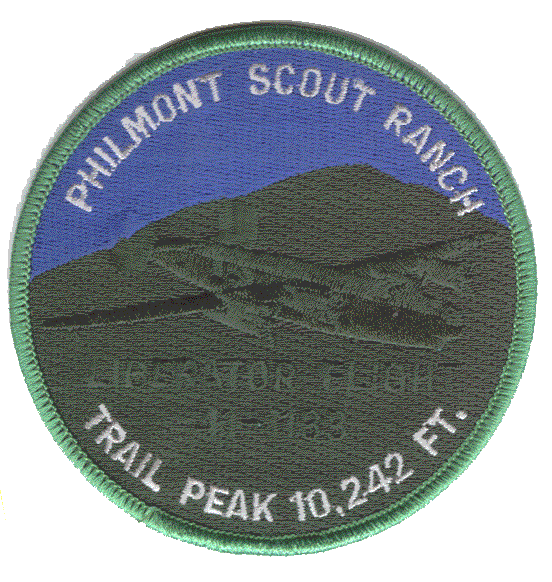
| A patch awarded at Philmont Scout Ranch for ascending Trail Peak. The silhouette of a B-26 Liberator is hidden in the stitching of the patch, as well as the words "Liberator Flight 41-1133". |
The Trail Peak crash site now sees much less traffic than it used to. The arrival of computerized itineraries evened out the camper loads, and took some of the pressure off Crater and Beaubien although decades of staff-tolerated, unauthorized scavenging by campers has removed nearly all remnants of the bomber except the starboard wing. For many years since 1948, the crash site was marked by a rock cairn and pole to which there was attached a canister containing an American flag, the Liberator's crew roster, and solemn instructions not to disturb the site or to remove any of the wreckage. Mic-O-Say tribesmen had first visited the crash site in 1947, and were led by Ernest Modlin, age 47, a professional Scouter and highly respected Mic-O-Say leader from Kansas City. Modlin, tribal "Medicine Man Curly Hawk," returned with a council expedition in 1948 and was climbing Trail Peak again when he was stricken with a massive, fatal heart attack not far from where Jeffries was killed. Now, their graves are within sight of each other in Kansas City's Mount Moriah South Cemetery. Modlin was posthumously elevated to Chieftain status at the tribal memorial service led by Chief Roe Bartle. Mic-O-Say tribesmen maintain the new memorial to Jeffries, but the old canister now contains only little scraps of paper on which expedition numbers and dates have been scrawled. Today, Roland Jeffries is but a bittersweet pang in his former fiance's heart and a warm memory for a surviving sister-in-law, a niece, a nephew, several childhood Scouting friends, and fellow fliers. Like that of so many, many pilots of his era, Jeffries' life is now encapsulated in a few old pictures, letters, yearbooks, and other mementoes typically buried in old steamer trunks which gather dust in attics and closet corners. In looking at the pictures of his proud, doting mother, the loving, adoring fiance, and loyal squadron mates, one can't help resist the inevitable "what ifs," -- what if the southerly winds aloft had been a few knots less (or more), what if they had taken off a few minutes earlier (or later), what if they hadn't lost number four, what if...what if..? For one member of Liberator 41-1133's crew, there was an "after the war." Hal Blackburn set up TWA's transatlantic routes in support of the Air Transport Command later in the war, and went on to a distinguished post-war career as a TWA operations vice-president. He passed away in the late 1980s after retiring to his farm located several hours west of TWA's New York headquarters. Robert Redding and Jonas Ruff, with their many hours as multi-engine instructors, would certainly have flown again with the airlines, and eventually looked back on careers that bridged the years between the DC-2 and Boeing 747. Bob Redding would probably have retired from airline flying in the 1970s to return to the North Platte Valley and farming the earth that was his heritage. And for Charles Reynard, a somewhat less predictable career. Law school? Ohio politics? Or possibly returning to Harvard for his Ph.D., a professorship at some midwestern college followed by a distinguished career in university administration, and maybe going back to Hiram as its president. Journalism? Reynard was a gifted writer whose potential would have put him in the same league with such pilot/authors as St. Exupery and Richard Hillary (both of whom would later be lost in the war). Reynard's range of topics extended well past flying, however. Nevertheless, his reflections about flight training, including the sadly prophetic passages on the sky and thunderstorms, are highly evocative. Ideally, Roland Jeffries would have survived his 25 bomber missions, come back to the zone of the interior, probably spent the rest of the war instructing, and capitalized upon his old "Sky Scout Troop 12" connections by flying for TWA after the war. In 1962, he might have bid a temporary farewell to Mary, and taken their 15 year old son, the Life Scout and Mic-O-Say brave to Philmont where Trail Peak would have been just a nice part of the scenery, but really not worth the climb. And, of course, Ernie Modlin, Chief Curly Hawk, would never have climbed Trail Peak to honor a fallen tribesman, and suffered such a pre-mature death. The eternal sky, temptress to all airmen, joined with fate, guardian of the lucky and betrayer of the less favored, and turned her back on Liberator 41-1133. First deserted by fortune, Roland Jeffries and his fellows were later abandoned by time -- with the exception of loyal Mic-O-Say tribesmen who are still pledged to sustaining the memory of members who gave all they had for their ideals and their country. May the rest of us not forget these seven Philmont-intertwined tragedies as part of victory's cost in WWII. |
|