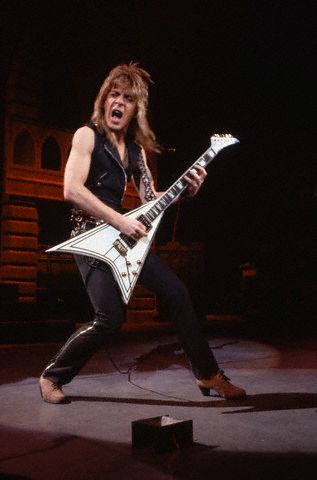
Randall William "Randy" Rhoads was born on December 6, 1956, in Santa Monica, California, - the youngest of three children. He started playing guitar at age six on his grandfather's old Gibson "Army-Navy" classical acoustic guitar and, according to his mother, he learned to play folk guitar, a popular way to learn guitar at the time - although he did not take lessons for very long.
Playing through high school, he became a heavy metal guitarist who played with Quiet Riot. Rhoads joined Ozzy Osbourne’s group without even auditioning, group leader Osbourne is quoted as saying. "He was only tuning up his guitar when I said, ‘You’ve got the gig. Phenomenal!"
Osbourne said, "I have a feeling about people. You could be the greatest player in the world, but if you haven’t got the feeling that I want to get, I don’t go for it. Randy (had) presence." A devoted student of classical guitar, Rhoads often combined his classical music influences with his own heavy metal style. While on tour with Ozzy Osbourne, he would seek out classical guitar tutors for lessons.
Several weeks before into the “Diary of a Madman” tour, Rhoads expressed interest in leaving Ozzy to pursue a degree in classical guitar in a university setting. During the Diary of a Madman tour he told Ozzy, “I want to learn to play classical guitar.”
Osborne said, "You're crazy, just play rock and roll and make some bucks.' He said, 'I want to do it.' So he started going to these seminars. Every town we'd go into, he'd look in the phone book for classical instructors. Seven weeks later, the classical stuff he was playing was unbelievable. Seven weeks. He worked around the clock to get where he wanted."
March 19, 1982...
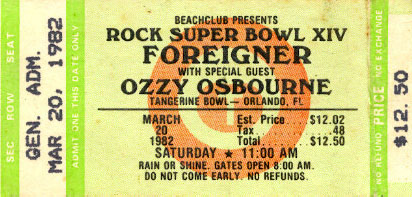
Randy Rhoads's last show was played on Thursday, March 18, 1982 at the Knoxville Civic Coliseum in Knoxville, Tennessee. The next day, the band was headed to a festival concert called "Rock Super Bowl XIV" at the Tangerine Bowl in Orlando, Florida.
Osbourne said. "I insist that we drive on after the gigs because, when you go back to the hotel, you have late nights, you have girls in the room and there's the hassle of kids running up and down the corridors. We get off a gig, go straight on the bus drive to the next hotel. We've got beds on the bus. We just sleep on the bus, go to the hotel, check in do your work in the day. It's just work, you know. Many people think that a rock 'n' roller's life is one enormous party with perks. It isn't. It's hard work, and, if you start to burn yourself out, then you burn your life out..."
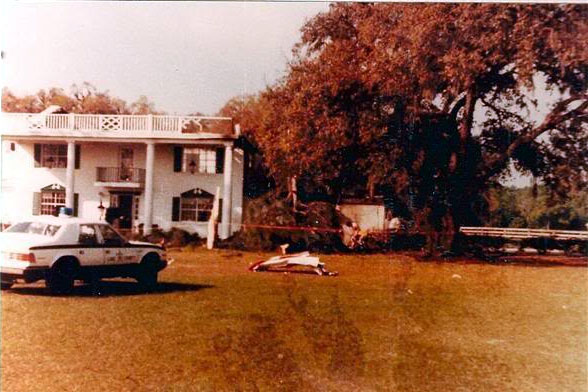
After driving much of the night in the band’s Greyhound-type bus, with a golden-brown top, white bottom and equestrian art on the sides, they stopped at Flying Baron Estates (10FA), a property belonging to Jerry Calhoun, who used to record country and western music in Nashville, Tennessee, and was then the owner of "Florida Coach," (a manufacturer and leaser of touring motor coach buses) in Leesburg, Florida, at about 8 on the morning of the 19th to pick up some spare parts for the bus. On the property, there was a small airstrip lined with small helicopters and planes, and three houses. One belonged to the tour bus driver, Andrew C. Aycock, and another – a white Georgian-style mansion - was owned by Calhoun.
Aycock and his ex-wife, Wanda, went into Calhoun’s house to make some coffee while some members of Ozzy Osbournes band slept in the bus - The bus - outfitted with plush chairs, video games and a stereo system - and others got out and "stretched". Aycock - a licensed pilot, although not then-medically certified or legally current in his ability - talked the band's keyboardist, Don Airey, into taking a “test flight” with him in a 1955 Beechcraft Bonanza F-35, registered as N567LT, stored in a nearby hangar even though the plane belonged to Mike Partin, who had no knowledge of the pending flight. Also, joining the pair was tour manager, Jake Duncan. The short joyride, during which he made several low passes at tree-top level over the area, ended and the plane landed safely.
Then Aycock took Rhoads and Rachel Youngblood, 58, the group's makeup artist, hairdresser and seamstress, on another flight. Airey persuaded Rhoads to go on the second flight, despite his fear of flying. Rhoads apparently agreed to go for two reasons: the seamstress had a heart condition so Aycock agreed to do nothing risky; also, Rhoads wanted to take an aerial photo as one of his hobbies was photography.
During the second flight, attempts were made to "buzz" the tour bus, which was parked about 60 feet from Calhoun’s mansion, where the other band members, Ozzy Osbourne, manager Sharon Arden, guitarist Tommy Aldridge, and bassist Rudy Sarzo, were sleeping, while Don Airey stood outside the bus, watching the flight. The Bonanza succeeded a couple times, but the last attempt was botched.
Mary Lee Morrison, who was riding her horse within sight of the estate, said "I was going for a nice peaceful ride on my horse and kept hearing this plane. It was flying so low that when it passed over me, I could see the interior of it," she said. "I was crying, I was so shocked. It was a harrowing experience. The other members of the group were just very upset and shocked."
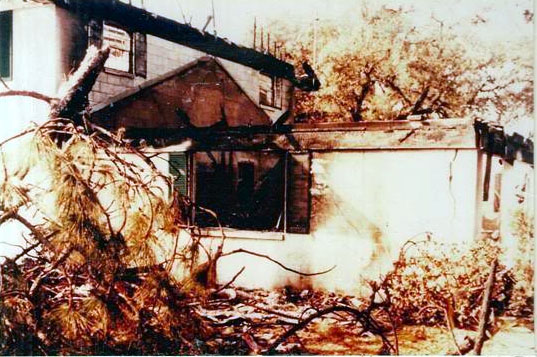
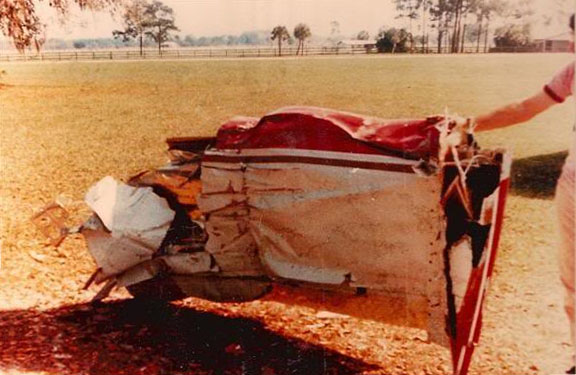
On the fourth pass, while the plane was flying about 10 feet above the ground at a speed between 140 and 180 miles per hour, the Bonanza’s left wing collided with the rear of the bus, cutting a six-foot-long gash through the fiberglass roof, then sent the plane spiraling over the bus, severing 10 feet off a large pine tree before crashing through the north side wall and roof of the garage on the west end of Calhoun’s mansion, exploding on impact, and setting the house on fire – destroying the roof, upper bedrooms and garage, and causing structural damage to the concrete block walls of the home.
The band members on the bus "thought they had been involved in a traffic accident," officials said.
Jesse Herndon, a deaf 70-year-old who was inside the house during the impact, escaped with no injuries after Ozzy Osbourne rushed into the house to insure no one would be hurt.
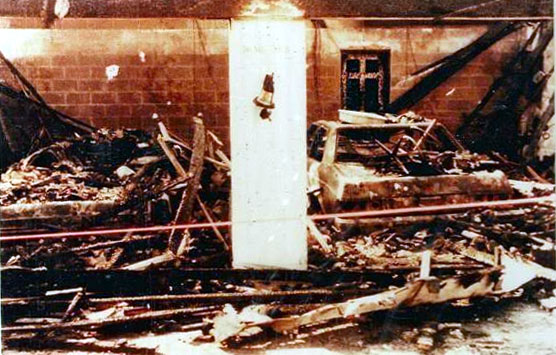
All three aboard were killed instantly: one victim was found outside the window of the garage, just below where the plane struck the wall. The other two victims were found inside the garage, one beside and one atop the two burned-out automobiles, an Oldsmobile and a Ford Granada, parked inside.
The inboard portion of left wing with the landing gear and the plane's empennage were found outside the garage against the northern wall, and the major portion of the wreckage was found inside the garage, entering through the roof. Fiberglass from the explosive impact of the plane was scattered over more than an acre, with no part of the red & white plane was larger than a breadbox, expect for the six-foot long section of now-crumpled wing which struck the bus.
Ozzy tried to explain what happened in a later interview, "I was sleeping on the bus. Don Airey saw it. At first I thought the bus driver had fallen asleep at the wheel, crashed into a truck and run off the road. The plane ripped the bus into a million pieces. All we've got are fragments. ... It was no prank. It was an accident and that's it. For God's sake, if I ever hear anybody say it was one of my practical jokes that went wrong, I'll strangle the bastard. It was an accident, a horrible accident.”
A day later, a devastated Ozzy Osbourne gave a statement to the investigators. “At approximately 9:00 a.m. on Friday, March 19, 1982, I was awoken from my sleep by a loud explosion. I immediately thought that we'd hit a vehicle on the road. I got out of the bed, screaming to my fiancée, Sharon, ‘Get off the bus.’ Meanwhile, she was screaming to everyone else to get off the bus. After getting out of the bus, I saw that a plane had crashed. I didn't know who was on the plane at the time. When we realized that our people were on the plane, I found it very difficult to get assistance from anyone to help. In fact, it took almost a half-hour before anyone arrived. One small fire engine arrived, which appeared to squirt three gallons of water over the inferno. We asked for further assistance, such as telephones, and didn't receive any further help. In the end, we finally found a telephone and Sharon phoned her father.”
Sharon told authorities: “I went to bed around 11:30 p.m. the night of the 18th. The next thing I knew, I woke with a huge bang and the bus was rocking. My bed was at the back of the bus. I ran to the front of the bus to look out of the windows, I had no idea where I was or what had happened. There was glass everywhere in the bus; everything was upside down. The bus driver’s ex-wife said: ‘Don't look, don't come out.’ I left the bus and saw flames coming from a house, and a big hole in our bus. I ran screaming trying to find out what had happened, but no one would say. Then I found out. I asked for a phone. I was told by a man, who I did not know, that there was no phone and to keep my mouth shut and I did not see anything. I told him to go to hell and then I found a phone. I did not see the crash. All I saw was fire.”
Mike Smalt, a deputy sheriff in the Lake County Sheriff's Department, was the first on the accident scene, and witnessed the Leesburg Fire and Rescue Unit and a fire truck on the scene trying to extinguish the flames as well as parts laying in front of the house that were debris from what appeared to be the wing of a plane.
Jack Barker, Atlanta regional spokesman for the Federal Aviation Administration, said the FAA flew an investigator to the scene that same day, arriving in the afternoon, as the National Transportation Safety Board initiated its investigation into the mishap, as Osbourne and his band relocated to the Hilco Inn in Leesburg as they regrouped and mourned.
Osbourne canceled his group’s appearance at “Rock Super Bowl XIV”, and a spokesman for the promoters, Beachclub Productions, said that anyone with tickets may get a refund if they wished, though the show would go on as scheduled with Pat Travers as the replacement act.
Rhoads's funeral was held at the First Lutheran Church in Burbank, California, on March 24, 1982. He is interred at Mountain View Cemetery in San Bernardino, California, where his grandparents are also buried.
The bodies were burned beyond recognition. Rhoads had to be identified by his jewelry and Aycock through dental records. It was later revealed in an autopsy, and with toxicology test conducted by the FAA's Civil Aerospace Medical Institute in Oklahoma City, Oklahoma, that Aycock's system showed traces of cocaine at the time; while Rhoads' toxicology test revealed only the slightest presence of nicotine. The NTSB investigation also determined that Aycock's medical certificate had expired – making him ineligible to legally fly a plane - and that his biennial flight review, required for all pilots, was overdue. Nevertheless, the NTSB concluded the probable cause of the accident was the pilot-in-command’s poor judgment while performing “buzzing” in which he misjudged the altitude clearance.
According to Osbourne, “I was crazy after it happened. I never spoke, I never went out. ... He was a hero, a true legend. He was a saint, he was an angel, and too good for this world. His death's always on my mind."
In 1987, five years after Rhoads's death, Osbourne released Tribute, the only official album featuring Osbourne and Rhoads playing together in concert. Most of the album is a live performance from Cleveland, Ohio. Contrary to popular belief, Randy's guitar solo was not taken from the King Biscuit Flower Hour show, which became an extremely popular and fast selling bootleg by the name of "Bats Head Soup". The songs "Goodbye to Romance" and "No Bone Movies" from the Tribute album were recorded on the UK "Blizzard of Ozz" tour at Southampton, on the same date as the Mr. Crowley EP.
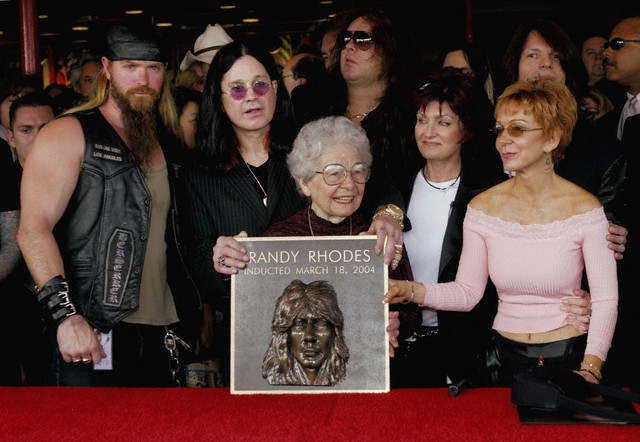
Randy was inducted into the Guitar Center Rock Walk on March 18, 2004. In a 2006 Guitar World article, it was mentioned that Rhoads's last name was mistakenly spelled "Rhodes" on his plaque, and by the time it was discovered, there was not enough time to correct the mistake. It has since been fixed.
Despite his relatively short career, Rhoads is a major influence on neo-classical metal players that emerged in the 1980s. He is cited as an influence by many contemporary guitarists of all styles. He is included in several 'Greatest Guitarist' lists. Fans of Rhoads, to this day, contemplate the irony of one of Rhoads' and Osbourne’s last songs, "Flying High Again." and its lyrics: "Got a crazy feeling I don’t understand - Gotta get away from here - Feeling like I shoulda kept my feet on the ground - Waiting for the sun to appear."



 Randy was inducted into the Guitar Center Rock Walk on March 18, 2004. In a 2006 Guitar World article, it was mentioned that Rhoads's last name was mistakenly spelled "Rhodes" on his plaque, and by the time it was discovered, there was not enough time to correct the mistake. It has since been fixed.