The Luckiest Green Beret of Vietnam… Near California City, CA January 14, 1983 Duty, Honor, Country… 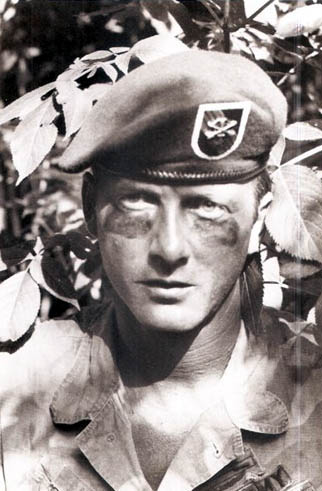 During the United States' involvement in the 2nd Indochina War (also called the Vietnam War), it was a military policy that, after a soldier received multiple awards of the Purple Heart – the decoration for combat injury or wound – that said soldier would be sent out of the combat zone. The idea was to spread the harm more evenly across the members of the military services. However, some soldiers bucked the policy by not reporting trauma up their chain of command. During the United States' involvement in the 2nd Indochina War (also called the Vietnam War), it was a military policy that, after a soldier received multiple awards of the Purple Heart – the decoration for combat injury or wound – that said soldier would be sent out of the combat zone. The idea was to spread the harm more evenly across the members of the military services. However, some soldiers bucked the policy by not reporting trauma up their chain of command.
Leonard Joseph Svec was one of those soldiers. Born in 1947 in Texas, he graduated high school in 1965 and went to the University of Houston before enlisting in the U.S. Army. He trained as a paratrooper, and served with the Special Forces, commonly referred to as the “Green Berets” for the distinctive headgear. While the details are largely classified, Svec likely participated in some of the most secretive and difficult missions of the conflict, often times behind enemy lines. But before he departed Southeast Asia, he had received seven Purple Hearts. However, he received wounds for many more (rumored by some to be near 20). Ultimately, he was injured to such a point that he was med-evac'ed out, and taken to Tripler Army Medical Center, located in Honolulu, Hawaii. There, he made a full recovery, and shared some of his insights and humor by working for the Honolulu Star Bulletin as a political cartoonist and writer. Pull! But he maintained a strong interest in parachuting. In the late 1970s, he returned to the sports while living in the Houston area, and quickly became a major figure in the United States Parachuting Association (USPA) – being elected as Conference Director, by write-in, in 1978, and National Director in 1980. He also competed on various jump teams, and served as Leader of the U.S. National Skydiving Team which won numerous gold medals at the World Meet in Zephyrhills, Florida, in 1981. He was also a great advocate of the sport – funding other people's skydiving teams when they ran out of money in order to permit them to compete in the Nationals and in world competitions.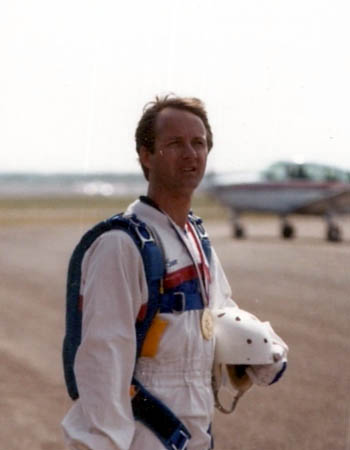 In 1980, Svec achieved one of his greatest achievements in parachuting when he successfully persuaded the National Park Service to authorize parachute jumps from the top of Yosemite's El Capitan, and – on July 1st - was the first to do so legally. Unfortunately, the permission was short-lived, as the Park Service reversed its policy after only a few months. With such a reputation, Svec's skills became in demand in the world of entertainment – the television series “Fall Guy” contracted his services. Building a list on Hollywood contacts, in late 1982, he was hired by Warner Brothers studios to perform a scene of their upcoming motion picture, “The Right Stuff”, based on the best-selling book by Tom Wolfe, about the early days of the “Space Race”. History meets Hollywood… The scene was a recreation of the December 10th, 1963, ejection and freefall of Chuck Yeager during his NF-104A 'Zoom' flight. The production of the shots called for Svec to don a silver helmet and simulated spacesuit, and be mounted atop a mock ejection seat made of black fiberglass, and equipped with an automatic activation device and small parachute. The plan called for him to hold two handles on the seat, and release them on cue. The difficulty came in the form of a small smoke canister that was attached to Svec's helmet. In Yeager's original ejection, a rocket motor in his ejection seat which forced the separation of the pilot from the seat (nicknamed a 'butt kicker') smashed into his helmet's faceplate, and lodged itself inside, producing heat and smoke fueled by pure oxygen, inside Yeager's suit. Yeager disabled the oxygen flow by lifting the faceshield upwards, deployed his parachute, and survived the accident after several days of hospitalization. In Svec's recreation, however, the ability to stop the smoke was not possible, and in the initial jumps in Texas, the smoke was still burning and he was coughing and choking under canopy. He could hardly see to land and his film crew had trouble getting the helmet off his head. Due to a lack of cloud cover for the background of the shot, the production relocated to California City, located north of the city of Mojave to finish. 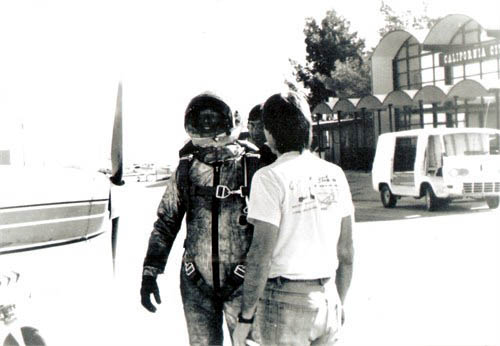 West to California... On Friday, January 14, 1983, the filming was to recommence. The planned jump was to start at 10,500 feet from a Cessna 206, registered as N29173. The camera operator, Rande Deluca, and Svec jumped without incident, but the smoke generator failed to work. So the pair held on to each other until they reached 3,500 feet. They separated, tracked away from each, and continued to free-fall, with Deluca engaging his main parachute at 2,500 feet. Svec, who was falling in a flat and stable position, never deployed either of his chutes. Having jumped without an automatic activation device, he impacted the desert floor, killing the 35-year-old instantly. An examination of both Svec's primary and reserve chutes showed no problems with either, and eyewitnesses on the ground saw no signs of struggle or difficulty on his part. The suit he wore was not particularly difficult to move around in and, with the exception of wearing the full-head helmet, nothing was out of the ordinary. In the end, no explanation was found for the untimely death of the veteran of over 2,000 jumps, although it is widely assumed that the smoke rendered him unconscious and unable to react. Lasting Effects... Svec was buried by family and friends in a quiet ceremony at the Earthman's Resthaven Chapel near Resthaven Cemetery on the afternoon of Tuesday, January 18, 1983, in Houston, Texas. Larry Bagley, the USPA president, served as a pallbearer and led a delegation of association officials who joined with hundreds of friends at the ceremony in the cemetery chapel. "This is one of the biggest services we've ever had," was the comment of one of the representatives present. Svec's gravestone, emblazoned with a parachutist under a full canopy, reads the closing words of a poem by Mary Elizabeth Frye, “Do not stand on my grave and cry... I am not there, I did not die.” The accident did not affect the final outcome of the film’s production. "The movie is basically completed already," said Alan Ladd Jr., president of the Ladd Company, the film's financier. Nevertheless, the remaining freefall shots were completed by B.J. Worth, also an accomplished parachutist and president of "Big Sky Films." To get the shot, Worth was pushed from an aircraft while strapped to an ejector seat, filmed by Deluca, who clung to the seat while it tumbled through the sky. The stunt double then leaves the seat and skydives away with two smoke canisters attached to his helmet to give the impression of fire. Deluca continued to work with Worth, making several jumps to get the desired footage. The film had its world premiere on October 16, 1983, at the Kennedy Center in Washington, D.C. The film was dedicated 'In Memory of Joseph Leonard Svec'. Cameraman Rande Deluca later worked on the stunts and filming in movies like Octopussy, Fandango, and Spies Like Us. He died on April 9, 1986 at the age of 37 in Los Angeles, Calif., of cancer. |