 | Check-Six.com | |
Offering Aviation History & Adventure First-Hand! | ||
| ||||||||||
|
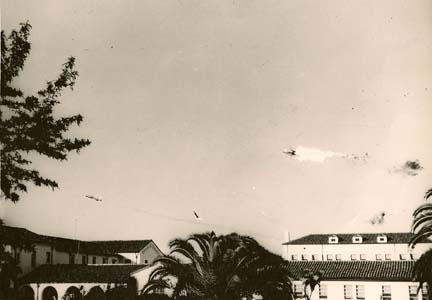
Mrs. Merle Smith, of San Pablo, said she heard the planes come low over her house. "There was a different kind of whine," she said. "I saw one of them going below the horizon of the hills as if it was going to land. There was a quick flash, a ball of fire, and black smoke," With TLC to Alabama... The next day, on orders from the 12th Air Force, the Thunderbirds were directed to fly the airplanes to Brookley Field in Alabama, and to “handle each of them like a crate of eggs.” A 40-member Air Force investigating team probed the crash, and concluded that the fuselage spine structure of Devlin's aircraft had failed. The defect was found to be a trapezoidal-shaped manufacturing joint - a plate that was designed to strengthen the connection between the forward and aft fuselage. It should have been rectangular. However, the investigation also turned up some very interesting side information on the particular aircraft the Devlin flew that day Thunderbird Two, Air Force serial number 57-5801, had been involved in an air-refueling incident. During an aborted hook-up attempt, turbulence dragged and pounded a drogue basket into the fuselage, damaging the aircraft's spine. The damage to the spine was repaired, but no direct evidence was uncovered that this incident caused a defect or weakness in the fuselage. But the suspicion remains that there may have been some connection between this, and the untimely destruction of Thunderbird Two. Throughout the Air Force, the Thunderchiefs were grounded from operations for two months, pending repairs and modifications to their design and structure, and the Thunderbirds, after returning to Nellis and flying the aircraft to Brookley AFB, Alabama, canceled the reminder of their air show season. Planning to finish out the year, the team reverted to the F-100D "Super Sabre", an upgrade to the F-100C model they had flown the year before. Although the switch back to the "Super Sabre" was intended to be temporary, the F-100D stayed with the team until 1969, and the Thunderbirds never again flew Thunderchiefs in their aerial demonstration routine.
Captain Devlin was buried on May 14th, 1964, in Section A-C at site 146 at Fort Rosecrans National Cemetery in San Diego, California. He was survived by his wife, Shirley, and their three sons, Greg, Bill, and Mark. When Republic shipped a large, one-twelfth scale, model of an F-105 to Nellis AFB, it had the name of the only Thunderbird Leader to fly the F-105, Paul Kauttu, on the canopy rail. Kauttu replaced his name with Devlin's. In 1975 and with Republic’s assistance, the Team added the “Devlin Memorial” plaque to the pedestal, which reads, “To the honor of Capt. Gene Devlin who lost his life on May 9, 1964, while serving his country as a U.S. Air Force Thunderbird. This memorial is dedicated to all whose common bond is uncommon devotion to duty.” Memorials...In 1999, to accommodate the realigning of base access roads, the memorial was removed, and replaced by a four-jet F-16 formation display (which is still mounted near the Nellis visitors’ center). Meanwhile, the F-105 replica was set aside near an old bunker, and with the frequent turnover of Thunderbirds personnel, it was forgotten, until the summer of 2012. That summer, a call came from the RED HORSE civil engineer squadron to the Thunderbirds office - a hangar was being demolished, and in the adjacent RV storage yard, was the model F-105 in Thunderbird colors. Air Force sergeant Anthony Graham marshaled a recovery of the model to be restored and returned to a memorial. The Thunderbirds Alumni Association (TBAA) fronted the $10,000 cost by Rick Dale of Rick's Restoration in Las Vegas, and the entire project was featured in an episode of the national television program, "American Restoration" in November of 2012. The official re-dedication ceremony was put on hold for a year to accommodate the 2013 TBAA reunion, which celebrated the Thunderbirds 60th anniversary. In October of 2008, the U.S. Air Force Auxiliary - the Civil Air Patrol - chartered Cadet Squadron 714 at Escondido Charter High School in California. It too was named in Captain Devlin's honor. Hamilton AFB was decommissioned in early 1970s, and was returned to Marin county. The airfield became part of a tidal wetland restoration effort that concluded in 2014. No trace of the runway remains.
|
|


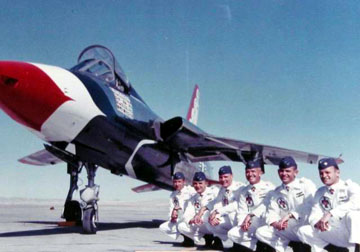 'Above the Best'
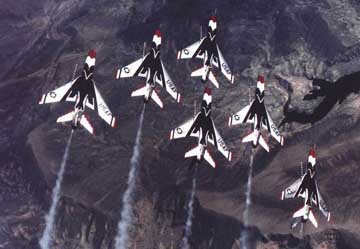
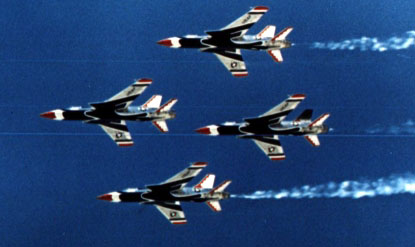 At 6:41 PM, the formation, after finishing these maneuvers, dove towards the runway at Hamilton Air Force Base, and started a series of sequential pitch-ups by each aircraft to enter the landing pattern.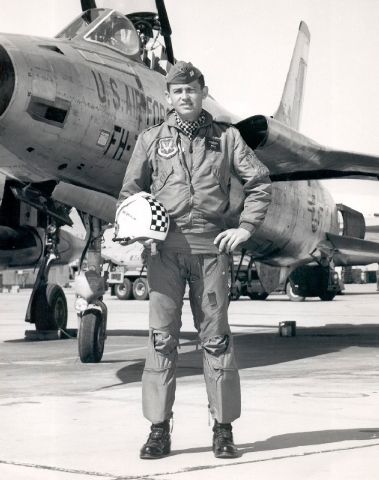
 With Honors...