The Crash of the X-15A-315 November 1967 The Rocketplane Jointly flown and maintained by the U.S. Air Force and NASA, the North American X-15 was a hypersonic rocket-powered aircraft that was part of the X-plane series of experimental aircraft which set numerous speed and altitude records in the 1960s. Reaching the edge of outer space and returning with valuable data used in aircraft and spacecraft design, the X-15's official world record for the highest speed ever recorded by a manned, powered aircraft, set in October 1967 when William J. Knight flew Mach 6.72 (4,520 mph) at 102,100 feet During the X-15 program, 13 flights by eight pilots met the USAF spaceflight criterion by exceeding the altitude of 50 miles, thus qualifying these pilots as being astronauts. The last qualifying flight was flown on November 15, 1967, by Major Michael J. Adams - but he would not live to pin on his wings. The Pilot Michael Adams was born in Sacramento, California, in 1930, and graduated from Sacramento Junior College. Enlisting in the U.S. Air Force in 1950 - he earned his pilot wings and a commission as a 2nd Lieutenant in 1952 at Webb Air Force Base, Texas. After training in F-80 and F-86 Sabres at Nellis AFB's gunnery school, he proceeded to fly fighter-bomber aircraft in 49 combat missions during the Korean War before being transferred to the 613th Fighter-Bomber Squadron at England AFB, Louisiana, and six months rotational duty at Chaumont Air Base in France. In 1958, Adams received a Bachelor of Science degree in Aeronautical Engineering from the University of Oklahoma. A year later, when the first group of American astronauts was announced, Adams set his sights on joining the astronaut corps. After studying astronautics at the Massachusetts Institute of Technology, he was selected for the U.S. Air Force Test Pilot School at Edwards AFB, Calif., in 1962. While at TPS, he won the A.B. Honts Trophy as the best scholar and pilot in his class, Class 62C, and continued on to joined the fourth class at the Aerospace Research Pilot School. While attending the school, on August 28, 1963, was flying in the back seat of a F-104B, tail number 56-3721, piloted by fellow student (and future astronaut) Capt. David R. Scott. As Scott was making an approach simulating a X-15 flame-out for training and evaluation purposes into Edwards' runway 4, the jet suddenly lost engine thrust and began to descend rapidly. Trial by Fire... Both pilots realized that the jet would hit hard, and each made opposite decisions that saved their lives. Scott elected to stay with the airplane while Adams chose to eject. Adams pulled the ejection handle just as the F-104 slammed into the runway, breaking off its landing gear and sliding a couple thousand feet down the runway. Had he ejected before impact, his parachute would not have had time to deploy due to the rapid rate of descent. If he had delayed ejecting for even a fraction of a second, he would have been crushed when the airplane's jet engine slammed forward into the rear cockpit. Adams' parachute opened just seconds before he hit the ground. He waved to Scott, who was climbing safely from the burning wreck. As the cockpit floor disintegrated, Scott's ejection seat had partially sequenced during the initial impact, locking his feet into the stirrups, but did not fire because the torque tube was unable to rotate due to crash damage. If Scott had ejected, he would have been killed. Recovered from minor injuries but losing a shot at being in the second group of astronauts, Adams graduated with honors from ARPS in December 1963, and worked on several flight test programs, like conducting stability and control tests in the Northrop F-5A jet fighter and the Cornell Aeronautical Laboratory variable stability T-33 program. In 1964, Adams became one of four aerospace research pilots from Edwards to participate in a five-month series of NASA moon landing practice tests with the Martin Company in Baltimore, Md. The tests simulated lunar landing missions in a full-scale command module and lunar excursion module crew compartment mock-up. Four seven-day simulated lunar landing missions were conducted, each with a three-man crew. Experienced in what it took to handle long duration space flight, in November of 1965, he was selected to be one of the first 8 astronauts in the U.S. Air Force Manned Orbiting Laboratory program. An early space station design, the MOL, also known by its classified designation and codename of KH-10 Dorian, was designed to serve as a space-based reconnaissance platform. To be a series of five, or more, two-man flights - lasting up to 30 days - in polar orbit to begin in 1968, the astronauts were to use surplus Gemini spacecraft attached to a new, cylindrical laboratory, with the whole platform launched by a Titan-III rocket from Vandenberg AFB, Calif. 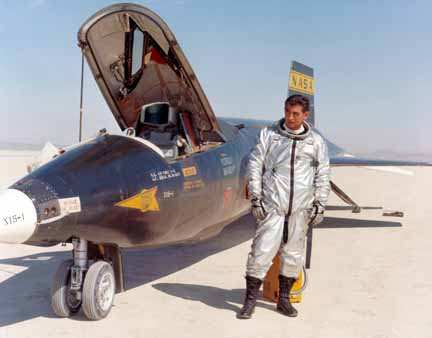 The development on the MOL project moved slow, as there were delays in production and testing hardware. Adams realized that, with the advent of the Corona (KH-4) unmanned reconnaissance satellite program, there was little chance of a MOL flight in his future, and he requested transfer to the well-underway X-15 program, which was granted on July 14th, 1966. The X-15 Program Nearly three months later, on September 28, 1966 - Adams readied for his first flight aboard the X-15, but it was aborted due to weather. A week later, the flight was scrubbed, as a malfunction of the canopy seal regulator prevented the cockpit from pressurizing. But on October 6th, 1966, Adams made his first X-15 flight, designated 1-69-116. Aboard X-15 #1, he rocketed from the mothership, NB-52A #52-0003, to Mach 3 and an altitude of over 75,000 feet. However, the forward fuel tank bulkhead ruptured in flight, causing the engine to shut down early, and forcing Adams to make an emergency landing at Cuddeback Lake.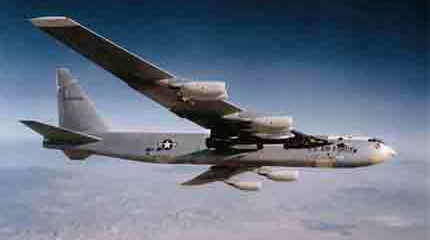 The next five flights, spread out over the following year, all had issues - from radio malfunctions and engine control problems, to airborne experiments not deploying and and circuit breakers popping. During his third flight, on March 2, 1967, the X-15 lost cabin pressure while climbing through 77,000 feet. This caused his pressure suit to inflate and made it more difficult for Adams to fly the airplane. However, as Adams reached the top of the climb, a peak altitude of 133,000 feet and a maximum speed of Mach 5.59 (3,822 mph), his inertial computer failed, blanking all of his flight data readouts. Flying blind, Adams successfully returned to Edwards AFB On approach he radioed the ground controller, fellow X-15 pilot Major William J. "Pete" Knight, saying "I thought you said every once in a while something goes wrong, Pete?" In a post-flight debriefing, Adams revealed that he had suffered vertigo during the climb-out. It would not be the last time this happened. But by November of 1967, just about everything that could go wrong for Adams had during the program. But he continued on to fly his seventh flight. X-15 Flight #3-65-97 On the morning of November 15, 1967 at 10:30 a.m., the X-15-3 dropped away, Major Adams at the controls, from its B-52 mothership at 45,000 feet near Nevada's Delamar Dry Lake. Starting his climb under full power, he quickly passed through 85,000 feet when an electrical disturbance distracted him and slightly degraded the control of the aircraft. 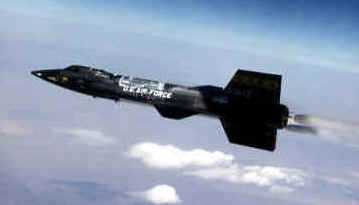 In the Dryden Flight Research Center flight control room, Pete Knight was working as mission controller, monitoring the mission with a team of engineers, and noticed something was wrong. As the X-15 climbed, Adams started a planned wing-rocking maneuver so an on-board camera could scan the horizon. The wing rocking quickly became excessive, by a factor of two or three. When Adams concluded the wing-rocking portion of the climb, the X-15 began a slow, gradual drift in heading. Forty seconds later, when the craft reached its maximum altitude of 266,000 feet , it was off heading by 15°. As the plane came over the top, the drift briefly halted, with the plane yawed 15° to the right. Then the drift began again; within 30 seconds, the plane was descending at right angles to the flight path. At 230,000 feet, encountering rapidly increasing dynamic pressures, the X-15 entered a spin at hypersonic speed! |
In the flight control room there was no way to monitor heading, so nobody suspected the true situation that Adams now faced. The controllers did not know that the plane was yawing, eventually turning completely around. In fact, control advised the pilot that he was ”a little bit high,” but in ”real good shape.”
Just 15 seconds later, Adams radioed that the plane ”seems squirrelly.” At 10:34 came a shattering call: ”I'm in a spin, Pete.”
A mission monitor called out that Adams had, indeed, lost control of the plane. Another pilot present said quietly, ”That boy's in trouble.”
Plagued by lack of heading information, the control room staff saw only large and very slow pitching and rolling motions. One reaction was ”disbelief; the feeling that possibly he was overstating the case.”
But Adams again called out, ”I'm in a spin.”
As best they could, the ground controllers sought to get the X-15 straightened out. They knew they had only seconds left. There was no recommended spin recovery technique for the plane, and engineers knew nothing about the X-15's supersonic spin tendencies. The chase pilots, realizing that the X-15 would never make Rogers Lake, went into afterburner and raced for the emergency lakes, for Ballarat and Cuddeback. 
Fighting For His Life...
Adams held the X-15's controls against the spin, using both the aerodynamic control surfaces and the reaction controls. Through some combination of pilot technique and basic aerodynamic stability, the plane recovered from the spin at 118,000 feet and went into a Mach 4.7 dive, inverted, at a dive angle between 40 and 45 degrees.
Adams was in a relatively high altitude dive and had a good chance of rolling upright, pulling out, and setting up a landing. But one more technical problem arose - the Honeywell adaptive flight control system began a limit-cycle oscillation just as the plane came out of the spin, preventing the system's gain changer from reducing pitch as dynamic pressure increased.
Adam's corrective action created a pilot-induced oscillation - a rapid pitching motion of increasing severity. All the while, the plane shot downward at 160,000 feet per minute, dynamic pressure increasing intolerably. High over the desert, it passed abeam of Cuddeback Lake, over the Searles Valley, over the Pinnacles, narrowing on toward Johannesburg.
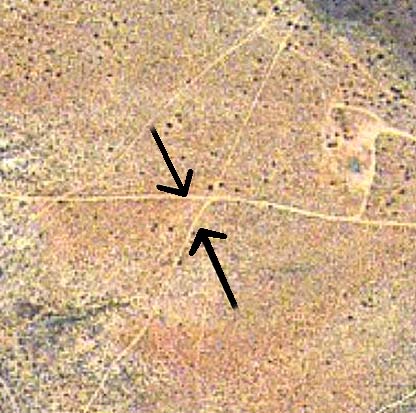
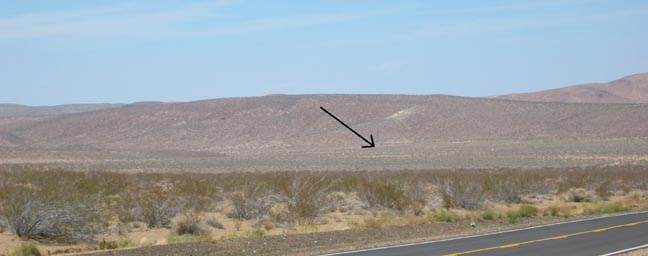
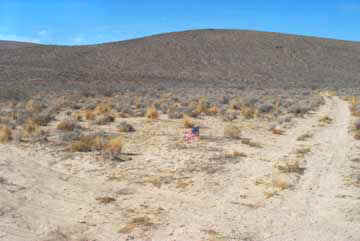
As the X-15 neared 65,000 feet, it was speeding downward at Mach 3.93 and experiencing over 15 g vertically, both positive and negative, and 8 g laterally. The airframe's structural limits were grossly exceeded, and the plane broke up into many pieces amid loud sonic rumblings, impacting in the desert northeast of Johannesburg some ten minutes after launch. Two hunters heard the noise and saw the forward fuselage, the largest section, tumbling over a hill.
On the ground, NASA control lost all telemetry at the moment of breakup, but still called to Adams. A chase pilot spotted dust on Cuddeback, but it was not the X-15. Then an Air Force pilot, who had been up on a delayed chase mission and had tagged along on the X-15 flight to see if he could fill in for an errant chase plane, spotted the main wreckage northwest of Cuddeback. Mike Adams was dead and the X-15 destroyed.
|





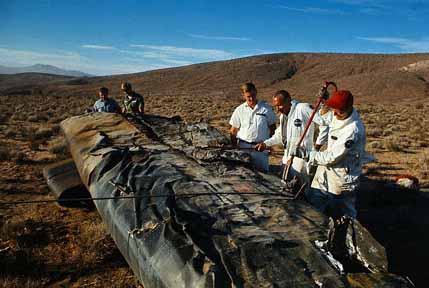

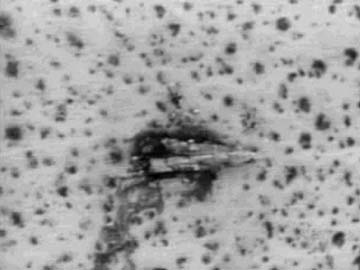
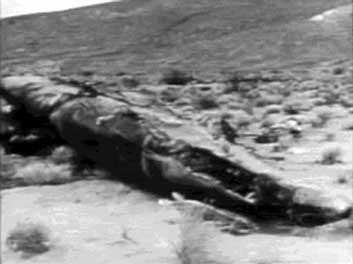

 Ground parties scoured the countryside looking for wreckage; critical to the investigation was the film from the cockpit camera. The weekend after the accident, an unofficial NASA search party found the camera; disappointingly, the film cartridge was nowhere in sight. Engineers theorized that the film cassette, being lighter than the camera, might be further away, blown north by winds at altitude. Engineer Victor Horton organized a search and, two weeks after the crash, during the first pass over the area, Willard E. Dives found the cassette which was flown to Boston for specialized processing.