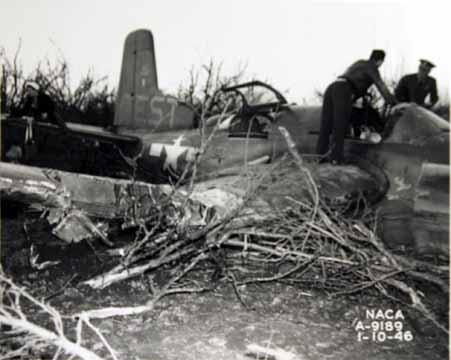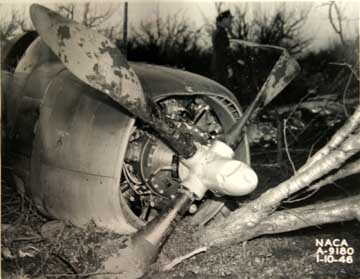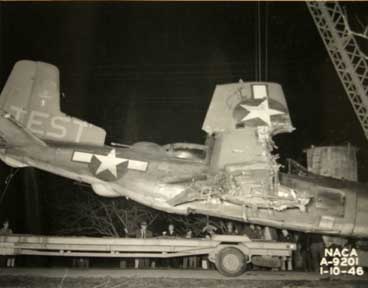

| | The Crash of the XSB2D-1 Sunnyvale, CA January 10, 1946 Succeeding A LegendThe Douglas SBD "Dauntless" dive bomber was a small aircraft that was slow, vulnerable, and already considered obsolete by some when it entered service. Nevertheless, it spearheaded the early offensives in the Pacific campaigns of World War II. The SBD, or "Slow But Deadly", was a highly accurate dive-bomber and was given numerous opportunities to prove its worth, especially during the Battle of Midway, where Dauntless bombers sunk four Japanese carriers. 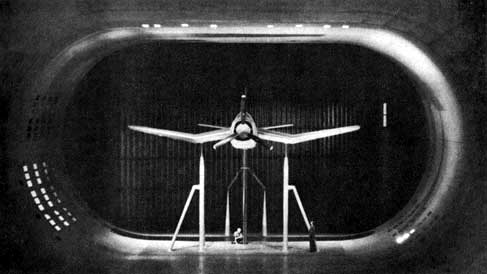 Around the time of the battle of Midway, Navy officials realized the advantages and drawbacks of the Dauntless, and set forth to design a build a replacement to their front-line dive bomber. Attempting to compensate for the disadvantages of the Dauntless, the SB2D "Destroyer", as it was called, would feature a Wright R-3350 radial engine, providing a whopping 2400 horsepower, an inverted gull & laminar flow wing design, remote controlled gun turrets, half-inch machine guns armed with 800 rounds, mounted on both the top and bottom of the craft, featured dive brakes, and a tricycle landing gear. It would carry two crew, a pilot, and a gunner/observer, and carry two Mark 13-1 torpedoes, or tow depth charges, to wrought further destruction upon the Japanese Navy. Around the time of the battle of Midway, Navy officials realized the advantages and drawbacks of the Dauntless, and set forth to design a build a replacement to their front-line dive bomber. Attempting to compensate for the disadvantages of the Dauntless, the SB2D "Destroyer", as it was called, would feature a Wright R-3350 radial engine, providing a whopping 2400 horsepower, an inverted gull & laminar flow wing design, remote controlled gun turrets, half-inch machine guns armed with 800 rounds, mounted on both the top and bottom of the craft, featured dive brakes, and a tricycle landing gear. It would carry two crew, a pilot, and a gunner/observer, and carry two Mark 13-1 torpedoes, or tow depth charges, to wrought further destruction upon the Japanese Navy.
Two prototypes of the XSB2D-1 were built, assigned the naval Bureau of Aeronautics numbers of 03551 and 03552. | Routine Flight Tests...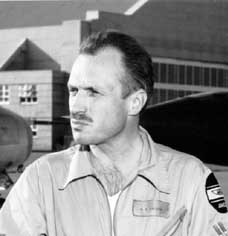 | | NACA pilot George Cooper |
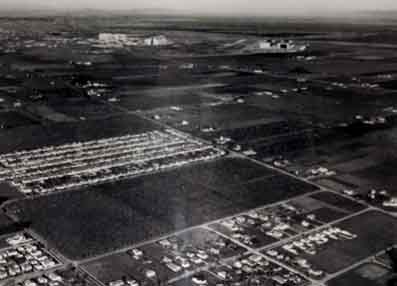
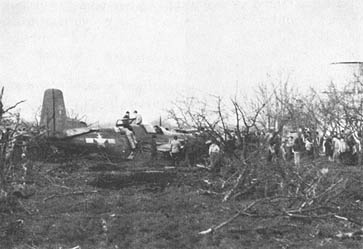
George Cooper's education was in the engineering of mineral mines. A soft-spoken person, he got the taste for flying during World War II, flying P-47s with the 412th Fighter Squadron in Europe. After the war, his talents in the cockpit were recognized, and his was hired by the National Advisory Committee for Aeronautics (NACA) as the head of the Flight Operation Brach of their Ames Aeronautical Laboratory. In the "gunner" seat sat Welko Gasich. He was responsible for gathering and reporting the results of these tests to NACA officials, in order to compare alternative methods for calculating takeoff ground run, a critical factor in the design of an airplane. Taking off, the pair had no clue that this would be the final flight of this XSB2D-1. An Eerie Quiet... About 1,000 feet over Sunnyvale, the engine, a Wright R-3350-14, caught fire. Low to the ground, and too far away from the airfield to glide in for a power-off landing. Cooper picked out a nearby orchard, filled with prune trees, for his emergency landing. Descending between a row of trees, Cooper recalled the wings cutting some 80, or more, trees at the trunk as he ripped thorough. Near the end of the field, shortly before a cross street, the airplane came to a stop. Neither Cooper or Gasich were injured in the crash that tore the wings off of the plane. A prune farmer, A. V. Schroeder, who owned the orchard, witnessed the spectacle, and also knew Cooper. The pilot calmly exited the cockpit and told him, "You keep asking me to drop in on you sometime, so here I am." | | EpilogueAn evaluation batch of thirteen SB2D-1s was ordered by the Navy, and a n additional prototype was completed and flown. A redesign of the plane removed the remotely-controlled gun barbettes, and the second crewman. Yet another redesign resulted, and another prototype built and flown in December of 1943. The SD2B was never put into production. Many people nowadays do not refer to it as the "Destroyer" as it was nicknamed as the time, but rather as the "Turkey". In later years, its naval designation was reassigned, and was called the BTD-1. However, knowledge gained from its design, construction, and testing, would see its way into a later aircraft of note, the AD-1 "Skyraider" George Cooper continued flying with NACA, which became NASA in 1958. Cooper's approach to flight testing forced a specific definition of the pilot's task and of its performance standards. His study of flight led to his creation, "The Cooper Pilot Opinion Rating Scale", which was initially published in 1957. After several years of experience gained in its application to many flight and simulator experiments and through its use by the military services and aircraft industry, it was subsequently modified in collaboration with Robert (Bob) Harper of the Cornell Aeronautical Laboratory and became the Cooper-Harper Handling Qualities Rating Scale in 1969. This rating scale has been one of the enduring contributions of flying qualities research at Ames over the past 40 years; the scale remains as the standard way of measuring flying qualities to this day. After his retirement from NASA in 1972, Cooper planted wine grapes, and became a winemaker. After several years of private production, he took the wine venture commercial in 1994 as the Cooper-Garrod Estate Vineyards, where he is today the winery manage and chief winemaker. Welko Gasich retired from the Northrop Corporation in 1988 as the Vice President of. He is often credited with having the vision behind the conception and development of the advanced supersonic trainer and international lightweight low-cost fighter aircraft, the YF-23 "Black Widow". |
The Crash Site Today
| 
| | | |
|

l1049-0085.jpg)