 | Check-Six.com | |
Offering Aviation History & Adventure First-Hand! | ||
| ||||||||||
|
| ||||||||||||||||||
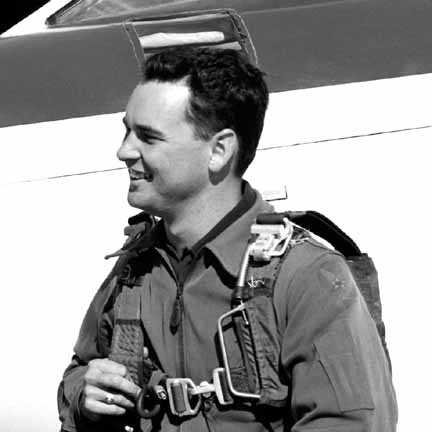
Walter P. Jones was a research pilot for NACA from the fall of 1950 to July 1952. He had been in the U.S. Air Force as a pilot before joining the Station.Jones flew the D-558-I #3 (5 flights, first on February 13, 1951) to study buffeting, tail loads and longitudinal stability. Jones made research flights on the D-558-II #3 ( 7 flights, first on July 20, 1951). These flights investigated pitch-up and evaluated outboard wing fences. |
|
Walt also made research flights in the Northrop X-4 (14 flights, first on March 26, 1952) and the Bell X-5 (8 flights, first on June 20, 1952).In July 1952, Walt left NACA's High-Speed Flight Research Station to join Northrop Corporation as a pilot. Returning from a test mission in a Northrop YF-89D Scorpion he was fatally injured on October 20, 1953, north of Edwards Air Force Base. Also aboard the jet and killed in the crash was Jack Collingsworth, a civilian radar operator for Northrop.Click here for complete bio | |
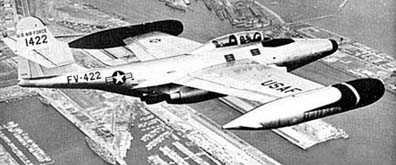
The first F-89D was obtained by modifying F-89B serial number 49-2463, the aircraft being redesignated YF-89D. The first flight of the YF-89D took place on October 23, 1951. The first two production F-89Ds were delivered to the USAF on June 30, 1952. Some 125 F-89Ds had been built by the time that the problems with the Scorpion’s wings were discovered and resulted in the grounding of the entire fleet. These F-89Ds remained at the factory until the wing modifications could be made that would make the aircraft safe to operate in the field. | |
F-89D Scorpion - USAF all-weather interceptor. |
|
| |
This aerial should give you some idea of what the site is like today. | 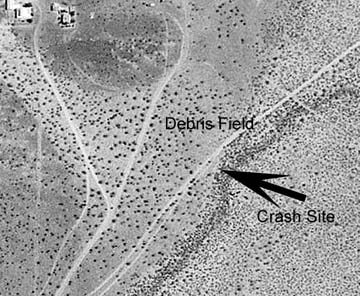 |
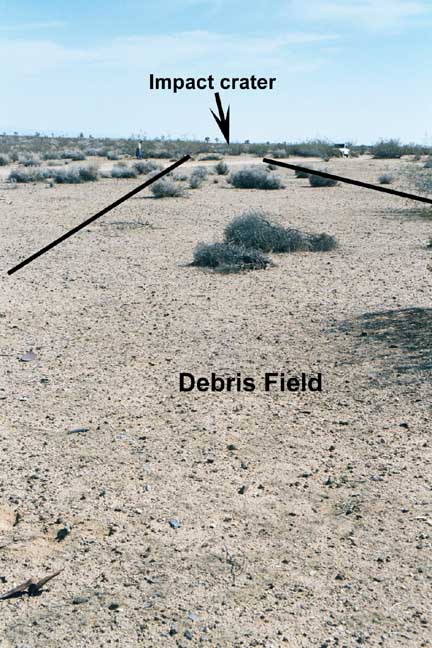
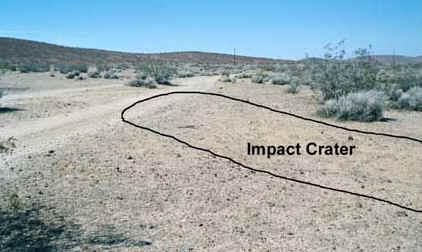 | The impact area and spread of debris indicates the jet crashed at a shallow angle at a high speed. According to the crash report the crater was nearly 92-feet long. |
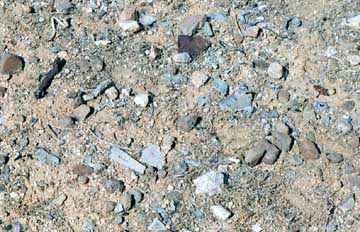
Debris is spread over a very wide area and there is a lot of it! | |
 | |
|