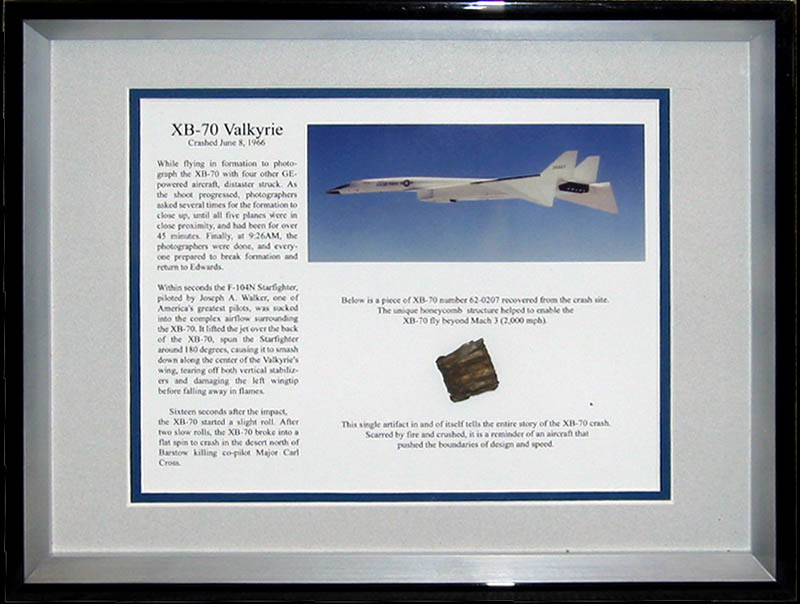
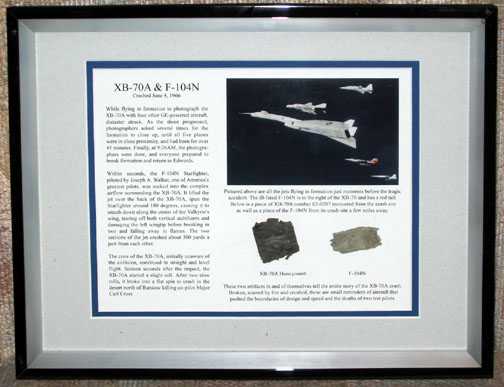
With research and development studies beginning in 1955, the XB-70 was a large, long-range strategic bomber was planned to be the replacement for the B-52. As in the B-58 program, the Air Force wanted new technology advances. To this end, the Air Force gave the prime contractor total weapon system responsibility. Competition between Boeing and North American for the contract occurred during the design phase. In 1958, the North American design was chosen and a development contract awarded. The Air Force requirement was for a Mach 3, high-altitude, long-range bomber capable of carrying nuclear and conventional weapons. The aircraft was fabricated using titanium and brazed stainless steel “honeycomb” materials to withstand the heating during the sustained high Mach number portions of the flights. The propulsion system consisted of six General Electric turbojet engines (J93-GE 3) with two large rectangular inlet ducts providing two-dimensional airflow. During the early 1960s, the NASA Flight Research Center was involved in support of the national Supersonic Transport Program (SST). Two prototype Mach 3+ high altitude bombers, built by North American Aviation for the Air Force, became available for SST research with the cancellation of their intended military program. Aircraft No. 2 (serial # 62-0207) with its improved wing design, was capable of sustained Mach 3 flight at altitudes around 70,000 ft. This highly instrumented vehicle was destroyed in a mid-air collision with NASA F-104N (N813NA) on 8 June 1966. The collision killed test pilots Joseph A. Walker and Major Carl Cross. For more information about the XB-70A crash site click here. For more information about the F-104N crash site click here. Retrieved from the crash site, this piece of honeycomb is a reminder of that crash and the death of the supersonic bomber until the B-1 program of the mid-1970s. Included is a Certificate of Origin, certifying that your artifact came from this historic site. |