'The True Story of Jeremiah Weed' | 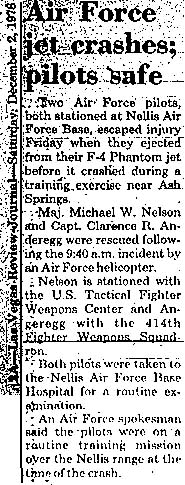 | | A newspaper account of Hanson and Anderegg's crash of a McDonnell Douglas F-4E, USAF tail no. 74-0651 | 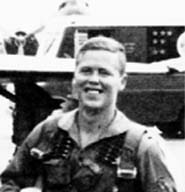 | Clarence R. “Dick” Anderegg | 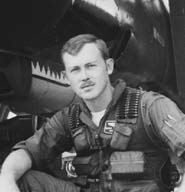 | Clyde "Joe Bob" Phillips |
From 'Sierra Hotel - Flying Air Force Fighters in the Decade After Vietnam ', by Colonel Clarence Richard "Dick" Anderegg, USAF, (Retired) ', by Colonel Clarence Richard "Dick" Anderegg, USAF, (Retired)
Every USAF fighter squadron has a lounge where the pilots sometimes gather for a cold beer after the flying day is over. Every refrigerator in each of those lounges contains a chilled bottle of a 100-proof product called Jeremiah Weed. For special occasions, and sometimes for no reason at all, someone will bring out the Weed, fill a shot glass for each person present, and propose a toast. At the conclusion of the toast, all down their Weed in a single gulp. It is not tasty. To many it seems like drinking kerosene, and it leaves a very strong aftertaste. Be that as it may, few refuse because the downing of a Weed is a ritual deeply imbedded in the fighter pilot culture. That ritual started long before today’s squadron commanders were even in college, and stories abound as to how the custom started. A famous newsman once said, “When there is disagreement between the legend and the truth, always print the legend.” Since I disagree, here is the true story of Jeremiah Weed, and I know it’s true because I was part of it. On December 1, 1978, I was flying as an instructor in the back seat of a F–4E, tail number 649, on a BFM hop out of the 414th FWSq at Nellis Air Force Base, Nevada. The student in my front seat, Maj. Nort Nelson, was a highly experienced F–4 pilot with hundreds of combat hours. Leading the flight was Capt. Joe Bob Phillips, who had in his back seat Capt. Larry Ernst, an instructor who was just along for the ride. The mission called for Joe Bob to attack Nort in a scripted scenario that gave Nort the opportunity to use his best defensive BFM to defeat Joe Bob’s attacks. The mission did not last long. On the first engagement, Nort managed to put the airplane into a position from which I judged that recovery was impossible (The details are for another story, which I will tell in a future book). I ejected both of us from the jet. Neither of us was injured, and within an hour we were picked up by a helicopter that returned us to Nellis. It probably goes without saying that Nort and I had different views: he thought he could miss the ground; I did not. It was too close to bet my life on. The accident investigators agreed with me. They determined that ejection was the only possibility for survival. Further, they believed that if I had delayed more than a second, one or both of us would have died in the desert seventy miles north of Las Vegas. A year later, both Joe Bob and Nort were members of the F–16 Multinational Operational Test and Evaluation squadron at Hill Air Force Base, Utah. On the first anniversary of the accident, they were flying to Nellis to participate in Red Flag. As they passed over the crash site, which Joe Bob easily found since he had circled our downed position many times, they sketched some brief road maps on cards in their cockpits and decided to return to the site by car. The next day, a Friday, they drove out of Las Vegas with a friend, Pete Mock, intending to find the site and camp out in the crater that the crashing airplane had gouged in the high desert. However, it was dark by the time they got to the dirt road they thought would lead them to the site. After a couple of aborted attempts to drive up dirt roads to nowhere, they decided to go back to a roadside café they had passed to ask directions. They entered the Paranaghat Bar and found no customers, only a bearded bartender who looked a lot like Grizzly Adams. When they told the bartender what they were up to, he was delighted to tell them he had seen the fire from the crashing airplane the day of the accident. Further, he was very pleased that he had three real fighter pilots in his bar. He had heard that fighter pilots knew many bar games (true), and he wanted to play games for drinks. When they balked at the idea, he persisted, and after much cajoling asked them if they knew the game “horses.” They shook their heads no (not true). Over the next several minutes, the bartender “taught” them horses, finally saying that whoever lost had to buy a round of drinks. After three games of horses, the bartender had bought all three rounds. And after three rounds the pilots were a little less stressed to get to the crash site. Joe Bob asked the bartender if he knew how to do afterburners. No, the bartender said, he had never heard of that game. So, Joe Bob explained to him how a shot of brandy in a shot glass is ignited so that the alcohol on top burns, and then the drinker throws down the flaming shot. If done correctly, all the brandy is emptied from the shot glass, so that when the drinker puts the glass down, a small, blue flame still burns in the bottom. The bartender was eager to play but said he had no brandy. Nort suggested that any high-proof booze might work, and the bartender fumbled around under the bar for a moment. He straightened up and plopped a tall, brown bottle with a brown and green label on the bar, and said, “I’ve got this here stuff—it’s 100 proof.” The brand name on the green label proclaimed that it was Jeremiah Weed. The three fighter pilots filled their shot glasses and demonstrated, all three glasses returning to the bar empty except for a small blue flame flickering at the bottom. The bartender immediately poured one for himself and lit the top. Now, these were no ordinary twentieth-century shot glasses. Joe Bob thought they might be from the 1800s because the glass was very thick, and the bottom was probably an inch of heavy glass. When the bartender picked his up, he held it by the bottom while he licked and smoothed the mustache of his thick beard out of the line of fire. He took several moments on his grooming, not realizing that as he held the thick glass at the bottom, the top near the fire was heating quickly. By the time he tilted his head back and put the glass to his lips…..well, Joe Bob says you could probably hear the s-s-s-s-sizzle of the hot glass barbecuing the bartender’s lips halfway to Las Vegas. Then the bartender made his second mistake and flinched. The flaming Weed went all over his beard, and by the time Joe Bob, Nort, and Pete could beat out the flames, the bar was filled with the smell of cooked lips and singed hair. As soon as things calmed down a bit, the trio, feeling badly that they had not paid for a drink all night and greatly embarrassed that they had nearly immolated their new friend, bought another bottle of Weed from him and left again for the crash site, this time guided by one of the bartender’s friends who had entered the bar just in time to witness and smell the blistering. The friend showed them the correct dirt road, and the trio found the crash crater, where they spent the rest of the night camped out and drinking the entire bottle of Weed. The next morning they dragged themselves out of the crater, gathered a few souvenirs from the parts still lying around, and headed straight for the Nellis Air Force Base Officers’ Club. There they found the manager, showed her the empty bottle, and strongly suggested she add it to the bar stock. She did. Soon, the Nellis fighter pilots were downing shots of Weed (nonflaming) for no good reason except it was different, and it was a good excuse to toast “fallen comrades.” As Red Flags came through the Nellis club, they saw the weapons school guys doing it, so they did it, too. And that is the true story of how Jeremiah Weed started. I have a bottle in my freezer. But - Who Was Jeremiah Weed? - Click here Click here to read about other commemorative aviation drinks |




 ...
...  , as a part of any aviator's music collection. Buy them now! You will not regret it!