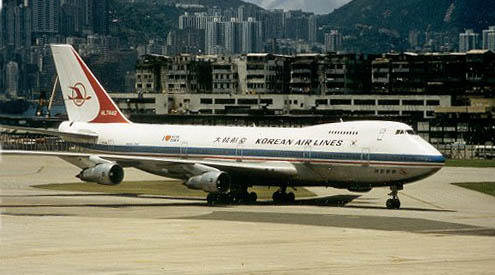
Many books have been written on the subject, here in brief overview of what happened.
The Boeing arrived at Anchorage at 03:30 local time after a flight from New York. At 05:00 the aircraft took off bound for Seoul. The flight was cleared directly to the Bethel VOR beacon and then on to the Romeo 20 route. However, the aircraft started diverging from it's intended course and passed 12mls North of the Bethel beacon. While approaching the Kamchatka peninsula, 6 MiG-23 fighters were scrambled. Because a US Boeing RC-135 intelligence plane was flying in the area East off Kamchatka, the Soviet defense forces probably thought the B747 radar echo to be the RC-135. KAL 007 left Russian airspace over the Okhostk Sea and the fighters returned to their base. Passing abeam the Nippi beacon (4 hours after take-off), the aircraft was 185 miles off course and headed for Sakhalin. Two Soviet Sukhoi Su-15 fighters were scrambled from the Dolinsk-Sokol Airbase at 17:42 UTC and 17:54 respectively. At 18:16h UTC flight 007 re-entered Soviet airspace. At 18:22h the Soviet command ordered destruction of the target (for the 2nd time). Two air-to-air missiles were launched by one of the fighters and struck the Boeing at 18:26h. Cabin pressure was lost and the aircraft suffered control problems, causing the Boeing to spiral down and crash into the sea.
In December 1983, the most "authoritative" and oft-cited study of the incident, a report by the International Civil Aviation Organization (ICAO), concluded: "As a direct result of the missile attack, KE007 crashed and sank into the Sea of Japan southwest of Sakhalin Island. There were no survivors among the passengers, flight crew and cabin attendants." The ICAO report, entitled Destruction of Korean Air Lines Boeing 747 Over Sea of Japan 31, August 1983, reached this determination even though it acknowledged that the "location of the main wreckage was not determined." The failure to find the "main wreckage" should have raised the possibility that no such wreckage existed; yet, that possibility was not seriously considered by the ICAO, a United Nations affiliate.
One of many perplexing details that raise questions about what really happened to KAL 007 after the attack is that the jetliner remained airborne for at least 12 minutes. During a press briefing on the morning of September 1, 1983, Secretary of State George Shultz told reporters: "At 1826 hours the Soviet pilot reported that he fired a missile and the target was destroyed. At 1830 hours the Korean aircraft was reported by radar at 5,000 meters [16,400 feet]. At 1838 hours the Korean plane disappeared from the radar screen."
To date, no one has adequately explained how a jetliner supposedly blownup and hurtling out of control toward the sea would take at least 12 minutes to fall 35,000 feet. For comparison, consider this Associated Press dispatch as printed by Deseret News (Salt Lake City) for February 20, 1985: "A China Airlines jumbo jet fell 32,000 feet in less than two minutes Tuesday [February 19th] after all four of its engines failed but the pilot restarted them and flew 500 miles with a damaged tail before making an emergency landing here [San Francisco], authorities said .... The Boeing 747 ... fell from a cruising altitude of 41,000 feet to 9,000 feet, said ... a spokesman at San Francisco International Airport." The plane fell 32,000 feet in something less than two minutes. Let us be conservative (and keep the arithmetic simple) by assuming that it was exactly two minutes, in which case the rate of descent would have been 267 feet per second. Had KAL 007 "plummeted" toward the sea at that rate, its fall would have taken about two minutes and 11 seconds -- not 12 minutes.
It is important to note that its disappearance from the radar screen by no means meant that KAL 007 had crashed. It could have remained airborne thereafter until it either landed or ran out of fuel. Newsweek for September 12, 1983 reported that the plane went off radar while it was still 5,000 feet in the air. And R. W. Johnson asserts in Shootdown that it "went off the Wakkanai radar at 1000 feet."
In any event, KAL 007 remained aloft for at least 12 minutes after the attack, which is near-conclusive evidence that the crew was at least partially in control of the aircraft. Otherwise, the descent would have been far more precipitous.
Another remarkable aspect of the descent is that it appears to have been carried out according to standard procedure for an aircraft that has suffered an engine loss and decompression, but is still being controlled by the crew. A precipitous initial descent (between 4,000 and 7,000 feet per minute, depending on weather conditions and the structural condition of the aircraft) is intended to quickly reach a level where there is adequate oxygen and a warmer temperature. Thereafter, the rate is reduced as the pilot signals for assistance, seeks a place to land, makes his position known to potential rescuers, etc. The available data indicates that the Captain of KAL 007 followed that procedure.
Click here for more info.
Click here for the FBI file on the KAL 007 disappearance (FBI FOIA Reading Room)
The FAA temporarily closed Airway R-20, the air corridor that Korean Air Flight 007 was meant to follow, on September 2, but airlines fiercely resisted the closure of this popular route, the shortest of five corridors spanning Alaska and the Far East. It was therefore reopened, a month later, after safety and navigational aids were checked.
; |
|  Rescue 007: Untold Story of KAL 007's Survivors Rescue 007: Untold Story of KAL 007's Survivors
| From the Publisher | | Evidence has now surfaced (some quite literally from the bottom of the sea) proving that KAL 007 had indeed ditched successfully off the shores of tiny Moneron Island, and that the passengers and crew were rescued to be held captive in the former Soviet Union. Here, in this book, are the unparalleled transcripts and chronicling of the whole Soviet hierarchy from the Commander of the Far East Military District down to squeezing the trigger. Here are the high level, and sometimes vehement, interchanges that resulted in both the shooting down and the ordering of rescue missions involving KGB patrol boats, helicopters, and civilian trawlers around Moneron. And, here finally, is the evidence we need to bring our people home. Senator Jesse Helms to Boris Yeltsin—December 10, 1991: "The KAL-007 tragedy was one of the most tense incidents of the entire Cold War. . . Please provide a detailed list of the camps containing live passengers and crew, together with a map showing their location." |
|
| | | |