Harbinger The Crash of the XFL Blimp Oakland, California January 9, 2001 A Dream Given Form…Football – known as gridiron throughout much of the world -is the most popular sport in the United States. Each year, starting at the beginning of August, and rolling to the climatic Super Bowl in the following year, the National Football essentially owns a day of the week – Sunday – for half of the year with enthusiasm so intense, the popularity carries over in college, high school, and youth league football.  The NFL’s dominance effectively creates a monopolistic situation.- a situation confirmed when an upstart professional football league, the United States Football League, or USFL, filed an antitrust lawsuit against the NFL. The USFL found it was unable to move its spring play schedule into the autumn because of the financial interests involved. The NFL’s dominance effectively creates a monopolistic situation.- a situation confirmed when an upstart professional football league, the United States Football League, or USFL, filed an antitrust lawsuit against the NFL. The USFL found it was unable to move its spring play schedule into the autumn because of the financial interests involved.
A New York jury ruled that the NFL had violated anti-monopoly laws, but in a Pyrrhic twist, the fledgling league was awarded a judgment of a mere $1 – that was tripled to $3 due to the antitrust laws of the time. The NFL appealed the ruling in court, as well as judgments for $5.5 million in owed legal fees, ending up in the U.S. Supreme Court in 1990, which affirmed the lower courts’ rulings. Four years after the USFL had ceased operations, it finally received a check for $3.76 in damages - the additional 76¢ representing interest earned while litigation had continued. Notably, that check has never been cashed. A decade later, the concept of “spring football” would be tried again, this time by the most unlikely of figures. Attitude A third-generation wrestling promoter, Vince McMahon brought the parent company of the World Wrestling Federation (WWF) from his father in 1982. He set out to unite the regionally-fractured world of wrestling in the U.S. His competitive tactics were successful, and the WWF quickly grew, becoming the most prominent purveyor of "sports entertainment" in the country. Looking to expand beyond wrestling, on February 2nd, 2000, at a news conference at the “WWE New York” restaurant on the corner of Broadway and West 43rd in New York City, McMahon unveiled to the media his new concept for a football league – the XFL. The new league would combine the traditional game of American football with the kayfabe - the portrayal of staged events as "authentic" - and stunts of professional wrestling. Hyped as "real" football - without penalties for roughness and with fewer rules in general - the games would have numerous features, such as players and coaches with microphones, as well as cameras in the huddle and the locker rooms. To build excitement early in the game, instead of a coin toss like in the NFL, XFL officials put the ball on the ground and let a player from each team scramble for it to determine who received the kickoff option.  American television network NBC, which had lost coverage of NFL games to rival channels at the end of the 1997 season, was eager to replace the programming. Weeks after the formation of the XFL unveiling, on March 31st, 2000, NBC Sports President Dick Ebersol and Vince McMahon informed the world of the 50/50 partnership with NBC and the WWF in the endeavor - with NBC contributing $50-million per season to the XFL for the T.V. broadcast rights. American television network NBC, which had lost coverage of NFL games to rival channels at the end of the 1997 season, was eager to replace the programming. Weeks after the formation of the XFL unveiling, on March 31st, 2000, NBC Sports President Dick Ebersol and Vince McMahon informed the world of the 50/50 partnership with NBC and the WWF in the endeavor - with NBC contributing $50-million per season to the XFL for the T.V. broadcast rights.
Marketing the upstart rival to America’s most popular sports league would require unorthodox methods. Washington Post reporter Paul Farhi wrote, “The XFL wants to be known as a bad, bad boy. It wants sports purists to stammer at its audacity, to wince at its mayhem, to shudder at its wicked flouting of football tradition. It practically dares them to be offended. […] XFL's games have been amped up to emphasize speed, violence, and sex appeal, wrapped in a layer of hyperbole.” And the marketing reflected the approach. Ads featured players training in a variable war zone, dodging mines and explosions amidst a rainstorm. Another showed a runner is sacked by a wrecking ball – all while emphasizing the unique rule changes. And the cheerleaders were also highlighted. The XFL wanted to appeal to a younger demographic with its marketing – but that didn’t rule out other, tried-and-true, forms of advertising – including the deployment of a blimp.  From Russia with Love From Russia with Love
Igor Pasternak was born in Soviet Kazakhstan and raised in Ukraine. In 1981, he founded a design bureau at Lviv Polytechnic University and later – in 1986 - started a private company to build tethered balloons and blimps for the European advertising market. He formed his first company, Aeros Limited, in Ukraine as one of the first private aerospace and engineering companies permitted under Gorbachev’s Perestroika reforms. The company built and delivered advertising blimps and tethered aerostats to customers across Europe while researching and developing heavy-lift airship concepts. Seeking new opportunities, Pasternak then immigrated to the United States in 1993, bringing the company and his ideas with him to potential prosperity. Two years later, in 1995, Igor walked into the FAA’s Long Beach office in a pinstripe suit and with an interpreter in tow. FAA engineer Maureen Moreland briefed him with excerpts from a 1,100-page volume of regulations, ask him a few complicated questions about propulsion, aerodynamics and aircraft structures, and answered a few questions Pasternak had for her. These were the first steps in bringing his newest idea: a digitally controlled dual ballonet airship, to life. With a half-million dollars of their own money and a $400,000 Small Business Association loan, Pasternak and his family continued their blimp and aerostat manufacturing business – now called Worldwide Aeros - with the same zeal they practiced in the former Soviet Union. The first, the “Aeros 50” was certified in June of 1995 and the prototype - a seventy-eight-foot one-seater and the only one built – was sold to an Atlanta company to use for advertising during the 1996 Paralympic Games.  While developing the fly-by-wire technology, Igor learned to speak English (“by watching Arnold Schwarzenegger movies” he once told an interviewer) and raised $7 million in capital to finance the new project. In the process, the company pitched ideas to the world, like a $28 million "party" blimp that would fly scenic tours over the Grand Canyon. Carrying up to 80 passengers at a speed of up to 174 miles per hour, the “D-1” helium-filled blimp would include a restaurant, bar, dance floor, and possibly gaming tables and slot machines. In addition, two larger models: the D-4, which would be 552 feet long; and the D-8, at 976 feet long and a cargo capacity of up to 1.6 million pounds. While developing the fly-by-wire technology, Igor learned to speak English (“by watching Arnold Schwarzenegger movies” he once told an interviewer) and raised $7 million in capital to finance the new project. In the process, the company pitched ideas to the world, like a $28 million "party" blimp that would fly scenic tours over the Grand Canyon. Carrying up to 80 passengers at a speed of up to 174 miles per hour, the “D-1” helium-filled blimp would include a restaurant, bar, dance floor, and possibly gaming tables and slot machines. In addition, two larger models: the D-4, which would be 552 feet long; and the D-8, at 976 feet long and a cargo capacity of up to 1.6 million pounds.
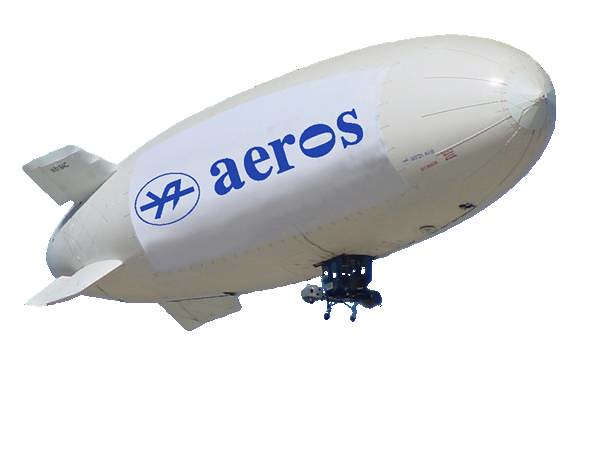 "The more money there is available, the faster everything happens," said Pasternak at the time, who expects to sell stock at some point. "Our goal is the creation of an industry. The first couple of airships are basically the first step." Pasternak envisioned a future with blimps dousing forest fires with water, delivering pre-assembled houses, setting bridges in place and laying miles of pipeline. "The more money there is available, the faster everything happens," said Pasternak at the time, who expects to sell stock at some point. "Our goal is the creation of an industry. The first couple of airships are basically the first step." Pasternak envisioned a future with blimps dousing forest fires with water, delivering pre-assembled houses, setting bridges in place and laying miles of pipeline.
By 1999, Worldwide Aeros launched the airship model 40A, nicknamed ’ Sky Dragon,’ and featuring increased payload and capabilities from the Aeros 50. The first design – which the only prototype was would be a stepping stone to the next model, the 40B, that would be operated by a fly-by-wire system. Fly-by-wire uses electrical wires to send signals to pneumatic cylinders that move the control surfaces, instead of cables that connect fins and rudders directly to the steering controls in the gondola. It offers some weight savings, as well as reliability.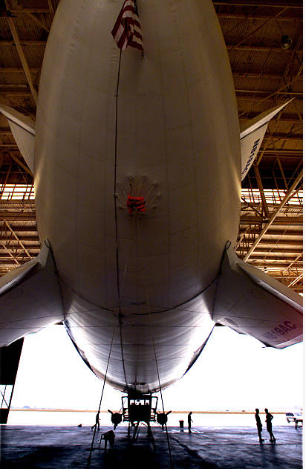 The 40B was built with a length of 143 feet, a volume of 88,570 cubic feet, and seated five. About three-quarters the size of Goodyear’s blimps and powered by two Continental 125 horsepower IO-240-B engines, the 40B is slightly larger than most of the other airships flying in the United States at the time. The envelope has 2,000 separate pieces of fabric joined by a heat-sealing rather than a sewing process that took an eight-member crew four months to assemble. The First Tragedy…On January 27th, 2000, while the 40B was in the flight testing phase, Pasternak’s 32-year-old sister Marina, and engineer Levon Samamyam, 35, were “diving” inside the airship’s envelope to patch punctures inside of an inner air chamber (called a ‘ballonet’ and nested inside of the main outer skin of the blimp) in Building 795 at San Bernardino International Airport. They ordered other crew members to shut off an air pump to partially collapse an inner balloon so they could reach a hole. But inert helium gas had gathered at the top of the balloon, displacing the remaining oxygen, and the pair suffocated. When they failed to respond to radio and voice calls, employees of Airship USA -the company who would lease the blimp for advertising and marketing – investigated and found the pair shortly before 6 PM. One of the workers used a knife to tear open the blimp and dragged them from the ballonet to begin CPR. San Bernardino City Fire Department paramedics arrived and transported Marina and Levon to Loma Linda University Medical Center - where they were pronounced dead. An Occupational Safety and Health Administration (OSHA) inspection conducted a week later (#119957298) found ten safety violations, including three severe, and was fined nearly $40,000 that summer – which was reduced to $17,280 on appeal. Just a few days after the FAA awarded a type certificate for manufacturing the Aeros 40B – only the seventh such certification of an airship by the FAA – another accident would strike, and the fines from the January accident would have to wait.  | Airship pilot Sandra Hoffecker in
the gondola of the first Aeros 40B |
Bad Luck Strikes Again…On the morning of June 28th, 2000, an instructional flight of the new Aeros 40B - registered as N819AC – to familiarize the co-pilot with the airship handling characteristics was concluding at San Bernardino International Airport. The instructor pilot, 46-year-old Sandra Hoffecker, was demonstrating a lighter than neutral landing for her student pilot that morning. On the ground, supporting the landing, were two ground crew assigned to catch the mooring rope and assist with the airship’s handling. As the blimp neared the landing area, some 100 yards northeast of Building 795 on the airport’s ramp, one of the ground handlers caught the nose line and the other ground crew, Dean C. Norsworthy, 38, ran to assist. But Norsworthy then realized that he was on a collision course with the other ground handler and "began running backward to avoid being hit," tripping over his own feet. Stumbling backwards, Norsworthy twisted to the left and fell, striking his head on the concrete apron. Neither of the ground handlers was wearing helmets. The other ground handler immediately launched the airship back into the air so he could attend to his injured coworker. A local ambulance was called, and Norsworthy was taken to Loma Linda University Medical Center for treatment but passed away on July 11th, 2000, from his injuries. He was later buried in Holy Sepulcher Cemetery in the city of Orange, California. The National Transportation Safety Board found the probable cause of the accident to be the ground crew's diverted attention toward the landing airship while trying to catch a mooring rope, which resulted in their failure to detect an imminent collision with each other. On With the Show… But the death and investigation didn’t slow the advertisers from signing. In September of 2000, Grant Murray, president of Airship USA, announced a contract with the XFL "You can't not look at a blimp," Murray said of the advertising medium. "People love them when they see them because they're so graceful. They just float there." The airship also would serve as an excellent aerial platform on which to mount cameras. But the death and investigation didn’t slow the advertisers from signing. In September of 2000, Grant Murray, president of Airship USA, announced a contract with the XFL "You can't not look at a blimp," Murray said of the advertising medium. "People love them when they see them because they're so graceful. They just float there." The airship also would serve as an excellent aerial platform on which to mount cameras.
 The XFL wanted the blimp to look like one of its specialty footballs. Instead of a regulation NFL football, the new league created “the toughest football ever” - a black, red, and white ball made out of Pittard’s WR100 leather so that it would retain less water and dry faster than any other football. The XFL wanted the blimp to look like one of its specialty footballs. Instead of a regulation NFL football, the new league created “the toughest football ever” - a black, red, and white ball made out of Pittard’s WR100 leather so that it would retain less water and dry faster than any other football.
The problem was, whenever the ball got even slightly wet, the black dye would rub off, making the ball so slippery that it would become challenging to throw or catch. On Saturday, December 30th, 2000, the XFL-branded blimp was first seen flying through the skies of Las Vegas – where the first televised XFL game would be played in the coming weeks. With the NFL playoffs in full swing, the blimp was in Oakland as the league had flown it over the January 6th, 2001, AFC divisional playoff game between the Oakland Raiders and Miami Dolphins. With the Raiders winning that game, 27-0, they advanced to the following week's AFC Championship, which would again take place in Oakland at Network Associates Coliseum. 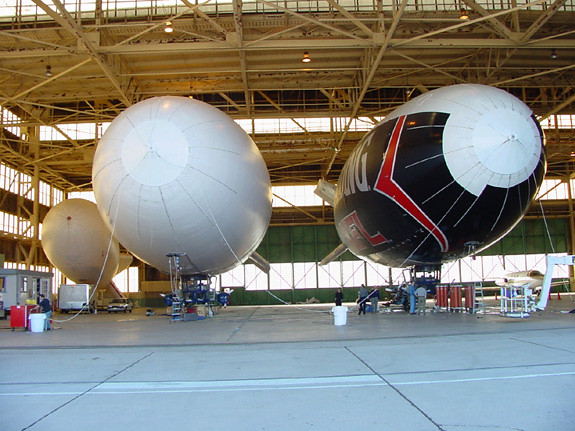 On the morning of Tuesday, January 9th, 2001, Aeros 40B, N819AC, departed before noon for an instructional flight, practicing touch-and-go takeoffs and landings. Acting as the instructor in the blimp’s right seat was Hunter “Catfish” Harris – a veteran of 8,400 flight hours – as the less experienced Paul Adams – with 4,000 hours aloft – flew the airship from the left. The day was cold and cloudy, with rain showers passing through the region. After leaving the ground, the pilots requested touch-and-go takeoffs and landings with Oakland Airport’s North Field air traffic control tower. However, the controller on duty informed the flight crew that they were too busy to handle their request, so Harris and Adams decided to depart the airport’s airspace, heading toward the Golden Gate Bridge. Return to Base...But the weather had other plans, and the airship was forced to return to Oakland and conduct touch-and-go takeoffs and landings. About 8 miles from the airport, they encountered a light misting rain, and both pilots noted that the fuel gauge indicator on the annunciator panel had a red indication, and the digital display read ‘OPEN.’ However, after a few seconds, the LED indicator returned to a typical reading. Because, during the preflight inspection of the airship, the pair had visually inspected the fuel tanks and verified they were full, neither were worried because it appeared that it was an indicator error. As they approach the Oakland Airport, the falling rain increased in intensity. Harris advised Adams to increase the engine’s speed to counter the stronger winds, and they then discussed that they would not do a "normal 'weigh-off'" to determine the weight and trim. He rationalized that this wasn’t needed because the airship was heavy with rain, had no ballast to drop, and they could estimate their trim by visually checking the ballonet volume. 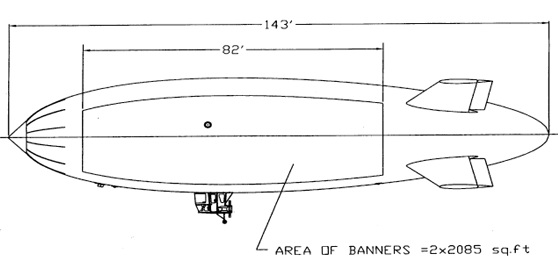 Getting out of his seat to read the ballonet numbers, Harris told Adams that they had "6-7 in the rear and the front was flat." An unusual flight condition, the instructor had the pilot pump and dump the aft ballonet twice. Rechecking the ballonets, he noticed they were now even, at around "3 ½ each." Harris then suggested that they pump aft on the way to land and lock off the front valves to hold the trim condition. Complying with the suggestion, Adams "locked off" the forward ballonet for landing, which would maintain the same amount of air in the forward ballonet throughout the landing. Getting out of his seat to read the ballonet numbers, Harris told Adams that they had "6-7 in the rear and the front was flat." An unusual flight condition, the instructor had the pilot pump and dump the aft ballonet twice. Rechecking the ballonets, he noticed they were now even, at around "3 ½ each." Harris then suggested that they pump aft on the way to land and lock off the front valves to hold the trim condition. Complying with the suggestion, Adams "locked off" the forward ballonet for landing, which would maintain the same amount of air in the forward ballonet throughout the landing.
But while setting up for the approach, the airship’s nose dropped, likely due to the gusty winds, and Adams noted that the Hull Pressure Indicator (HPI) was low, choosing to switch the fan blower to the ‘ON’ position to add air to the front ballonet. The nose climbed back up for a moment but quickly dropped again. Looking at the cockpit instruments, Adams again noted the HPI reading was still low, and recovered using the same procedure as before. But the nose dropped a third time. He told Harris that the airship’s flight controls did not feel normal, so he checked the air pressure system and saw that the rear ballonet valve was open, but the gauge on the annunciator panel indicated that the valve should have been closed! Noticing that at least one of the aft valves was open and would not respond to air valve control inputs, both pilots continued to work the problem: Harris attempting to manually close the valve - with no response - as Adams flew the airship. Downward... 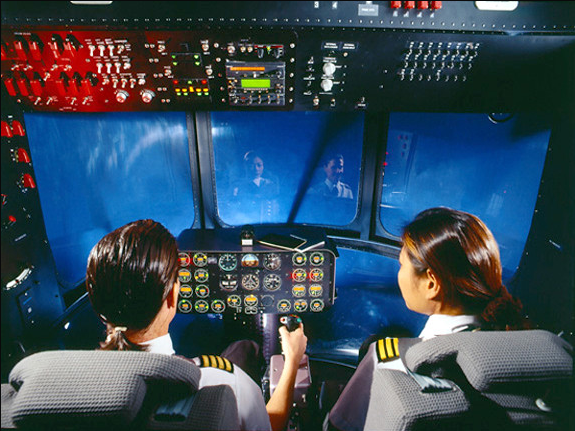 “We were losing systems,” said Harris, “so we started losing ability to control the airship. It was a very unnerving feeling.” Recognizing the dire situation, Harris and Adams switched seats, giving full command of the blimp to the more senior and experienced pilot. With Harris now in the left chair, Adams sat in the right position, radioing the ground crew that they were having difficulty controlling the airship and were coming into land. The ground crew, returning from a lunch break, sped to the airport to assist the blimp’s return to land on Runway 15. “We were losing systems,” said Harris, “so we started losing ability to control the airship. It was a very unnerving feeling.” Recognizing the dire situation, Harris and Adams switched seats, giving full command of the blimp to the more senior and experienced pilot. With Harris now in the left chair, Adams sat in the right position, radioing the ground crew that they were having difficulty controlling the airship and were coming into land. The ground crew, returning from a lunch break, sped to the airport to assist the blimp’s return to land on Runway 15.
On the first attempt to land, Harris brought the airship in too high and too fast, forcing him to abort. He set up for a second approach, and due to the low nose condition, he added more power and placed the flight control system – a joystick - to the full aft position to raise the nose. Harris continued pulling back, as any movement forward resulted in an immediate drop of the nose. Fearing the flight controls were malfunctioning, as the airship turned to final, it descended in a stair-step pattern. He did not have time to accomplish the complete emergency procedure for that due to the low altitude, high airspeed, deteriorating weather, and the need to get the airship on the ground. “We landed on the runway as we intended to,” Harris continued, “but our approach speed was much higher than normal.” The airship hit the ground hard, as it was traveling at a fast forward airspeed and very heavy nose. The gondola dug into the ground, collapsing the landing gear. After “a hard landing,” Harris said “wind shift took us off the runway and towards a parked airplane. At this point we were along for the ride.” Still in motion, the blimp bounced two times, and then the nose sunk in the soft dirt, skidding across a nearby taxiway and hitting a parked Navy P-3 Orion that was on loan to the Western Aerospace Museum. The impact damaged the airplane’s vertical fin, rudder, and left wing while ripping a large tear on the airship’s starboard side. “After we hit the plane,” said Harris, “we came to a momentary stop.” At this point, both Harris and Adams realized that this was their best chance at surviving, and – according to Harris, “instructed Paul to get out.” Both jumped out on opposite sides of the gondola. In an attempt to keep the still-buoyant blimp from climbing skyward again – Harris pulled the emergency ripcord on his side of the envelope, noting that this was “the first time I’ve ever had to do that. It’s a real shock to have to go through that situation.” but it failed to open the emergency deflation panel. At the same time, Adams initially ran away from the airship because the airship was traveling in his direction, but turned around and returned to the blimp to pull the emergency helium release cord. But before he could, he was yanked off of his feet, and he lost hold of it due to the wet rope. And Up Again...With a few hundred pounds of flight crew removed from the airship, it took off and climbed to a peak altitude of 1,600 feet above ground level as the winds carried it to the northwest over the Oakland Estuary. But once at that altitude, the airship’s “pressure height” - an altitude where the helium pressure forced open special valves that “dumped a bunch of helium out,” according to Harris, the blimps started a gentle descent. The blimp drifted for some 4 miles over the water, drawing the attention of drivers along Interstate 880 and elsewhere. Alameda resident Diana Foster was in her home two blocks from the water when she heard a sound that she at first thought was a hedge clipper. But it was so loud she went outside to investigate and was surprised to see the airship, hanging in the air. "The whole side of the blimp was rippling. It looked like it wasn't full," Foster told reporters. 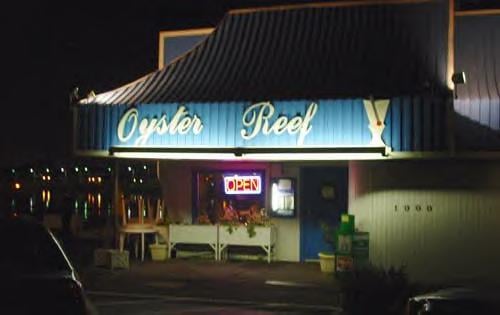 Scrambling for her video camera, Foster hopped in her car to follow the blimp only to watch it disappear behind the Con Agra flour mill on Embarcadero. Lunch Service at the Oyster ReefMeanwhile - at 1000 Embarcadero, at 10th Avenue, on the shore of the Oakland Inner Harbor, near the marina and about a mile south of the Jack London Square - stood the Oyster Reef restaurant. Owner Laura Lee was in the middle of lunch service to about 25 customers when one of them spotted the blimp. It dropped down on the waterfront side of the building, and slowly descended until it’s gondola snagged on the mast of a sailboat in the Central Basin marina.  Pulled downwards, the gondola swung toward the restaurant's windows, and the deflating blimp’s large envelope draped itself over the roof of the restaurant—next to where the boat was moored—and atop a nearby power line. Pulled downwards, the gondola swung toward the restaurant's windows, and the deflating blimp’s large envelope draped itself over the roof of the restaurant—next to where the boat was moored—and atop a nearby power line. Oakland firefighters arrived at the crash site quickly and - using axes and poles - punched holes in airship envelope’s rubberlike surface – deflated it slowly as to minimize damage to property. Assessing the DamageWhile Paul Adams was hospitalized for a wrist injury, Harris was said that, “Only my right shoulder and my right elbow were both banged up a bit.” On the ground, no other injuries were reported. "These are highly experienced crews... I'm just glad they are okay," Airship USA president Grant Murray told reporters after describing the accident. "There could have been a number of reasons. An airship moves with great mass, and it's very difficult to control it." To remove the wreck, Bigge Crane and Rigging Co. of Oakland – famed from their work on removing the Japan Air Lines DC-8 that landed in San Francisco Bay while on approach to SFO in 1968 – was called in. Quickly, they removed the blimp's gondola, nylon fabric, and four fins from the restaurant the evening of the crash, and on to the following day. 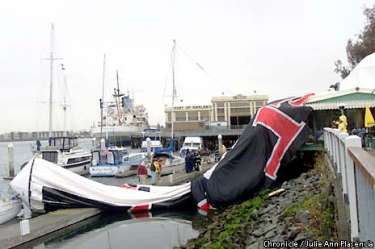 The blimp needed $2.5 million in repairs, while the sailboat and restaurant had only minor damages - the blimp knocked out a large antennae on the roof and caused a roof leak. FAA inspectors examined the wreckage, including the airship's two Teledyne Continental engines, as part of their probe. Because of structural damage sustained in the impact sequence, the airship’s systems could not be tested as installed on the airship. However, each system was functionally tested and found to be in working condition. The blimp needed $2.5 million in repairs, while the sailboat and restaurant had only minor damages - the blimp knocked out a large antennae on the roof and caused a roof leak. FAA inspectors examined the wreckage, including the airship's two Teledyne Continental engines, as part of their probe. Because of structural damage sustained in the impact sequence, the airship’s systems could not be tested as installed on the airship. However, each system was functionally tested and found to be in working condition.
The investigation reviewed the FAA-approved flight manual and found that - in the emergency procedures section, under “pressure-related emergencies,” it stated that, with a high-pressure indication, the pilot should check that the helium release valves and air valves are in the UNLOCKED position. With the aft ballonet valves in the OPEN position and the fan for the forward ballonet in the ON position, the forward ballonet became fully inflated, which caused the out-of-trim/unequal hull pressure condition. But, most importantly, the investigation uncovered that the blimp had no minimum equipment list – meaning that if a component was found to be inoperative, the airship was not approved for flight and considered to be in an unairworthy condition. The dual ballonet level cockpit indicator had been taped over and marked “In-Op” before the flight – and the airship should have never taken off in that scenario! Harris had his reservations, however. “My number-one concern,” said Harris, “was the integrity of the fly-by-wire system in adverse weather conditions. This was the first time I ever flew [a fly-by-wire blimp] in the rain, and I didn’t learn until later that this was the first time this airship had been flown in the rain. Normally, to fly an airship in the rain doesn’t affect the airship at all, other than to make the vehicle somewhat heavier.” Harris said that he and Adams “are suspicious of the effect that rain had on the system. All that we know is that it’s a weather- related incident.” EpilogueThe XFL's opening game took place on February 3rd, 2001, one year after the league was announced, less than one week following the NFL's Super Bowl XXXV. The first game was between the New York/New Jersey Hitmen and the Las Vegas Outlaws at Sam Boyd Stadium in Las Vegas, Nevada. While this first game brought higher television viewership than NBC had projected, ratings quickly nosedived. NBC and the WWF each lost a estimated $35 million, only recuperating 30% of their combined initial $100 million investment.  On April 21st, 2001, the season concluded as the Los Angeles Xtreme defeated the San Francisco Demons in the XFL Championship “Million Dollar Game.” Though paid attendance at games remained respectable, low T.V. ratings – which included breaking the record for the lowest prime-time ratings for a major broadcast network - plagued the endeavor, and the XFL ceased operations after just one season on May 10th, 2001. Despite the financial losses, Ebersol was not overly disheartened, telling the Los Angeles Times, "Strange as it may seem to hear, this was one of the most fun experiences of my life." McMahon later suggested that maybe the blimp crash should have been seen as an omen for what would end up happening to the XFL. NBC would continue to experiment with covering other football events, notably the Arena Football League starting in 2003. On November 28th, 2004, a private charter jet carrying Ebersol and two of his sons, Charlie and Teddy, crashed during an attempted takeoff from Colorado’s Montrose Regional Airport. The jet's captain, Luis Polanco, flight attendant Warren T. Richardson III, and Teddy Ebersol were killed. The senior Ebersol and the plane’s first officer, survived, though seriously injured, along with Charlie, who was thrown clear of the plane and rushed back inside and managed to pull his father to safety. Arena Football coverage also proved to be a failure. On August 6th, 2006, NBC resumed coverage of NFL games with the annual AFC-NFC Hall of Fame Game. Ebersol resigned from the chairmanship of NBC Sports in 2011. Also, in 2011, the Oyster Reef Seafood Restaurant and Bar closed its doors to business.  After a lengthy investigation by the NTSB into the design of the blimp, the Board released its final report (LAX01FA071) on the accident on January 3rd, 2012. In it, it determined the probable cause of this accident to be that one or both of the rear ballonet air relief valves remained in an open position for undetermined reasons, which caused an out-of-balance trim condition. Also, causal factors contributing to the accident were the flight crew’s decision to fly the airship with a known deficiency - the inoperative ballonet indicator - and the pilot’s failure to follow proper emergency procedures. After a lengthy investigation by the NTSB into the design of the blimp, the Board released its final report (LAX01FA071) on the accident on January 3rd, 2012. In it, it determined the probable cause of this accident to be that one or both of the rear ballonet air relief valves remained in an open position for undetermined reasons, which caused an out-of-balance trim condition. Also, causal factors contributing to the accident were the flight crew’s decision to fly the airship with a known deficiency - the inoperative ballonet indicator - and the pilot’s failure to follow proper emergency procedures.
In 2013, a casual German-American eatery & bar, Brotzeit Lokal, opened on the site of the Ocean Reef restaurant in Oakland. Complete with communal tables, counter seats & a waterfront beer garden, it enjoys a popular following in the region. Today, Hunter Harris still flies and is a famed aerial photographer, having earned the coveted distinction of "Master Photographer" from the international Professional Aerial Photographers Association. Paul Adams still works in the airship industry, having owned and operated several companies dedicated to advancing the technology. Rebirths... Igor Pasternak still designs and builds airships and aerostats. In a 2016 interview with “The New Yorker” magazine, he discussed his proposed airship masterpiece, the Aeroscraft. The Aeroscraft will come in three sizes. The ML866 will be five hundred and fifty-five feet long and able to carry sixty-six tons of cargo. The ML868 will be about thirty percent larger, with a capacity of two hundred and fifty tons. And the ML86X will be nine hundred and twenty feet (nearly three football fields) long, two hundred and fifteen feet (more than the Tower of Pisa) high, three hundred and fifty-five feet (two Boeing 747s) wide, and able to carry five hundred tons. Igor Pasternak still designs and builds airships and aerostats. In a 2016 interview with “The New Yorker” magazine, he discussed his proposed airship masterpiece, the Aeroscraft. The Aeroscraft will come in three sizes. The ML866 will be five hundred and fifty-five feet long and able to carry sixty-six tons of cargo. The ML868 will be about thirty percent larger, with a capacity of two hundred and fifty tons. And the ML86X will be nine hundred and twenty feet (nearly three football fields) long, two hundred and fifteen feet (more than the Tower of Pisa) high, three hundred and fifty-five feet (two Boeing 747s) wide, and able to carry five hundred tons.
The letters “ML” in the names are a tribute to Marina and Levon, who both died in the January 2000 repair accident.  Also, in 2016, Charlies Ebersol interviewed both Vince McMahon and Dick Ebersol for the ESPN “30 for 30” documentary series. The episode, entitled “This Was the XFL” aired on February 2nd, 2017. Included in the footage was aerial coverage of the 2001 blimp accident. Also, in 2016, Charlies Ebersol interviewed both Vince McMahon and Dick Ebersol for the ESPN “30 for 30” documentary series. The episode, entitled “This Was the XFL” aired on February 2nd, 2017. Included in the footage was aerial coverage of the 2001 blimp accident.
At the episode closing, Dick Ebersol asked Vince McMahon, ”do you ever have any thoughts of trying again?” Without hesitation, McMahon replied... “Yes, I do.” “We’ll have to do it with our own money because I don’t work at NBC anymore,” reminded Ebersol, as both laughed and smiled. On January 25th, 2018, McMahon - who retained the rights to the XFL name - announced that he would revive it for a new iteration of the league. It would not utilize the same sports entertainment features associated with the original, and McMahon’s company invested a reported half a billion dollars in the project. The debut games of the new XFL were played on February 8th, 2020. Oddly enough, it has more competition than just the NFL as the year prior, in 2019, Charlie Ebersol launched the Alliance of American Football, or the AAF, an 8-team spring pro-football league. An adviser on the league is his father, Dick Ebersol. |