The “Primal Man” CrashNear Bishop, California March 13, 1974 "The Struggle for Survival"... The entertainment industry has always been a large user of aircraft in the completion of their work. From bringing the necessary minds from New York and Hollywood together at the inception of a new project, to bringing the stars to the red carpet, the folks of Tinseltown have needed fast and reliable transportation. A series of television specials, entitled “Primal Man”, told the story of mankind's rise and development from the basic primate. The third one-hour installment of the series, to be entitled "The Struggle for Survival", was to depict Australopithecus, man's early ancestor, and tell the legend of man's survival which began some four million years ago. and continues through to today with environmental threats to man. The production, sponsored by the Travelers Insurance Company, and produced by Wolper Productions, in association with Jack Kaufman Productions, would require filming in mountainous terrain, in order to accurately reflect the desired Ice Age setting for the special's characters in a particular scene - the hunt of a Siberian tiger! The filming at the Mammoth Mountain resort begun on Monday, March 11th, and continued for two more days until Wednesday the 13th. A tiger had been rented for the filming, but Stan Margulies, the vice president of Wolper Productions, said the animal was to be returned to Los Angeles by truck. The rest of the production company would return to Burbank via a chartered plane. 
The charter company selected by Wolper Productions was Sierra Pacific Airlines. Formerly called 'Trans Sierra Airlines" and now a subsidiary of the Mammoth Mountain Ski Area corporation, which operates ski lifts near Mammoth Lakes, the airline had just purchased four of the 44-passenger Convair 440 "Metropolitans" in November of 1973, shortly after it was acquired by the ski operator. Although Convair 440s were widely regarded as the major short-haul aircraft used widely by major commercial airlines in the early 1950s, Sierra Pacific used the planes to operate regularly scheduled flights of passengers from major California cities to eastern Sierra ski resort destinations. Foreshadowing Disaster... Originally, the plane used for the charter, a prop-driven Convair 440, tail number N4819C, was to be used on a regularly scheduled passenger flight to Mammoth, which was scheduled to depart Burbank at 3:45 p.m., with the return flight from Mammoth being the charter - Flight 802. However, because of a problem with one of the generators on N4819C, the flight was cancelled, and its passengers were dispatched on another Sierra Pacific flight. By 5:30 p.m., the problem with the generator (a blown fuse) on aircraft N4819C was remedied, but because of the late hour, a night takeoff would have been necessary from Mammoth Lakes Airport, and since the airport was restricted to daylight operations only, Flight 802 was rescheduled to pick up the Wolper Production crew at the Bishop Airport. Because the airport in Bishop is located about 45 miles south of Mammoth Lakes, the airline arranged bus transportation for the production crew from Mammoth Lakes to Bishop. The plane finally left Burbank at 6:14 p.m., and arrived at the Bishop Airport just over an hour later at 7:20 p.m. The production team was pressed for time - All were scheduled to report for more filming in Malibu on Friday, March 15th. Powered by two 2 Pratt & Whitney R-2800-CB16 "Double Wasp" 18 cylinder air cooled radial engines, the plane then took off at 8:24 p.m. and slammed into the ridge at the 7,000-foot level less than five minutes later. Click Here to Read the Crew and Passenger List of Sierra Pacific Charter Flight 802 Eyewitnesses said the Sierra Pacific plane blew up like a fireball, its ton and a half of aviation gasoline igniting, after slamming into the ridge about five minutes after takeoff from Bishop Airport Wednesday night. According to Sheriff Floyd Barton, who saw the fireball from eight miles away on the valley floor, the plane exploded and "looked like a giant napalm bomb going off." 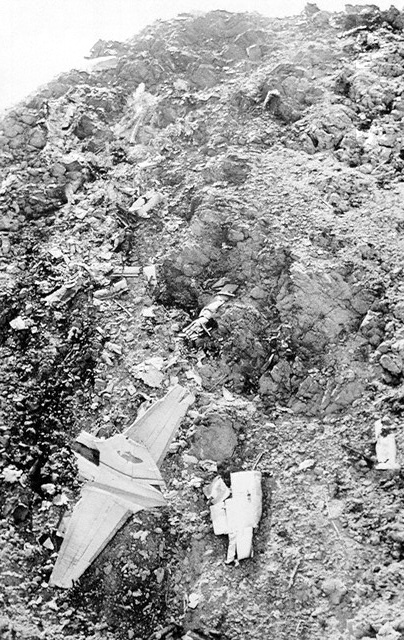
First on Scene... Mike Antonio, a pilot for the Western Helicopter Company, flew to the scene with Dr. Dave Sheldon of Bishop. Afterwards, he said, "The plane smacked hard into the ridge and spread wreckage for 300 feet. There wasn't much left of the plane. I could see a tail section, an engine, not much else. All of it was burning. The bodies were pretty badly burned too." He said he and the doctor spent 30 minutes hunting through the smoldering bodies and airplane litter, across the snow-patched slope, "but we couldn't find any survivors so we shoved off." In Los Angeles, Sierra Pacific spokesman Dean Sparkman said the pilot had been in contact with the control tower at Bishop Airport until just before the crash and had reported no difficulties. On the scene of the crash were officials from the Federal Aviation Authority, workers from the Inyo County coroner's office, and an FBI team, assisting in identification of the bodies, many of which were badly burned, were on the scene. All 36 bodies were recovered from the crash site, and taken to to a makeshift mortuary at Bishop Airport. Parking Choice Saved Photographer's Life… "They asked me to go on the flight because I had shot pictures of them before and made friends, They said, 'Rather than go back alone, why don't you come with us,'" Dennis Plehn, a 29-year-old photographer, recalled the following day in an interview with the Associated Press. "But my car had been parked at International Airport (in Los Angeles) and their plane was going to Lockheed airport in Burbank, so I turned them down." he said. Plehn said another factor which kept him off the plane was his company's decision to move up his departure time by a half hour. He was shooting publicity pictures of the television movie series on behalf of a public relations firm. He had returned to Los Angeles and was sleeping early Thursday when word of the crash came by telephone. "I didn't believe it," he said. "I was very happy I wasn't on the plane." A Shot in the Dark... "The plane was not in the normal climb corridor," according to a statement of Bill Hendricks, head of a seven-man National Transportation Safety Board (NTSB) investigating team. He stated that federal regulations required that the plane climb to 8,000 feet while it was within two miles of Bishop Airport, then climb to 10,000 and then 13,000 feet as it headed away. Sierra Pacific spokesman Dean Sparkman said the pilot had been in contact with the control tower at Bishop Airport until just before the crash and had reported no difficulties. Days later, on March 19th, 1974, Nancy J. Jacob, wife of David Jacob, the key grip on the production, and one of the 35 persons killed in the crash, filed suit against Sierra Pacific Airlines, the Mammoth Mountain Corporation and 50 unidentified persons. Her Superior Court suit sought $5,000,000 in general damages, and accused the pilot and Sierra Pacific Airlines of "negligently, wantonly, recklessly and unlawfully flying a plane." The on-scene investigation by the NTSB into the crash's cause was completed on March 22, 1974. In late May of 1974, producer Jack Kaufman announced that the film of a Siberian tiger hunt, a re-creation of man's ancestors stalking a tiger through the snow, was recovered from the burned wreckage of the plane, and would appear in the third segment of "Primal Man". "Looking at the people you remember the accident," Kaufman said. "I think for a few days it was a question of whether we would go on. Certainly in my case. I think after the accident everyone was in a state of shock. You didn't want to go on. But we recovered. We had to go on or their sacrifice would have been in vain." Prior to airing, producer David Wolper said, "Everyone connected with the project gave a little bit of extra effort to make this show the best we have ever done. This show is the last effort of some truly fine craftsmen and artists." The third segment aired on ABC on June 21st, 1974. Unsolved Mystery... The Aircraft Accident Report on the crash was issued by the NTSB on January 10th, 1975. Surprisingly, finding no indication of mechanical failure, the NTSB was unable to determine the probable cause of this accident, or establish the reason why the flight crew did not maintain a safe distance from hazardous terrain during night visual flight. Several theories were suggested by the NTSB, including that, since was a pilot-trainee in the cockpit during the flight, an “instructional relationship” could possibly have distracted the captain from adequately monitoring the plane’s flight path during its climb-out of Bishop Airport. To this day, this crash remains one of the only three aviation mishaps to be unsolved by the NTSB in its forty year history. The Safety Board did, however, recommend the installation of Distance Measuring Equipment (DME), co-channeled and co-located with the Bishop VOR navigation beacon, a study of the feasibility of an instrument climb procedure to the northwest of the Bishop VOR using a designated radial and the DME, and the requirement that all nighttime departures and arrivals at the Bishop Airport be conducted in accordance with the prescribed instrument procedures. |