The Mark IV Bomb
Crash of the B-29 on Travis AFB, CA
August 5, 1950
|
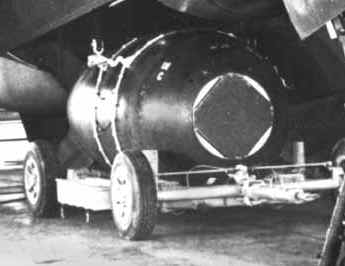
The B-29 was loaded with a fourth-generation O Mark IV atomic bomb, an implosion bomb similar to the one dropped during World War II on Nagasaki.
| 
| 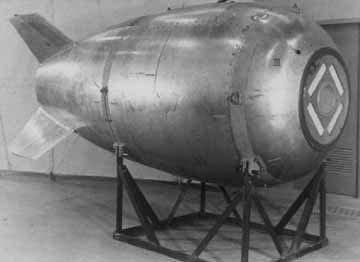
| Similar to "Fat Man" dropped on Nagasaki which was a Mark III. Yield 1 to 31 kilotons. (Bomb dropped on Hiroshima had a yield of 15 kilotons) | The Mark IV atomic bomb (also referred to as Mark 4, Mark-IV, Mk 4 and Mk-4) weighed 10,800 pounds had a yield of from 1-31 kilotons and was in service from March 1949 until May 1953.The Mark IV, was manually "safed" by removal of a capsule containing the fissionable material through a trap door in the sphere reachable from the nose of the case.Ground handling was accomplished with the N-1 dolly originally procured from Boeing Aircraft Company beginning in late 1947. The N-1 was a low bed roadable dolly without a lifting mechanism. The B-29 was literally lifted up (tilted), the Mark IV rolled in place and the B-29 lowered as the bomb was guided into the bomb bay.When the Travis B-29 crashed, the capsule containing the fissionable material was not in place. In fact, it wasn't even on the same plane.It was standard operating procedure at the time that when transporting "special weapons" not to transport the fissionable capsule and the main sphere containing the high explosives trigger together.However, the bomb did have depleted uranium in it, used as ballast. The high density of depleted uranium meant very small amounts (in volume) could be used while not taking up very much space, thus keeping the overall size of the bomb to a minimum. More on Depleted UraniumDepleted uranium is what is left over when most of the highly radioactive types (isotopes) of uranium are removed for use as nuclear fuel or nuclear weapons. The depleted uranium used in armor-piercing munitions and in enhanced armor protection for some Abrams tanks is also used in civilian industry, primarily for stabilizers in airplanes and boats.Depleted uranium is a heavy metal that is also slightly radioactive. Heavy metals (uranium, lead, tungsten, etc.) have chemical toxicity properties that, in high doses, can cause adverse health effects. Depleted uranium that remains outside the body can not harm you. A common misconception is that radiation is depleted uranium's primary hazard. This is not the case under most exposure scenarios. Depleted uranium is approximately 40 percent less radioactive than natural uranium. Depleted uranium emits alpha and beta particles, and gamma rays. Alpha particles, the primary radiation type produced by depleted uranium, are blocked by skin, while beta particles are blocked by the boots, most clothing, etc. While gamma rays are a form of highly-penetrating energy , the amount of gamma radiation emitted by depleted uranium is very low. Thus, depleted uranium does not significantly add to the background radiation that we encounter every day.When fired, or after "cooking off" in fires or explosions, the exposed depleted uranium poses an extremely low radiological threat as long as it remains outside the body. Taken into the body via metal fragments or dust-like particles, depleted uranium may pose a long-term health hazard to personnel if the amount is large. However, the amount which remains in the body depends on a number of factors, including the amount inhaled or ingested, the particle size and the ability of the particles to dissolve in body fluids.Check out the ATSDR-PHA Report to find out more about the survey conducted of the crash site to determine any health hazards. |     
|
|