"Fallen Astronaut"
Apollo 15's journey to the moon was the most perilous mission planned by NASA. It's destination was the Apennine region of the Moon. By all accounts a success, it provided a rare moment of introspection for astronauts. David Scott's final task of his moon-walk was to drive the Rover out a distance from the Lunar Module to a point where the TV camera could watch the lift off. He left a small Bible on the Rover's dash panel; and, beside the Rover, he laid a figure of a fallen astronaut and a small plaque recording the names of all the astronauts and cosmonauts that had lost their lives in the furtherance of space exploration. The Rover carried its own message, 'Man's first wheels on the moon. Delivered by Falcon, July 30, 1971.' Belgian Artist Paul Van Hoeydonck was commissioned to created the now iconic statuette for the occasion. It was small, stylized and incredibly artistic. The surface appeared to be smooth to the touch like a women's tungsten ring, although it was made out of tin. Smuggled aboard the lunar module without the knowledge of NASA officials, David Scott and Jim Irwin performed a brief, yet reverent, ceremony on the lunar surface. The crew of Apollo 15, in their own words: | Mission Time - 167:41:30 [Without Houston's knowledge, Dave is preparing and photographing a memorial to the astronauts and cosmonauts who had died in space and in other circumstances. Dave talked about the memorial during the post-flight press conference. Photos AS15-88- 11893 and 11894 are a stereo-pair of the memorial.] [Jones - "It was in your post-flight press conference."] [Scott - "That's where we told 'em about it. I was thinking I had discussed it on the Moon, but I didn't."] [Jones - "Tell me about it."] [Scott - "We made a plaque for all the astronauts and cosmonauts that had been killed. And a little figurine, a Fallen Astronaut, and we put it right by the Rover. You can see it in the picture (AS15-88-11893). That was just a little memorial, in alphabetical order. In relative terms, we had both lost a lot and, interestingly enough, we didn't lose any more after that until Challenger. That's what I was doing when I said I was cleaning up behind the Rover (at 167:43:36). Jim knew what I was doing. We just thought we'd recognize the guys that made the ultimate contribution."] [In a 2000 exchange of e-mail, Dave Scott adds "As I recall, we had the idea for the memorial and then looked around for the manner in which it might best be realized. The plaque was the obvious baseline. And either Al or Jim found van Hoeydonck. I remember meeting him at least once."] [Jones - "I'm glad you did it."] [Scott - "We felt satisfied in doing it. Several good guys didn't get to go."] [Jones - "I was just checking to see if there was any notation in the printed version of your checklist."] [Scott - "Probably not. That's one of the things that's easy to remember."] [Scott - "The plaque is explained in the Apollo 15 movie (Apollo 15: In the Mountains of the Moon), too, because they folded our press conference into that."] |
The fourteen astronauts and cosmonauts listed on the memorial are: Charles Bassett (died Feb. 1966 in an aircraft accident), Pavel L. Belyayev (Jan. 1970, disease), Roger Chaffee (Jan. 1967, Apollo 1 fire), Georgi Dobrovolsky (Jun. 1971 re-entry pressurization failure), Theodore C. Freeman (Oct. 1964, aircraft accident), Yuri A. Gagarin (Mar. 1968, aircraft accident),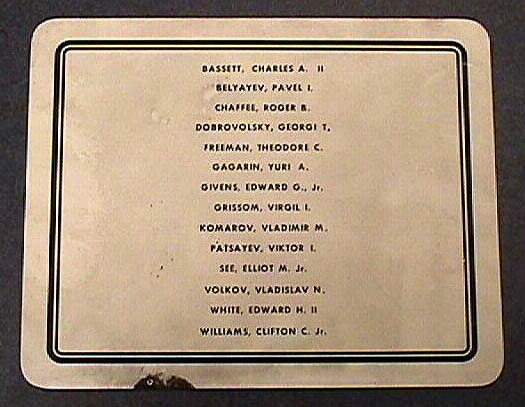 Edward Givens (Jun. 1967, automobile accident), Gus Grissom (Jan. 1967, Apollo 1 fire), Vladimir Komarov (Apr. 1967, re-entry parachute failure), Viktor Patsayev (Jun. 1971, re-entry pressurization failure), Elliot See (Feb. 1966, aircraft accident), Vladislaw N. Volkov (Jun. 1971, re-entry pressurization failure), Edward H. White, Jr. (Jan. 1967, Apollo 1 fire), Clifton C. Williams (Oct. 1967, aircraft accident). |
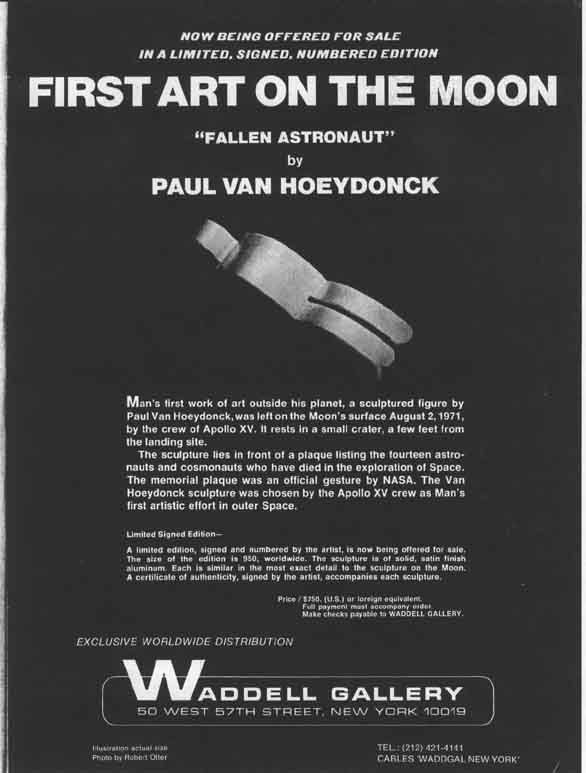 | | The ad that appeared on page 7 of the July 1972 issue of "Art in America" magazine | |
Unknown at the time, two of the original selection of 20 cosmonauts were also deceased before Apollo 15: Valentin Bondarenko, who died during a fire during training in March of 1961, and Grigori Nelyubov, who died in a train accident/suicide in February of 1966. After Being the First... After the crew mentioned the statuette during their post-flight press conference, the National Air and Space Museum requested that a replica be made for public display. The crew agreed, under the condition that it was to be displayed "with good taste and without publicity"; in April 1972, Van Hoeydonck presented the Museum with a replica of Fallen Astronaut, which is now on display with a replica of the plaque. CBS anchorman Walter Cronkite revealed, during the broadcast of the Apollo 16 launch, the existence of the "fallen astronaut" and plaque the day prior.
In May 1972, David Scott learned that Van Hoeydonck planned to make more replicas and sell them. Feeling that this would be a violation of the spirit of their agreement, Scott tried to persuade Van Hoeydonck to refrain. It was advertised, in a black-and-white, full page advertisement in the July 1972 issue of "Art in America" magazine, that 950 replicas of the "Fallen Astronaut" figurine signed by the sculptor were going to be sold by Richard Waddell of the Waddell Gallery in New York (located at 50 West 57th) at a price of $750 apiece, a second edition at a lower but unspecified price, and a catalog edition at $5.
After the negative comments from NASA regarding the intended sale, Van Hoeydonck retracted his permission for it and none were sold, despite having been produced. Several of the replicas reside in various museums scattered across the globe. The one that was gifted to the National Air & Space Museum is on display in Gallery 114, the Space Race exhibition, in Washington, DC. The same Apollo mission was also rocked by controversy regarding the carriage of 398 unauthorized postal covers to the Moon for commercial resale afterwards by a German stamp dealer, Hermann Sieger.
You are the #  person to pay tribute to 'Fallen Astronauts'. Thank you! person to pay tribute to 'Fallen Astronauts'. Thank you! Click here to visit Check-Six.com, Offering Aviation History and Adventure First-Hand |