
| | Check-Six Online Museum "First Flights" Wing 
Cover Flown on First Airmail Flight between Nome and Fairbanks, Alaska |
| | Place your pointer over the photo to see the reverse of the cover |
When Noel Wein flew an open cockpit bi-plane from Anchorage to Fairbanks in 1924, Alaska's first air carrier, Wein Airlines, was born. Beginning with a three hundred dollar one way Fairbanks to Nome route, Wein built runways, hired pilots, and brought planes from as far away as Germany to serve dozens of bush villages.
MORE INFO COMING SOON | Cover Flown Aboard First Flight of the Douglas B-19 Experimental Super Bomber | 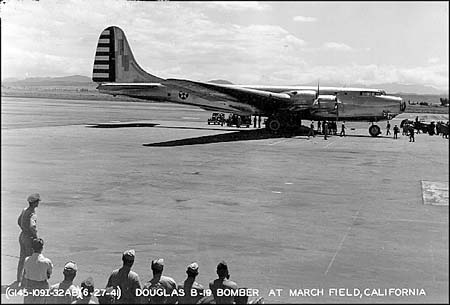 |
On September 29, 1936, Douglas Aircraft received an order for a prototype Long Range Bomber. Designated the XB-19, this airplane was the largest American bomber ever flown until after World War II. The XB-19 was essentially used as a test bed for very large bomber construction techniques and flight characteristics. The Douglas Aircraft Company actually wanted to cancel the project because of the expense and extended construction time which made the aircraft obsolete before it ever flew. However, the Army Air Corps insisted the aircraft be completed for test use.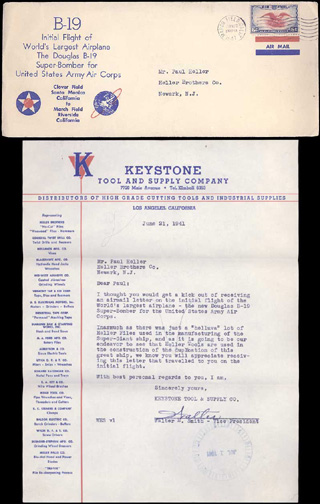 | Although only one was built, the big plane with a crew of eighteen did prove to be an invaluable aid in the design of future Air Force bombers such as the Boeing B-29 and Convair B-36. It continued to serve as a transport until 1949, when it was sadly cut up for scrap. The first flight of the XB-19 took place from Clover Field in Santa Monica on June 27, 1941 with a crew of seven captained by Major Stanley M. Umstead. On its first flight, it was flown to March Field and turned over to the Army for evaluation. Such was the degree of popular enthusiasm aroused by the XB-19 "Super-Bomber" that President Franklin Roosevelt himself telegraphed congratulations to Donald Douglas for this achievement. This original piece of mail was on board as the B-19 made its first flight from Santa Monica to March Field on June 27, 1941. | The front of the envelope reads: | B-19 Initial Flight of World's Largest Airplane
The Douglas B-19 Super-Bomber
for United States Army Air Corps Clover Field - Santa Monica California to
March Field - Riverside California |
|
Enclosed is a personal/business letter from the vice president of Keystone, a tool and supply contractor, to the president of Heller Brothers, a manufacturer of files used in building the plane, the contractor noting that "inasmuch as there was just a "helluva" lot of Heller Files used in the manufacturing of the Super-Giant ship, and as it is going to be our endeavor to see that Heller Tools are used in the construction of the duplication of this great ship, we know you will appreciate receiving this letter that traveled to you on the initial flight." It should be noted to only one of this aircraft was ever built. The original was scrapped in 1949. Do You Have a B-19 Cover? Wanna Know What It's Worth? | 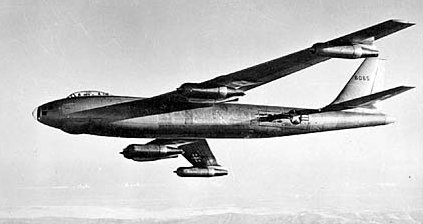 | Cover Flown On First Flight of the Boeing XB-47 "Stratojet" |
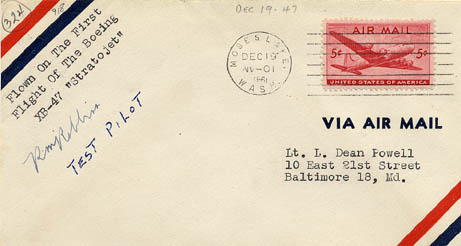
The Boeing B-47 "Stratojet" jet bomber was a major postwar innovation in combat jet design, and led to the development of modern jet airliners. While 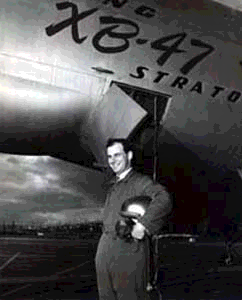 it never saw serious combat use, it was the mainstay of US strategic defense in the 1950s, with over 2000 aircraft built. It was designed to be able to carry a 1-ton bomb at over 300 miles per hour! it never saw serious combat use, it was the mainstay of US strategic defense in the 1950s, with over 2000 aircraft built. It was designed to be able to carry a 1-ton bomb at over 300 miles per hour! The XB-47 prototype first flew on 17 December 1947 (the 44th anniversary of the Wright Brother's first flight at Kitty Hawk, NC), with test pilots Robert Robbins and Scott Osler at the the controls. The aircraft flew from Runway 13 at Boeing Field in Seattle to the Moses Lake Airfield in central Washington state (a distance of 145 miles, which it flew in 27 minutes!), in a flight that lasted a total of 52 minutes. There were no major problems, except that Robbins had to pull up the flaps with the emergency hydraulic system and the engine fire warning lights kept popping on, the sensor technology being very unreliable at the time. Robbins reported that the flight characteristics of the aircraft were good, and was quoted as saying that it was a, "very easy aircraft to fly." One of only three covers flown on that historic day, this cover is autographed by Robert Robbins. It is addressed to a "Lt. L. Dean Powell" of Baltimore, Maryland. The stamp, typical of airmail stamps of that era, was cancelled on December 19th, 1947 (two days after the flight) at Moses Lakes, Washington. | Cover Flown On First Flight of the Boeing YB-52 "Stratofortress" | 
|
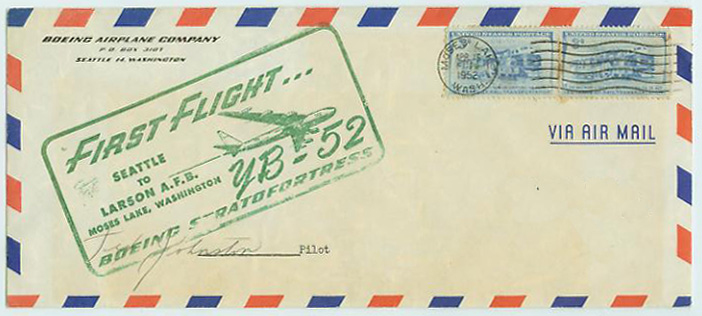 This cover was flown on the first flight of the Boeing YB-52 "Stratofortress", which flew from Seattle to Larson AFB, Washington on April 15, 1952. This cover was flown on the first flight of the Boeing YB-52 "Stratofortress", which flew from Seattle to Larson AFB, Washington on April 15, 1952.
The pilot for that first flight was Alvin M. "Tex" Johnston, one of Boeing's top test pilots. Johnston got his nickname because of his fondness for wearing fancy cowboy boots, even during test flights. He became an aviation legend in 1954 when he put the 707 jetliner prototype into a complete 360-degree barrel roll over Lake Washington — not once, but twice during the plane's first public display. The co-pilot was Lt. Col. Guy M. Townsend of the U.S. Air Force flight test center. During World War II, he had flown Boeing B-17s and B-29s. After a long Air Force career, Townsend retired as a brigadier general and joined Boeing. Just before 10 a.m. the pilots in the cockpit began a final check of all instruments and controls. At 10:45 a.m. the big plane's eight jet engines came to life with an ear-piercing roar. At 11:03 a.m. the B-52 headed down the taxiway, turned onto the main runway at the north end of Boeing Field and stopped. Johnston advanced the eight throttles to full power and released the brakes. At 11:09 a.m. the wheels started to roll, and the aircraft took to the skies effortlessly. Johnston and Townsend kept the plane over the Seattle area for about 40 minutes as they checked the landing gear, flaps and ailerons. They then climbed to 25,000 feet and headed for Larson Air Force Base at Moses Lake, Washington. Arriving around noon, the YB-52 flew over the Moses Lake area for the next two hours as the pilots continued to perform a series of tests. Johnston radioed back to Boeing Field that the plane's performance appeared to be just as predicted by the engineers. At 2 p.m. the YB-52 touched down on the 10,000-foot runway at Larson Air Force Base. The flight had lasted two hours and 51 minutes. At the time, it was the longest and most successful first flight in Boeing history. (Source: Boeing) Postmarked Moses Lake, Wash., April 16, 1952 (although the flight took place on the15th) on Boeing Airplane Company envelope, and is signed by the flight's pilot, Tex Johnston. |
Check out the 'American Astrophilately' website for amazing pieces of history!;                           
|