

| | Check-Six Online Museum Sea / Nautical Wing 
Wooden Deck Block from the USCGC Taney, WHEC-37 | 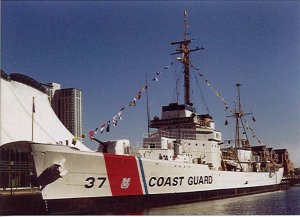 |
USCGC ''Taney'' (WPG/WHEC-37)''' is a United States Coast Guard High Endurance Cutter, notable as the last ship floating that fought in the attack on Pearl Harbor. She was named for Roger B. Taney, formerly Secretary of the Treasury and Chief Justice of the United States.
She is also one of two ''Treasury''-class Coast Guard Cutters still afloat. Serving her country for 50 years, the ''Taney'' saw action in both theaters of combat in World War II, serving as command ship at the 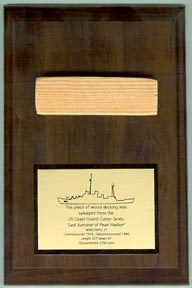 Battle of Okinawa, and as part of fleet escort in the Atlantic & Mediterranean. She also served in the Vietnam War in Operation Market Time. ''Taney'' also patrolled the seas working in drug interdiction and fisheries protection. USCGC ''Taney'' also participated in the search for Amelia Earhart. Battle of Okinawa, and as part of fleet escort in the Atlantic & Mediterranean. She also served in the Vietnam War in Operation Market Time. ''Taney'' also patrolled the seas working in drug interdiction and fisheries protection. USCGC ''Taney'' also participated in the search for Amelia Earhart. She was formally decommissioned on 7 December 1986 and turned over to the city of Baltimore, Maryland, for use as a museum ship. Over her distinguished career, Taney received three battle stars for World War II service and numerous theatre ribbons for service in World War II, the Korean War, and the Vietnam War. As of 2005, the ''Taney'' is located in the historic Baltimore Inner Harbor as part of the Baltimore Maritime Museum. The Taney's original wood decks deteriorated to a point beyond repair and were restored to their once-proud condition. Keepsakes from this historic deck when made available to donors for contributing to this important restoration.
Mounted on a wooden plaque, individually numbered, with an engraved brass plaque and certificate of authenticity. The plaque measured 5 inches in width by 7 inched in length. The wood block itself about an inch in height by 3 inches in length. | 
| Keychain Made From the Propeller of the RMS Queen Mary |
| | Place your pointer over the photo to see the reverse of the keychain |
The Royal Mail Steamer Queen Mary... By all measures, the Queen Mary was truly "titanic." Bigger, faster and more powerful than her predecessor the Titanic, she lived a long life that included 1,001 successful Atlantic crossings. Built in Southampton, England in 1937, the Queen Mary held the record for the fastest-ever North Atlantic crossing, and for three years she carried the rich and famous across the Atlantic in great luxury. In 1939, the world began to darken as World War II approached. On September 2, 1939, the Queen Mary crew blacked out her portholes. The following day, England and France declared war on Germany. Refitted as a troop ship, her capacity increased from 2,410 to 5,500, Queen Mary carried troops to the war and Winston Churchill to war conferences for the next six years. She survived a collision at sea with the British light cruiser Curacoa in October of 1942, carried the most people ever on a floating vessel (16,683) in July of 1943, and participated in the D-Day invasion in June of 1944. Finally, Queen Mary resumed her glamorous life as a cruise ship. That is, until technology made her obsolete. Slowly, air travel became the preferred way of crossing the Atlantic, and transatlantic cruise ships fell out of fashion. Queen Mary survived until 1967, when Cunard sold her for $3.45 million. Queen Mary made her 516th and final voyage to Long Beach, California on December 9, 1967. She is currently located at the Queen Mary Seaport, and is listed on the National Register of Historic Places. |  | Piece of the Flight Deck of the Aircraft Carrier USS Yorktown, CVS-10 | 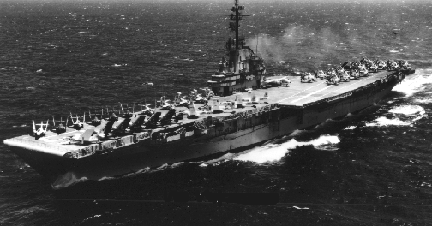 |
The fourth Yorktown (CV-10) was laid down on 1 December 1941 at Newport News, Va., by the Newport News Shipbuilding & Drydock Co. as Bon Homme Richard; renamed Yorktown on 26 September 1942; launched on 21 January 1943, sponsored by Mrs. Eleanor Roosevelt; and commissioned on 15 April 1943 at the Norfolk Navy Yard, Capt. Joseph J. ("Jocko") Clark in command. Second of the Essex class carriers, Yorktown 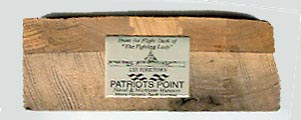 replaced her namesake, lost at the Battle of Midway in June 1942. The Essex carriers formed the core of the fast carrier task forces that struck Japanese forces in the Pacific with devastating results. Yorktown's planes inflicted heavy losses on the enemy at Truk and in the Marianas; the carrier supported American troops in the Philippines, at Iwo Jima, and at Okinawa. Yorktown received 11 battle stars for her World War II service and was awarded the Presidential Unit Citation. For service off Vietnam she was awarded four battle stars. replaced her namesake, lost at the Battle of Midway in June 1942. The Essex carriers formed the core of the fast carrier task forces that struck Japanese forces in the Pacific with devastating results. Yorktown's planes inflicted heavy losses on the enemy at Truk and in the Marianas; the carrier supported American troops in the Philippines, at Iwo Jima, and at Okinawa. Yorktown received 11 battle stars for her World War II service and was awarded the Presidential Unit Citation. For service off Vietnam she was awarded four battle stars. Yorktown and other Essex class carriers were the core of the U.S. postwar fleet. After Korean War duty, Yorktown was modernized for antisubmarine warfare and was deployed to Vietnam. In 1968, the carrier recovered the crew of Apollo 8, the first manned flight to orbit the moon. Decommissioned in 1970, Yorktown became the centerpiece of the fleet of ships at Patriots Point, South Carolina, in 1975, where she resides to this day. During the course of maintenance of the vessel, some of her flight deck was removed and replaced. This piece measures 5.5 inches in length, 2 inches in height, and 1 inch in thickness. In the piece is a small metal plaque reading, From the Flight Deck of "The fighting Lady" - USS YORKTOWN - Patriots Point Naval & Maritime Museum - Mount Pleasant, South Carolina. | 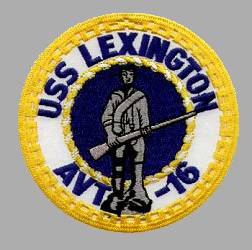
| Piece of the Flight Deck of the Aircraft Carrier USS Lexington, AVT-16 | 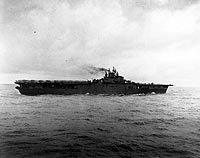
|
Named for the CV-2 scuttled by the Navy after sustaining serious damage in the Battle of the Coral Sea in May of 1942. Lexington served as the flagship of Fast Carrier Task Force 58 under the command of Admiral Marc Mitscher. Mitscher is credited with making the aircraft carrier task force the predominant naval weapon system of the 20th century while aboard Lexington in the western Pacific. Lexington participated in every major naval campaign from Tarawa to Tokyo and was hit twice by the enemy. Lexington was 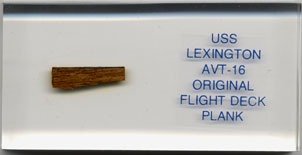 nicknamed "The Blue Ghost" by the Japanese propagandist Tokyo Rose because she never wore the typical camouflage paint of all the other U.S. aircraft carriers. nicknamed "The Blue Ghost" by the Japanese propagandist Tokyo Rose because she never wore the typical camouflage paint of all the other U.S. aircraft carriers. After World War II, Lexington was modernized and recommissioned in 1955 for Cold War service in the U.S. Navy. This small piece of her flight deck bears silent witness to many of the actions of World War II, as well as the training endured by many young aviators who have since defended America. During the 1980's, the U.S. Navy came to the realization that keeping in service its last remaining World War II Essex Class aircraft carrier was becoming increasingly expensive and that the USS Lexington would have to be replaced by a more modern ship. In August of 1990, the Secretary of the Navy announced that the USS Forrestal would replace USS Lexington as the Navy's training carrier. | 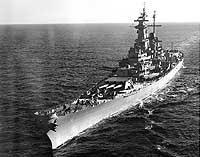 | Piece of the Teakwood Deck of the Battleship USS Wisconsin, BB-64 |  |
USS Wisconsin (BB-64), one of the four Iowa-class battleships, began her career in the middle of World War II. Wisconsin reported for duty with the Pacific Fleet in October 1944. The powerful new warship joined Admiral William F. Halsey's 3rd Fleet when the liberation of the Philippines was underway. The battleship helped neutralize Japanese sea, air and ground forces occupying the islands. Wisconsin was reassigned to the 5th Fleet in February 1945 and supported the landings on Iwo Jima and Okinawa. The battleship's brief but active World War II career concluded with the transport of war-weary GI's back to the U.S. during operation Magic Carpet. Wisconsin entered the Atlantic Reserve Fleet at Norfolk in 1948, only to be recommissioned in March 1951 for the Korean War. She steamed to the Pacific and assumed her station as flagship for Vice Admiral H. M. Martin, Commander, 7th Fleet. The battleship provided gunfire support for American, Korean and other United Nations troops on the Korean peninsula until relieved by her sister-ship Iowa in April 1952. 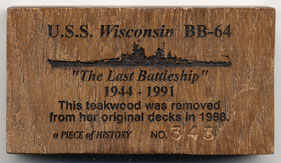 Wisconsin embarked on a series of training missions in the ensuing years. A 1956 collision with USS Eaton (DD-510) damaged the battleship's bow. In a novel repair technique, the bow of the uncompleted battleship Kentucky was grafted on the old battleship in only 16 days at Norfolk Naval Shipyard. Wisconsin embarked on a series of training missions in the ensuing years. A 1956 collision with USS Eaton (DD-510) damaged the battleship's bow. In a novel repair technique, the bow of the uncompleted battleship Kentucky was grafted on the old battleship in only 16 days at Norfolk Naval Shipyard.
Wisconsin once again entered the inactive fleet in 1958, where she remained until 1988, when she was reactivated. The ship carried new Tomahawk and Harpoon missiles in addition to her 16-inch guns when she steamed to the Persian Gulf in 1990 for Operation Desert Storm. After effective use of missiles and high explosives in the desert conflict, the battleship returned home to be decommissioned for the third time in September 1991. Still a defense asset, she now on display at the Hampton Roads Naval Museum in Virginia. During the recommissioning in October of 1988, all of the teakwood decking was replaced. The U.S.S. Wisconsin Association was able to obtain some of this teakwood, from where this piece originated. This is piece is numbered 343. | | |
                          
|