

| | Check-Six Online Museum Sea / Nautical Wing | | Marble Flooring From the USS Arizona Memorial | 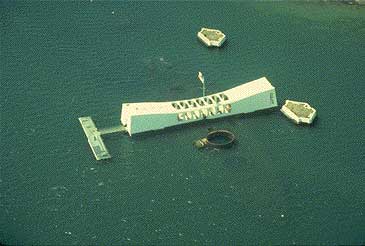 |
In March 1950, Admiral Arthur W. Radford, the Commander in Chief Pacific Fleet, originated the practice of displaying the National Ensign over the sunken remains of USS Arizona (BB-39). The ship's midships structure, which remained above water level, came to be used as a platform for memorial services, and she was the object of passing honors rendered as Navy ships passed by. 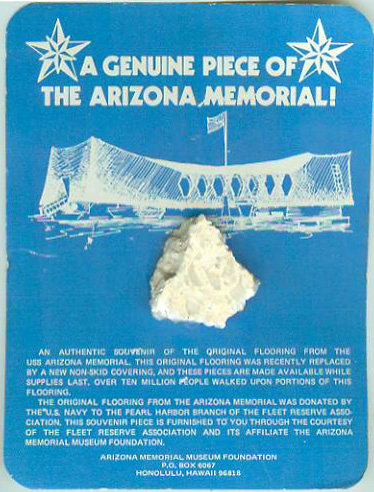 During the later 1950s, efforts began to erect a suitable memorial over her hulk to commemorate the sacrifices of her more than 1100 dead crewmen, the other U.S. Servicemen killed in the Pearl Harbor attack and the personnel lost in the Pacific Theatre during the Second World War. Some of the Arizona's remaining midships superstructure was removed, and pilings were driven beyond the sides of her hull to support the Memorial, which spans but does not touch the sunken ship. During the later 1950s, efforts began to erect a suitable memorial over her hulk to commemorate the sacrifices of her more than 1100 dead crewmen, the other U.S. Servicemen killed in the Pearl Harbor attack and the personnel lost in the Pacific Theatre during the Second World War. Some of the Arizona's remaining midships superstructure was removed, and pilings were driven beyond the sides of her hull to support the Memorial, which spans but does not touch the sunken ship.
The national memorial was designed by Alfred Preis. The structure has two peaks at each end connected by a sag in the center of the structure. It represents the height of American pride before the war, the sudden depression of a nation after the attack and the rise of American power to new heights after the war. The architecture of the USS Arizona Memorial is explained by Preis as, "Wherein the structure sags in the center but stands strong and vigorous at the ends, expresses initial defeat and ultimate victory. The overall effect is one of serenity. Overtones of sadness have been omitted to permit the individual to contemplate his own personal responses, his innermost feelings." Dedicated in May 1962 by President John F. Kennedy, the white open-air shrine contains the names of all the men lost with Arizona and has sufficient space for 250 people to attend services within it. One of Hawaii's most-visited historic sites, it is reached by boat from the USS Arizona Memorial exhibit area on the opposite side of the Pearl Harbor channel. The original marble flooring of the Memorial was donated by the U.S. Navy. However, it was frequently wet, and deemed a safety hazard. Replaced by a new non-skid covering, the marble was removed and sold in pieces by the Arizona Memorial Museum Foundation, the forerunner of the current Arizona Memorial Museum Association. |  | Steel Hull Section Removed from the USS "Woodrow Wilson", SSBN-624 | 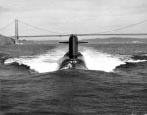 |
The USS "Woodrow Wilson" (SSBN-624) was laid down on 16 September 1961 at Vallejo, Calif., by the Mare Island Naval Shipyard; launched on 22 February 1963; sponsored by Miss Eleanor A. Sayre, the granddaughter of President Wilson; and commissioned on 27 December 1963, Commander Cleo N. Mitchell and Commander Walter N. Dietzen in command of the Blue and Gold crews, respectively. The "Woodrow Wilson" departed Vallejo, California, on 9 January 1964, bound for the east coast on a route which would take her through the Panama Canal. After stopping briefly at San Diego, the submarine proceeded on to Panama arriving on 19 January at the west coast end of the canal. Violent anti-American demonstrations and riots over a recent flag-displaying incident had resulted in an extremely tense atmosphere. As a result, the submarine transited the canal in a record seven hours and ten minutes while combat-ready marines and soldiers guarded the locks. Making port at Charleston, South Carolina, on 5 February, the "Woodrow Wilson" conducted shakedown off the lower eastern seaboard into March and underwent her post-shakedown availability into April. She put to sea at the end of May upon the conclusion of these repairs and alterations and commenced her first deterrent patrol out of Charleston in June. 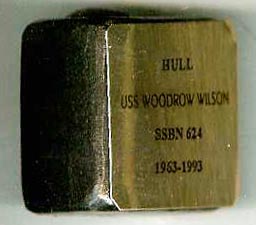 The "Woodrow Wilson" subsequently operated in the Atlantic until the autumn of 1969, conducting her patrols from forward bases at Rota, Spain, and Holy Loch, Scotland. She was then transferred to the Pacific and arrived at Pearl Harbor on 19 November, via Charleston and the Panama Canal. The fleet ballistic missile submarine continued toward the western Pacific to be based at Guam. She conducted deterrent patrols from Apra Harbor through 1972. In that year, she shifted back to the Atlantic and served with the Atlantic Fleet into 1978. Between 1964 and 1977, the ship performed 37 deterrent patrols. The "Woodrow Wilson" subsequently operated in the Atlantic until the autumn of 1969, conducting her patrols from forward bases at Rota, Spain, and Holy Loch, Scotland. She was then transferred to the Pacific and arrived at Pearl Harbor on 19 November, via Charleston and the Panama Canal. The fleet ballistic missile submarine continued toward the western Pacific to be based at Guam. She conducted deterrent patrols from Apra Harbor through 1972. In that year, she shifted back to the Atlantic and served with the Atlantic Fleet into 1978. Between 1964 and 1977, the ship performed 37 deterrent patrols.
Deactivated while still in commission on 11 January 1993, the "Woodrow Wilson" was both decommissioned and stricken from the Naval Vessel Register on 1 September 1994. She entered the Navy’s Nuclear Powered Ship and Submarine Recycling Program at Bremerton, Washington on 26 September 1997 and finished it on 27 October 1998. When she emerged from the program, the former ballistic missile submarine no longer existed as a complete ship and was classed as scrapped. (Text source: DANFS online) As part of the decommissioning of the "Woodrow Wilson", the rudder and sail (the tower-like portion of the submarine's hull) were removed for placement in Deterrent Park, a memorial set up by the Pacific Northwest Submarine Heritage Association to honor and | 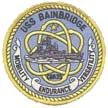 | Wood Deck Plank Segment From the USS Bainbridge, DLGN-25 | 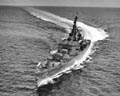 |
The USS Bainbridge (DLGN-25/CGN-25) was a 7800-ton nuclear-powered guided missile cruiser in the United States Navy. She is notable as the smallest nuclear-powered surface warship commissioned by any navy in the world. | Place your pointer over the photo to see the reverse of the lucite |
The Bainbridge was built at Quincy, Massachusetts. Commissioned on October 6th, 1962, she shook down off the East Coast and in the Caribbean area until February 1963, when she began her first Mediterranean deployment. This included demonstrations of her long-range high speed dash capabilities and operations with the nuclear-powered USS Enterprise (CVN-65). Bainbridge returned to the Mediterranean in May of 1964, this time joining Enterprise and the guided missile cruiser USS Long Beach (CGN-9) to form the all-nuclear-powered Task Force 1. At the end of July, the three ships began Operation "Sea Orbit", a two-month unrefueled cruise around the World. The USS Bainbridge, the world's first nuclear frigate and the fourth ship in the Navy to bear the name, was powered by two pressurized water reactors, and carried two twin Terrier missile launchers, two twin 3" .50 caliber radar controlled gun mounts, two torpedo mounts, an Anti-Submarine Rocket launcher, and was equipped with state of the art electronics and communications equipment. She entered dry dock at Mare Island Shipyard in August 1967 for her first refueling. In 1974, she began a 27 month shipyard modernization and overhaul in Bremerton, Washington. While in the shipyard, her 3" .50 caliber guns were removed and replaced with 20mm cannons, she received the AN/SPS-48 radar, and the Naval Tactical Data System was installed. Additionally, the aft superstructure was constructed and an additional level was added on the forward superstructure to support the SLQ-32. On June 30, 1975, BAINBRIDGE was redesignated a cruiser during the Navy's reorganization of ship designations; DLGN 25 became CGN 25. After deactivation, the 'Bainbridge' was towed to Norfolk Naval Shipyard for defueling and preparation for the final movement of the hull to Bremerton, Washington. The lucite here contains a large medallion bearing the ship's seal on one side, and a sketch of the Bainbridge on the flip. The lucite also contains a piece of deck wood from the ship. | 
| Carpet Segment from President Bush's Visit aboard USS Forrestal, CV-59, for the Malta Summit | 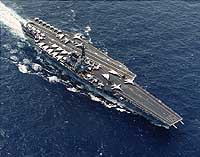 |
USS Forrestal, the lead ship of a class of 56,000 ton aircraft carriers, was built at Newport News, Virginia. Commissioned in October 1955 as the U.S. Navy's first carrier of entirely post-World War II design, she was conceived as an operational platform for large, high-performance aircraft. After shakedown in early 1956 and a trip to the eastern Atlantic during the Suez crisis later in the year, Forrestal began the first of her many Mediterranean cruises in January 1957. She operated in the North Atlantic in September and October of that year and again cruised to the eastern Atlantic during the 1958 Lebanon crisis. 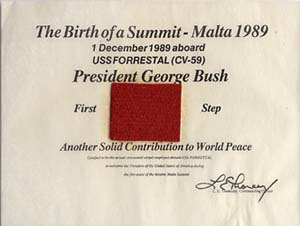
| The Birth of a Summit - Malta 1989
1 December 1989 aboard
USS Forrestal (CV-59)
President George Bush
First CARPET Step
Another Solid Contribution to World Peace
Certified to be the actual ceremonial carpet employed aboard USS FORRESTAL
to welcome the President of the United States of America during
the first event of the historic Malta Summit L.E. Thomassy, Commanding Officer | The text of the certificate |
From 1958 to 1966, Forrestal deployed to the Mediterranean six more times. Closer to home, she also conducted aircraft trials, operated in the Atlantic and Caribbean, and was refitted with new aviation and command and control systems. In June 1967, the big carrier began her only Pacific Ocean cruise, to provide additional airpower to the Vietnam war effort. This was cut short when, on 29 July she suffered a huge fire that began among aircraft on her flight deck and spread into her hangar. After her crew, showing (in the words of her embarked flag officer) "far more acts of sheer heroism than I could count" had extinguished the blaze, the ship was left badly damaged. More than 130 of Forrestal's men lost their lives, 26 aircraft were destroyed and over thirty damaged. From this tragic incident, the Navy learned firefighting lessons that are still fresh more than three decades later. Forrestal was repaired in time to begin her eighth Mediterranean tour in mid-1968. She returned regularly over the next twenty-three years, operating with that sea's Sixth Fleet for a career total of twenty separate deployments. During that period, Forrestal also was reclassified as CV-59 (in 1975), served as host ship for United States Bicentennial celebrations at New York City in July 1976, and underwent a massive Service Life Extension Program overhaul in 1983-85. Her Mediterranean visits included participation in Tunisian flood relief efforts in 1973, in the confrontation with Libya in 1981 and in protecting Iraq's Kurdish population in 1991. In 1982 and again in 1988, the carrier operated in the Indian Ocean. She was on "standby" duty in the Atlantic during the 1990-1991 Kuwait war. Following her 1991 deployment, Forrestal received a new mission, to serve as the Navy's training carrier. She was redesignated AVT-59 in February 1992 and spent much of that year on training service out of Pensacola, Florida. In September, she entered the Philadelphia Naval Shipyard to begin a major overhaul. However, her long service was cut short by the post-Cold War contraction of the Nation's military power. USS Forrestal was decommissioned in September 1993 and stricken from the Naval Vessel Register. However, she remains in Navy custody and is presently in storage at Newport, Rhode Island, awaiting a possible new role as a museum ship. (Source: Naval Historical Center) However, one of her proudest moment was when she broke from routine. Forrestal's crew became part of history, as they provided support to President of the United States George H. W. Bush during his Malta Summit. The support included a three-hour Presidential visit to the ship. When he boarded the vessel, he was greeted by red carpet. Mounted on a certificate, this segment of carpet was cut from the aforementioned red carpet which carried the President.
| 
| Piece of Keel Block from the launch of USS Columbia, SSN-771 |  |
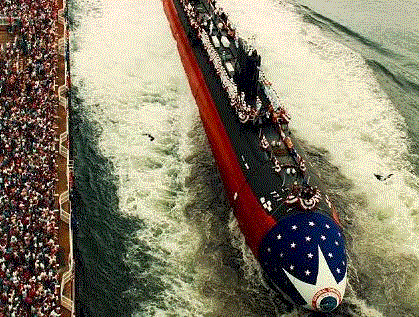
USS Columbia (SSN-771), the last 688 class submarine to be built at Electric Boat Shipyard in Groton, was christened and launched, on September 24, 1994 by Mrs. Hilary Rodham Clinton, by sliding down a 1,300 foot wooden ramp into the Thames River, the last boat to be launched in this dramatic fashion. Future submarines built in the United States will be launched by flooding the dry dock where they are built. As a result, the USS Columbia's motto is: "Last to slide, first in pride."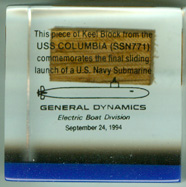 Columbia honors the capital of South Carolina, and cities in Missouri & Illinois. Six former Navy ships have borne this name. Their service extends from 1836 to 1984, the most famous being the Cruiser USS Columbia (CL-56) which earned a Navy Unit Citation & ten Battle Stars in World War II. She will be a vital part of the Navy's "Forward ... From the Sea" doctrine, bringing to bear shallow water operational capabilities including mine warfare, covert coastal surveillance and intelligence gathering, operations with special forces and combat search and rescue. Further, the submarine's ability to strike targets at, below and beyond the water's surface make it a potent asset in the nation's arsenal. Columbia is the 60th of 62 Los Angeles class submarines authorized for construction by Congress. The boat is equipped with the Tomahawk cruise missile system for a significant land attack and strike capability. Columbia is an improved version of the Los Angeles Class, with a hardened sail and retractable bow planes for surfacing through the ice during Arctic missions. | | |
                          

|