

| | Check-Six Online Museum Land / Terrestrial Wing 
Graphite from the World's First Atomic Reactor in Lucite | 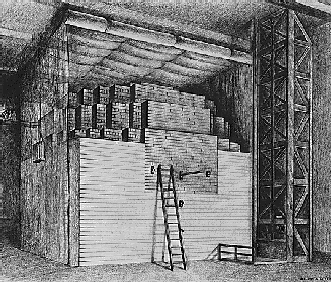 |
On November 16th, 1942, construction started on the world's first nuclear reactor, '''Chicago Pile-1''', shortened as '''CP-1''', built on a racquetball court under the abandoned west stands of the Alonzo Stagg Field stadium on the University of Chicago campus. Operation of CP-1 was 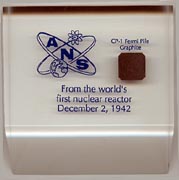 terminated in February 1943 and the nuclear reactor dismantled and moved to the laboratory's Palos Park site A, since a labor strike prevented the construction of the piles at a laboratory in the Argonne forest preserve. It was reconstructed using CP-1 materials but enlarged with a radiation shield and named CP-2. It began operation in March 1943. terminated in February 1943 and the nuclear reactor dismantled and moved to the laboratory's Palos Park site A, since a labor strike prevented the construction of the piles at a laboratory in the Argonne forest preserve. It was reconstructed using CP-1 materials but enlarged with a radiation shield and named CP-2. It began operation in March 1943.
The reactor was a pile of uranium and graphite blocks, assembled under the supervision of the renowned Italian physicist Enrico Fermi. It contained critical mass of the fissile material, together with control rods, and was built as a part of Manhattan Project research done by the University of Chicago Metallurgical Laboratory. The piles consisted of uranium pellets as a neutron–producing "core" separated from one another by graphite blocks to slow the neutrons. Fermi himself described the apparatus as "a crude pile of black bricks and wooden timbers." The controls consisted of cadmium-coated rods that absorbed neutrons. Withdrawing the rods would increase neutron activity in the pile to lead to a self-sustaining chain reaction. Re-inserting the rods would dampen the reaction. On December 2, 1942, Chicago Pile 1 (CP-1) was ready for a demonstration. Before a group of fifty, including dignitaries, a young scientist named George Weil worked the final control rod while Fermi carefully monitored the neutron activity. The pile went critical at 3:25 p.m. Fermi shut it down 33 minutes later. In 1943, he rebuilt the pile as CP-2 at the Argonne Laboratory. Today, the 12-foot bronze sculpture, by artist Henry Moore, stands on the site Measuring 4 inches length, 4 inched wide, and an inch in height, this lucite paperweight encapsulates a 1/2" by 1/2" wafer of the original graphite used to contain the first nuclear reaction. |  | Concrete Core Sample from the Mackinaw Bridge |
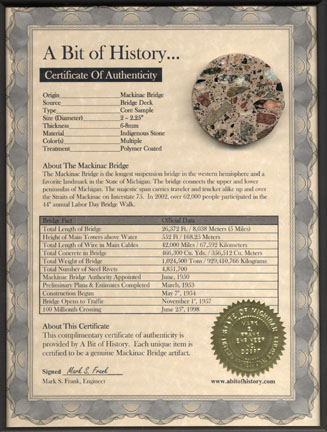 It was while working on a renovation project for the Mackinaw Bridge, the "A Bit of History" company founders discovered they had an opportunity to obtain a limited supply of original bridge material. They cut and finished some of this material, thinking the pieces might make good gifts for family and friends. It was while working on a renovation project for the Mackinaw Bridge, the "A Bit of History" company founders discovered they had an opportunity to obtain a limited supply of original bridge material. They cut and finished some of this material, thinking the pieces might make good gifts for family and friends.
They soon discovered the immense popularity of the this type of historical monument would make these items extremely popular. After some research and experimentation, they discovered that they could offer a variety of certified collectables that were both attractive and affordable enough for everyone to own "a bit of history..." The "Mighty Mac" is the longest suspension bridge in the western hemisphere (over 26,000 feet long) and is a favorite landmark in the state of Michigan, where it connects the upper and lower peninsulas of that state. Opened to traffic in 1957, in weighs over a million tons For more information about the Mackinaw Bridge, click here | 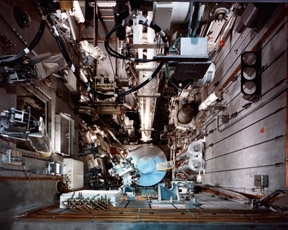 | First Production Chips from the Construction of the Fast Flux Test Facility |
The Fast Flux Test Facility (FFTF) is a 400-megawatt (thermal) liquid-metal (sodium) cooled fast neutron flux nuclear test reactor owned by the U.S. Department of Energy (DOE). The facility is located in the "400 Area" of the DOE's Hanford Site in 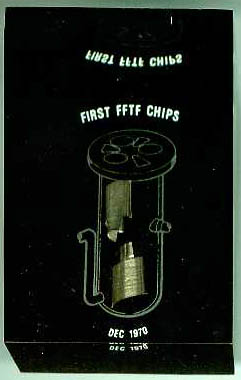 southeastern Washington State. The construction of FFTF was started in 1970, and completed in 1978, with initial operation began in 1980. From April 1982 to April 1992, the FFTF operated successfully as a national research facility to test advanced nuclear fuels, materials, components, nuclear power plant operations and maintenance protocols, and reactor safety designs. During this time, the FFTF also produced a wide variety of medical and industrial isotopes, made tritium for the U.S. fusion research program, and conducted cooperative international research work. southeastern Washington State. The construction of FFTF was started in 1970, and completed in 1978, with initial operation began in 1980. From April 1982 to April 1992, the FFTF operated successfully as a national research facility to test advanced nuclear fuels, materials, components, nuclear power plant operations and maintenance protocols, and reactor safety designs. During this time, the FFTF also produced a wide variety of medical and industrial isotopes, made tritium for the U.S. fusion research program, and conducted cooperative international research work. In December 1993, DOE ordered the FFTF to begin shutdown due to a lack of economically-viable missions at that time. From 1994 through 1997, fuel was removed from the reactor vessel for storage in fuel storage vessels and above-ground dry storage casks, and 23 of 100 FFTF operating systems were put into lay up. However, in January 1997, former Secretary of Energy, Hazel O'Leary, announced that the FFTF would be maintained in standby condition, pending an evaluation of the reactor for possible use in the agency's tritium production strategy. As a consequence of FFTF being placed in standby, facility transition work was limited to activities that would not preclude reactor restart, and the TPA milestones were no longer achievable. In December of 2001, the DOE announced the decision to permanently deactivate FFTF. (Text Source: DOE and FFTF website). These millings, encased in a wedge of lucite, come from the first piece milled especially for the Fast Flux Test Facility. Milled in December of 1970, they represent the first step in bringing nuclear technology to applied medical applications. The paperweight is 2 inches in height, sloping down to only one inch, 2 inches in width, and 3 inches in overall length. The silhouette of the FFTF, as well as the lettering, is reflective. | Statue of Liberty Medallion Made From Materials Removed During the 1986 Restoration | 
|
The Statue of Liberty renovation was indeed one of the greatest undertakings of the twentieth century, requiring $230 million in private funding. The Statue of Liberty's many corrosion problems were associated with thousands of holes pitting the copper surface caused by a century of salt-air exposure, distortion of the iron framework produced by continuous stress and fatigue, & the previous repair attempts that created different problems and more deterioration The French-American Committee for the Restoration of the Statue of Liberty was established in 1981. Following an initial diagnostic report for the NPS, it was determined that substantial work needed to be done. The Statue of Liberty-Ellis Island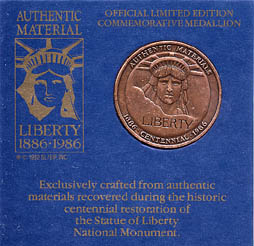 Foundation was then formed to raise the needed funds and to oversee the restoration of both the Statue of Liberty and Ellis Island. Again, as in the past, private contributions were the backbone of the foundation's success: More than $295 million was collected, with $86 million going to the statue's restoration. Foundation was then formed to raise the needed funds and to oversee the restoration of both the Statue of Liberty and Ellis Island. Again, as in the past, private contributions were the backbone of the foundation's success: More than $295 million was collected, with $86 million going to the statue's restoration. On July 4, 1986, America threw a birthday party for the Statue of Liberty that will not soon be forgotten. With a golden sunset glowing in the background, President Ronald Reagan declared, "We are the keepers of the flame of liberty; we hold it high for the world to see." Later that day, the president pressed a button that sent a laser beam across the water toward the statue. Slowly, dramatically, majestically, a light show unveiled Liberty and her new torch, and the most spectacular fireworks show America had ever seen exploded across the sky. With an entire nation watching - along with 1.5 billion television viewers around the world - and thousands of people filled with gratitude, one wonders how Bartholdi and Laboulaye might have felt as Liberty enlightened the world that historic night. The medallion was crafted from authentic materials from the Statue of Liberty - Ellis Island National Monument. These valuable materials were made available by the Statue of Liberty - Ellis Island Foundation, through their official licensee, the Gold Leaf Corporation. The Gold Leaf Corporation certifies the authenticity of these materials removed during the restoration of the Statue of Liberty from 1982-1992. Historical records make no mention of the source of the copper used in the Statue of Liberty. In the town of Visnes, near Stavanger, Norway, tradition holds that the copper came from the French-owned Visnes Mine. Ore from this mine, refined in France and Belgium, was a significant source of European copper in the late nineteenth century. In 1985, Bell Laboratories used emission spectrography to compare samples of copper from the Visnes Mines and from the Statue of Liberty, found the spectrum of impurities to be very similar, and concluded that the evidence argued strongly for a Norwegian origin of the copper. | | Section of Barded Wire from 'The Iron Curtain' | |
The "Crusade for Freedom" was sponsored by the "National Committee for a Free Europe, Inc"., an organization which operated Radio Free Europe as an independent counterpart of the government operated Voice of America. The Campaign was launched by General Eisenhower on Labor Day, 1950, with General Lucius D. Clay, former military governor of Germany, as its national chairman. The purpose of the Campaign was to offer all Americans an opportunity to play a personal part in a demonstration of the "free world's determination to resist Communist aggression." Activities sponsored by the Campaign include a drive to secure signatures on a Freedom Scroll, which was enshrined in the Crusade's Freedom Bell in Berlin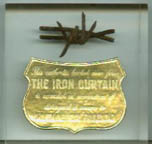 ; fund raising for Radio Free Europe; and "Winds of Freedom," an operation which launched thousands of balloons carrying millions of leaflets into Czechoslovakia and Poland. ; fund raising for Radio Free Europe; and "Winds of Freedom," an operation which launched thousands of balloons carrying millions of leaflets into Czechoslovakia and Poland. However, the "Crusade for Freedom" was later publicly discovered to be conduit for the Central Intelligence Agency to both secure & launder money for their radio networks, as well as provide a positive spin and its activities in eastern Europe. Although the Crusade for Freedom never raised enough money to actually fund Radio Free Europe (it could only finance a third of its budget), its advertising slogans such as "Help Truth Fight Communism," along with parades, public forums, and other events, served to mobilize support for America's cold war policies. At some point during the group's time, the organization produced, as an award of sorts, small sections of barded wire, encased in lucite, from 'The Iron Curtain' to present to donors and others associated with their activities. This is one of those lucite displays. It reads: " This authentic barded wire from The Iron Curtain is awarded in recognition of distinguished service to Crusade For Freedom". | Given to all the Warner Bros. employees at the Warner Bros. Burbank studio back around 1990. The studio had installed two large pieces of the Berlin Wall outside the company store. All employees of the studio were given these commemorative paperweights at that time. I was an working there at the time and this was the one I received. It is very nice, about 4" across and 3" deep. The piece of the wall encased in the lucite has the authentic stamp on it which states 'Authentic Berliner Maurer' with an image of the Brandenberg Gate. Text around the bottom says This is a remnant of the Berlin Wall, which stood as a barrier against the free exchange of ideas, information and culture. You helped bring this wall down. On the bottom of the paperweight is the Time Warner logo from that time as well as the words Time Warner. |
                          
|