

| | Check-Six Online Museum "First Flights" Wing 
| | Cover Flown On First Flight of the Rockwell B-1A "Lancer" |
The first B-1 aircraft (Tail number 74-0158) rolled out 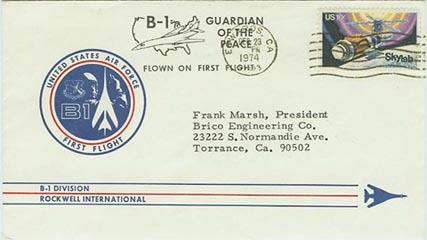 from USAF Plant 42 at Palmdale, CA on October 26, 1974. It made its first flight on December 23, 1974, a short hop lasting 78 minutes to Edwards AFB where the flight testing was to be carried out. The crew was Rockwell test pilot Charlie C. Bock, Colonel Emil Sturmthal, the director of the Joint Test Force, and Richard Abrams, flight test engineer. The jet bomber achieved a top speed of 207 MPH, and an altitude of 10,000 feet, covering a distance of over 250 miles.. from USAF Plant 42 at Palmdale, CA on October 26, 1974. It made its first flight on December 23, 1974, a short hop lasting 78 minutes to Edwards AFB where the flight testing was to be carried out. The crew was Rockwell test pilot Charlie C. Bock, Colonel Emil Sturmthal, the director of the Joint Test Force, and Richard Abrams, flight test engineer. The jet bomber achieved a top speed of 207 MPH, and an altitude of 10,000 feet, covering a distance of over 250 miles.. This cover was sent, after its flight, to the president of Brico Engineering Company, an outfit in Torrance, California, specializing in metalworking and aircraft parts. More Information To Be Added | | Pin Carried Aboard First Flight of the Northrop B-2 Stealth Bomber To Be Added | | Cover Flown Aboard First Flight of the Boeing 777 To Be Added | Pin & Photo Flown On First Flight of the YF-22A "Raptor" To Be Added | 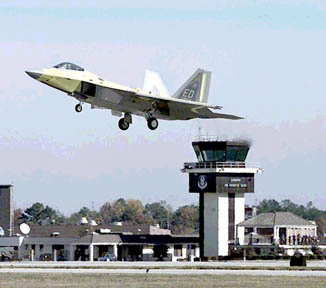
| Flag Flown on First Flight of Lockheed-Martin F-22A "Raptor" 4004 |
Raptor 4004, the fourth aircraft built and the first F-22 to fly with its advanced avionics hardware and integrated software aboard, was flown for the first time on November 15, 2000, from Lockheed Martin's facility in Marietta, Ga. The first-time avionics hardware on the flight included the Raptor's AN/APG-77 active element, phased array radar, the product of a joint venture between Northrop Grumman and Raytheon.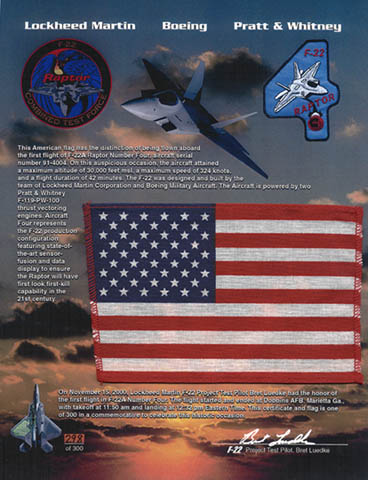 Lockheed Martin test pilot Bret Luedke was at the controls during the 42-minute flight, which accomplished a major Defense Acquisition Board (DAB) year 2000 criterion for the program. Ground testing of Raptor 4004's avionics system was completed prior to first flight. Lockheed Martin Aeronautics Company is responsible for overall leadership of the program's avionics team, which includes Lockheed Martin's facilities in Marietta and Fort Worth, Texas, Boeing in Seattle, Wash., and 11 major subsystem suppliers from across the country. Boeing is responsible for integrating the F-22's avionics hardware and software systems at its Avionics Integration Lab (AIL) in Seattle. The initial avionics flight test software package, called Block 1.2, includes stores management, the vehicle management system, utilities and subsystems management, basic radar functionality, mission software, the inertial reference system, the pilot/vehicle interface software, and cockpit display software. | Patch Carried Aboard First Flight of the Boeing X-45A Unmanned Combat Air Vehicle | 
|
The Boeing X-45A Unmanned Combat Air Vehicle, or UCAV, technology demonstration aircraft on May 22, 2002, made aerospace history by completing its first flight. This step marks the beginning of flight testing of the first unmanned system designed from inception for combat. The X-45A flew for 14 minutes at NASA's Dryden Flight Research Center at Edwards Air Force Base in California, reaching an airspeed of 195 knots and altitude of 7,500 feet. Flight characteristics and basic aspects of aircraft operations, particularly the command and control link between the aircraft and the mission-control station, were successfully demonstrated. To Be Added | 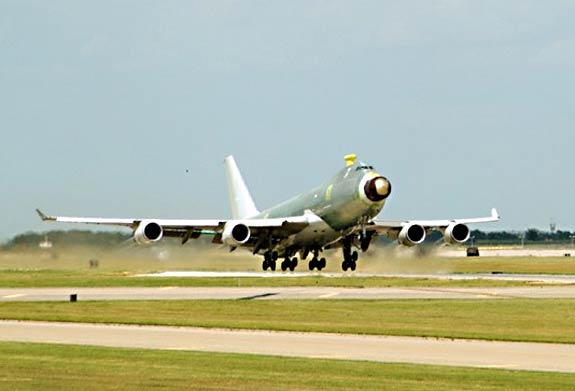 | Patch Carried Aboard First Flight of the Boeing Airborne Laser Aircraft |
The ABL weapon system consists of a high-energy, chemical oxygen iodine laser (COIL) mounted on a modified 747-400F (freighter) aircraft to shoot down theater ballistic missiles in their boost phase. A crew of four, including pilot and copilot, would be required to operate the airborne laser. 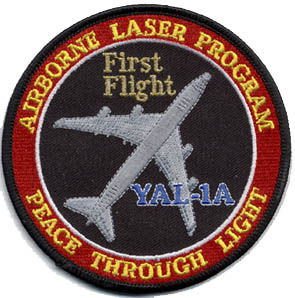 | | Patch Flown on First Flight | 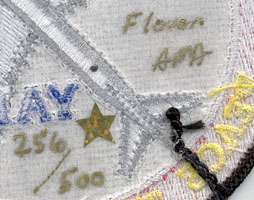 | | Close-up of patch's back |
The Airborne Laser made its maiden flight on Thursday, 18 July 2002, circling over western Kansas for one hour and 22 minutes before returning to its takeoff location at McConnell AFB. The aircraft, designated YAL-1A, had been at the Boeing modification facility adjacent to McConnell since January 2002 undergoing changes to prepare it for its intended role as the primary boost-phase component in the Missile Defense Agency's ballistic missile defense program. Later in 2002, after a series of almost a dozen functional ch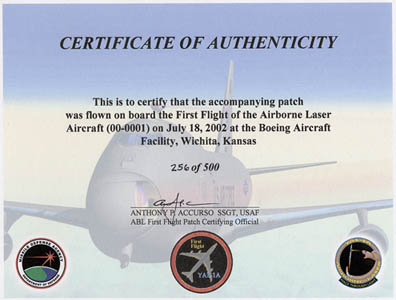 eck flights, the aircraft was painted Air Force gray and flown to Edwards AFB for a two-year-long series of tests, which demonstrated the effectiveness of its megawatt-class Chemical Oxygen Iodine Laser (COIL) and a highly sophisticated optical system designed to track missiles and put the laser beam on target. The testing is scheduled to culminate in the shoot-down of a ballistic missile in late 2004 eck flights, the aircraft was painted Air Force gray and flown to Edwards AFB for a two-year-long series of tests, which demonstrated the effectiveness of its megawatt-class Chemical Oxygen Iodine Laser (COIL) and a highly sophisticated optical system designed to track missiles and put the laser beam on target. The testing is scheduled to culminate in the shoot-down of a ballistic missile in late 2004 | Certificate Carried Aboard the First Flight of the General Electric Model GE90-115B Jet Engine | 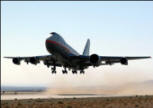 |
The GE90-115B is the sole powerplant for Boeing's longer-range 777-300ER and 777-200LR aircraft. The GE90-115B has been certified at 115,000 lbs. of thrust and has broken a number of aviation records. The Guinness Book of World Records recognized the engine as the "World's Most Powerful Commercial Jet Engine" in 2001 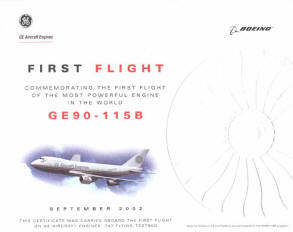 after it recorded an amazing 123,000 lbs. of steady-state thrust while undergoing initial ground testing. In late 2002, the engine shattered its original record by reaching 127,900 lbs. of thrust during required certification testing and ground testing at GE's outdoor test facility near Peebles, Ohio., after it recorded an amazing 123,000 lbs. of steady-state thrust while undergoing initial ground testing. In late 2002, the engine shattered its original record by reaching 127,900 lbs. of thrust during required certification testing and ground testing at GE's outdoor test facility near Peebles, Ohio., On September 18, 2002, the unique Boeing 747 Flying Testbed operated by GE took off from Mojave Airport with the GE90-115B engine on its first flight aloft. During the two hour and thirteen minute historic flight, the GE90-115B, completed several throttle and performance assessments to measure the engine's in-flight characteristics. The test waa the first in a series of 30 planned flights totaling 150 hours.
The tests evaluated altitude performance, air start surveys, and operability transients. In addition, the tests measured performance of the full authority digital electronic control (FADEC), acceleration time and performance during maneuvers.
General Electric modified its 747 testbed with structural changes to handle the engine’s higher thrust. In addition, they installed a new flight inlet, fan cowling to accommodate the larger fan diameter, and modified GE90 thrust reverser provided by Boeing. The certificate reads, "FIRST FLIGHT- COMMEMORATING THE FIRST FLIGHT OF THE MOST POWERFUL ENGINE IN THE WORLD - GE90-115B - SEPTEMBER 2002 - THIS CERTIFICATE WAS CARRIED ABOARD THE FIRST FLIGHT ON GE AIRCRAFT ENGINES' 747 FLYING TESTBED". The certificate bears the impression of a jet engine's fan blades, and a picture of the GE 747 airborne. It measures 11 inches by 8 1/2 inches in size on heavy cardstock. | | |
                         
|