
| | Check-Six Online Museum "And Now, Something Completely Different" Wing 
Theatre-Made Ace-of-Spades 'Death Card' from the Vietnam War | |
The 'Ace of Spades' has been employed, on numerous occasions, in the theatre of war. In the second World War, the American 101st Airborne Army Division were marked with the symbol painted on their helmets. In this capacity, it was used to represent good luck, due to its fortunate connotations in card playing. All four card suits were used for ease of identification of regiments within the airborne division following the confusion of a large scale combat airborne operation. Battalions within the regiments were denoted with tic marks or dots, marked from top clockwise; Headquarters at the twelve o'clock position, 1st Battalion at the three o'clock, et cetera. | Place your pointer over the photo to see the reverse of the card |
Some twenty years later, the 'Ace of Spades' was again used by American soldiers - this time as a psychological weapon in the Vietnam war. It was erroneously thought that Vietnamese ancient traditions held the symbolism of the spade to mean death and ill-fortune. The soldiers were quick to pick up this misconception, and in an effort to frighten away Viet Cong soldiers without firefight, it was common practice to leave an 'Ace of Spades' on the bodies of killed Vietnamese and even to litter the forested grounds and fields with the card. This custom was believed to be so effective, that the Bicycle Playing Cards company was asked to supply crates of that single card in bulk. The crates were often marked with 'Bicycle Secret Weapon.' This card reverse is roughly translated to mean "Death waits for the Viet Cong. Surrender or die!". | 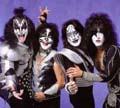 | Marvel Comic Book Printed, in part, from Blood from the band, KISS |
Given that the concept for the band KISS drew upon comic book superheroes almost as much as upon music itself, they were a natural to feature someday in their very own comic. Sure enough, that came to pass in 1977 when Marvel Comics issued the first Super Special KISS comic book. | Place your pointer over the photo to see the reverse of the comic book |
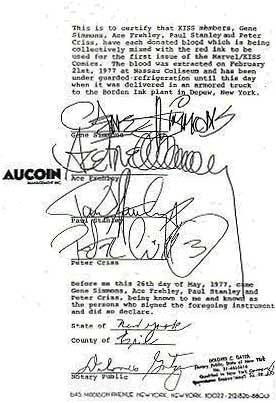
Never one to pass up a good marketing opportunity, KISS willingly went along with a promotional gimmick invented to spur sales of the first edition. As Gene Simmons recalled, "As the KISS comic book project moved along, someone came up with the idea of putting real blood in the ink. It wasn't me — maybe it was Bill [Aucoin] or Sean [Delaney]. We got into a DC3, one of those big prop planes, and flew up to Buffalo to Marvel's printing plant, where they pour the ink and make comic books. A notary public actually witnessed the blood being drawn.: The four members of KISS, Gene Simmons, Paul Stanley, Peter Criss, & Ace Frehley, allowed their blood to be drawn during a concert stop in New York at Nassau Coliseum on February 21st, 1977, and then they later flew up to the Borden Ink plant in Depew, New York, to be photographed adding their vials of donated blood to a barrel of red ink on May 26th, 1977. A notary public duly certified the authenticity of the process, and the notarized document was made available as the "KISS comic book contract". The Kiss Marvel comic book is released the same day as the band's "Love Gun" album, on June 30th, 1977, where its status among comic book collectors, as well as KISS fans, keeps in in high demand worldwide. The comic itself is 11 inches in height and 8.25 inches in width. | Silver Bar Minted From the U.S. Strategic Stockpile | |
| Place your pointer over the photo to see the reverse of the bar |
In the late 1960s, the U.S. Defense National Stockpile Center, an arm of the Defense Logistics Agency, had over 165 million ounces of silver in its stockpile. The silver stockpile posed a serious threat to the market when government officials determined it was no longer needed and that domestic silver production combined with reliable imports could sustain the United States in the event of an emergency. The General Services Administration, an executive branch agency, attempted to sell the silver in the fall of 1981 through auctions, but the auctions were discontinued when bid prices fell below the market price of silver. In 2000, the last remnants of the stockpile were directly towards the mintage of U.S. Mint coins. All future silver purchases of the U.S. Government will be on the 'open market' as opposed to withdrawn from the stockpile. Originally housed at the U.S. Assay Office in San Francisco, California, the silver, .999 Fine, in this bar was smelted and minted in its present 10 Troy ounce size by the Continental Coin Corporation. This particular bar displays one of the two front die patterns of these bars. However, both die patterns are in the museum's collection. | | | Piece of Wooden Cask from Bell's Whiskey (Aged 8 Years) |
Often whisky is aged for a while in bourbon casks, and finishes his aging period in some kind of other cask, in order to give is some new fragrances, before bottling. Generally it stays for 6 to 12 months in another kind of cask. This explains the "wood finish" mention on some bottling's. For instance, the 18 yo Glenmorangie finishes its maturation in next casks, which is rather uncommon in Scotland. A whisky cask is always a second hand cask. It generally contained bourbon (american whiskey made from corn - (maize). Sherry is also very popular in the whisky industry. Other casks are used too, like Port, Madeira and more rarely Claret (French red wine) or rum, etc... Glenmorangie is specialized in "wood finishes" and some of them are very expensive, probably because of the rarity of the casks. The advantage of oak for maturing alcohol is that it is not airtight. It lets surrounding air enter the cask (which explains the salted taste of a whisky aging near the sea), but is also lets evaporate the whisky it contains. It is generally admitted that between 1 en 2% a year evaporates this way. Evaporation can affect water contained in the cask, but also the alcohol itself, resulting in a diminution of the alcohol percentage. That is called "the angels share". However, this percentage is theoretical, because this could result in a strange situation, as old whiskies (30 years and more) would lose their right to be called whisky. Indeed, assuming a whisky has about 70% of alcohol when it leaves the spirit still, and loses about 1% of alcohol a year a 30 years old whisky would just have a percentage of 40%, which is the lowest limit for a whisky. The angels share is indeed the part of alcohol which escapes to excise rights. Excise rights are calculated on the amount of alcohol coming out of the still (and not on the amount of water). As this amount is diminishing over the years, it would not be fear to tax the marketed whisky based on the alcohol percentage it had when it was distilled... The nature of the warehouse is also very important. A damp cellar or a dry cellar will influence the evaporation of the spirit differently. In a dry cellar (with a concrete floor), water will evaporate mainly, letting a dryer whisky with a higher alcoholic percentage. In a damp warehouse (beaten-earth floor) the alcohol will evaporate, letting a rounder whisky, with a smoother taste. This pack was issued in November of 2005 to a select few. The presentation box contains a booklet called '8 Years in Oak' and an authentic piece from a cask that has aged whisky for 8 years. | | | | | MORE ITEMS COMING SOON! | | | |
                          
 |